


Free Shipping All Orders Over $95
A common planning assumption is about 100 inhalations per 0.5 mL THC cart, though actual yield varies with draw length, voltage and airflow. Divide that benchmark by your own daily puffs: at 5 puffs a day it points near 20 days, at 20 puffs a day near 5.
I treat that as a shop-counter estimate, closer to a fuel gauge than a label claim. Two clocks run on every cart: one counts down puffs until the oil is gone, the other tracks whether the coil, seals and taste still make a clean hit worth using.
Treat the question as a division problem, not a promise on the box. Total puffs divided by your daily puffs gives you days, and no label like casual or heavy does that math for you. Someone who only vapes after work can still take more draws than a person who sips occasionally all day.
One hundred inhalations is a workable planning figure for a 0.5 mL cartridge, and it stays an assumption rather than a guaranteed yield. A clinical cannabis dosing review describes how puff depth, draw duration, battery power, airflow, and device design all change how much oil each puff uses. Long draws on a high-voltage battery burn through a cart faster than short, cool puffs do.
The table runs the same division for a few routines. Session-based rows assume roughly nine puffs per session, so swap in your own count if yours runs longer or shorter.
| Usage pattern | Puffs per day | Estimated days from a 0.5 mL cart |
|---|---|---|
| Occasional, one session every other day | About half an average session daily | About 3 weeks |
| Light daily use | 5 | About 20 days |
| One average session daily | About 9 | About 11 days |
| Moderate daily use | 10 | About 10 days |
| Two average sessions daily | About 18 | 5 to 6 days |
| Heavy daily use | 20 | About 5 days |
Estimated days = approximate available puffs ÷ average daily puffs.
Pick the row closest to what you really do, not the identity that sounds right. These categories aren't medical definitions, and none recommends a particular amount of cannabis.
Practical rule: A puff estimate helps you plan a replacement. It doesn't tell you how much THC you should consume.
A Republican Eagle cartridge roundup puts 3–5 days on a casual user's 0.5 g cart and up to 10 days on a 1 g cart. Two things keep that range from matching the light-use row above. Grams measure mass and milliliters measure volume, so a 0.5 g cart is not automatically a 0.5 mL cart with the same puff supply. The roundup also doesn't publish a daily puff count behind its figures.
Run the same formula backward and the gap resolves. Emptying a roughly 100-puff cart in 3 to 5 days means averaging about 20 to 30-plus puffs a day, which sits on the heavy end of the table rather than the casual end. Its "casual" routine was far heavier than the five-puff row here, which shows why the word alone can't predict runtime.
When I check a customer's estimate at the counter, I ask for a puff count, not a self-description. Keep the product and routine specific, and replace a guessed puff count with a day or two of actual tracking before you rely on the table.
A session's effects almost always outlast the session itself. Your puff count tells you how much oil you used, but the effect clock runs on delivered dose, tolerance, and your own body. Cartridge size sets none of that, so a half-gram cart and a one-gram cart can produce the same effect window in the same person.
The diagram below maps how duration shifts with session length and usage.
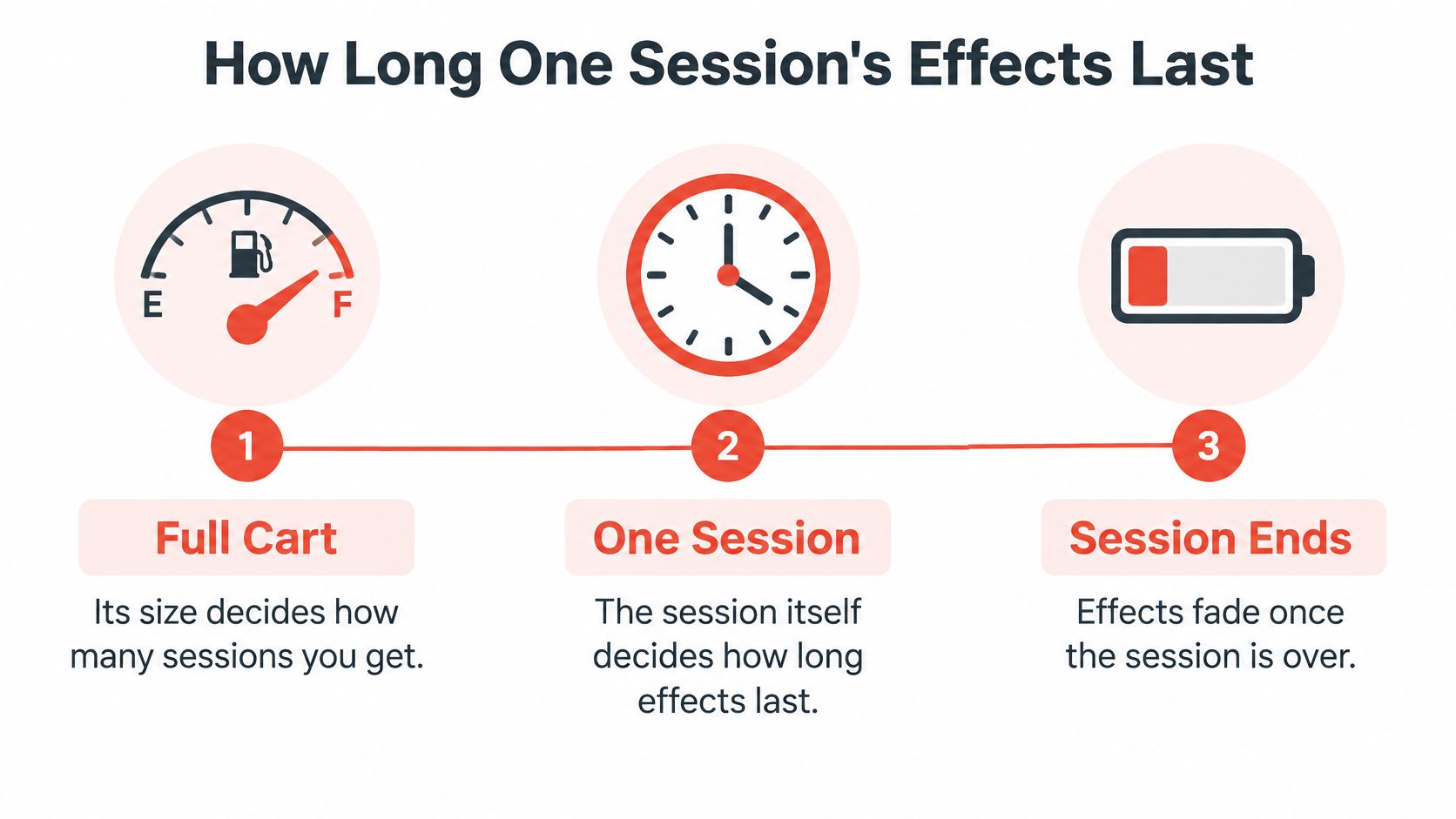
There's no fixed timer I can hand you, and any chart that promises one is overselling. What actually moves duration:
Treat the last puff as the start of your effect window, not the end of it. For typical duration ranges by dose and experience level, check the guide to how long a cart high lasts.
One hard rule: feeling "mostly fine" isn't a sobriety test. If you're planning to drive, work, or handle anything where impairment matters, wait until you're fully clear, and when you're unsure, give it more time or arrange another ride.
Your cart's real lifespan is a division problem: total puffs it can deliver, divided by the puffs you take per day. A tally without draw length can make two very different consumption patterns look identical, so log style alongside count.
In a measured study of cannabis-oil cartridge use, participants averaged 8.76 puffs per session, with a standard deviation of 8.23 puffs. Sessions ran from about 10.68 to 440 seconds, and the average draw lasted 4.06 seconds. That spread is why "one session" works as a rough unit, not a dependable measure of oil use.
Use plain descriptions in your log: quick tap, ordinary draw, or long pull. You don't need to change your routine to fit a category. The point is recognizing whether your pattern stays consistent.
An observational analysis of THC-vape puffing reported a mean draw duration of 3.68 seconds across 456 puffs, with individual draws ranging from 0.12 to 18.01 seconds and measured-use participant averages from 2.20 to 6.95 seconds. A bare puff count hides that much variation.
Longer draws generally consume more oil because the heater runs longer. If your pulls get longer as the cart empties, your early estimate stops matching what really happens.
A personal log is useful only when it describes your normal use. Don't take extra puffs to complete the measurement.
For a second check, weighing works if you have a reference point. A kitchen scale can track the cart's total weight over time, and if the manufacturer lists the empty hardware weight, or you can weigh a matching empty cartridge, the difference approximates remaining oil. Without a known empty weight, total cartridge weight on its own tells you very little. You can also watch the oil line through the cart's transparent wall to confirm the trend, though it isn't a calibrated measuring cylinder.
Don't open a sealed cartridge just to measure its contents. If weighing isn't possible, lean on the puff log as a planning aid rather than forcing a precise answer out of thin inputs.
A falling oil level also differs from usable yield. Leaks, poor oil flow, or failing hardware can leave visible oil you can't responsibly count as future sessions.
The useful result is a replacement window, meaning the span of days your math says the cart will probably last. Clean division can't fix uncertain inputs, and that's fine. A range you trust beats a date you don't.
Hardware changes what counts as a puff. In the cannabis-extract vaporizer testing research published in PLOS ONE, automatic draw cutoffs ranged from 4 seconds up to 15 seconds across the devices and power settings tested. A puff on one device can therefore involve several times the heating time of a puff on another.
The same study found clear differences in oil extraction between vaporizers run under identical controlled draws. A puff count taken from another device, or from a generic table, won't transfer cleanly to your hardware.
| Factor | Effect on oil use or quality | Practical adjustment |
|---|---|---|
| Voltage or power setting | Can change heating and oil consumption per draw | Use the lowest manufacturer-supported setting that performs properly |
| Heater cutoff time | Limits activation differently across devices | Learn the cutoff rather than treating it as a target |
| Airflow setting | Changes the draw and delivered aerosol | Keep intended air passages clear and follow device guidance |
| Chain-vaping | Repeated activation can increase heat exposure and consumption | Pause between draws |
| Storage temperature | Temperature and light exposure affect stability | Follow the label and avoid heat and direct sun |
| Vaping past flavor fade | Can indicate poor performance or overheating | Stop rather than chasing the remaining oil |
General device-care practice across manufacturers favors moderate draws, lower supported settings, and pauses between activations over repeated long draws. For device-specific adjustment, use the guide to choosing voltage for THC carts.
There's a real trade-off. An excessively low setting may not run the cartridge properly, while turning the power up to chase a bigger cloud raises consumption and heat exposure. Stay within the manufacturer's operating instructions instead of treating either extreme as automatically efficient.
Don't chase the last visible drop. Remaining oil doesn't justify repeated activation when vapor or flavor has deteriorated.
Choose a room-temperature storage location away from windows and hot dashboards, keep the cartridge upright, and protect the mouthpiece. Treat those as storage habits, not a way to extend the product beyond its labeled guidance.
If the cart develops a burnt taste, stop using it. More heat isn't a dependable fix for oil that won't reach the heater.
A full cart can still need replacement. Lasting means both the number of usable sessions and the period during which the product remains acceptable to use.
There isn't a universal expiration period supported for every formulation and device. Extract, hardware, packaging, temperature, light, and storage history all matter. In a cartridge-vaporization study, researchers used controlled warming to help extract saturate the heating core before testing, demonstrating that oil flow can affect performance independently of visible volume.
That laboratory procedure isn't a home repair instruction. Don't apply direct heat to a cartridge to imitate it.
The possibilities below are troubleshooting checks, not confirmed diagnoses. Neither appearance nor a test puff can establish that questionable contents are safe.
| Symptom | Possible cause | First action |
|---|---|---|
| Weak vapor, cart still full | Low battery or unsuitable power setting | Check charge and manufacturer-supported settings |
| Harsh or burnt hits | Overheating, poor oil flow, or heater problems | Stop use and check the device instructions |
| Gurgling or no vapor | Flow restriction, clogging, or wick problems | Let an undamaged cart rest upright at room temperature; follow approved guidance |
| Oil leaking from mouthpiece or seams | Seal or cartridge failure | Stop using it and replace it |
| Oil dark, thick, or unusually smelling | Possible deterioration or a formulation issue | Stop and ask the manufacturer; don't diagnose by color alone |
| Cart flickers or won't fire | Battery or connection problem | Check charge and accessible contacts as instructed |
For an undamaged device with ordinary weak output, start with the battery. Then check that the cartridge is seated as intended and that no visible obstruction interferes with normal operation.
Don't keep increasing power to force a clogged or failing cartridge to work. If approved external checks don't resolve it, replacement is more sensible than repeated heating.
For unopened carts, an intact package doesn't establish unlimited shelf life. Follow the printed date and batch-specific instructions, and consider storage history alongside packaging condition. The absence of a universal expiration period doesn't invalidate the manufacturer's date.
Replacement calls come down to condition. A cart that passes a quick glance can still be failing, so use the checklist below as a prompt for a closer look, not as proof that a clean-looking cart is safe.
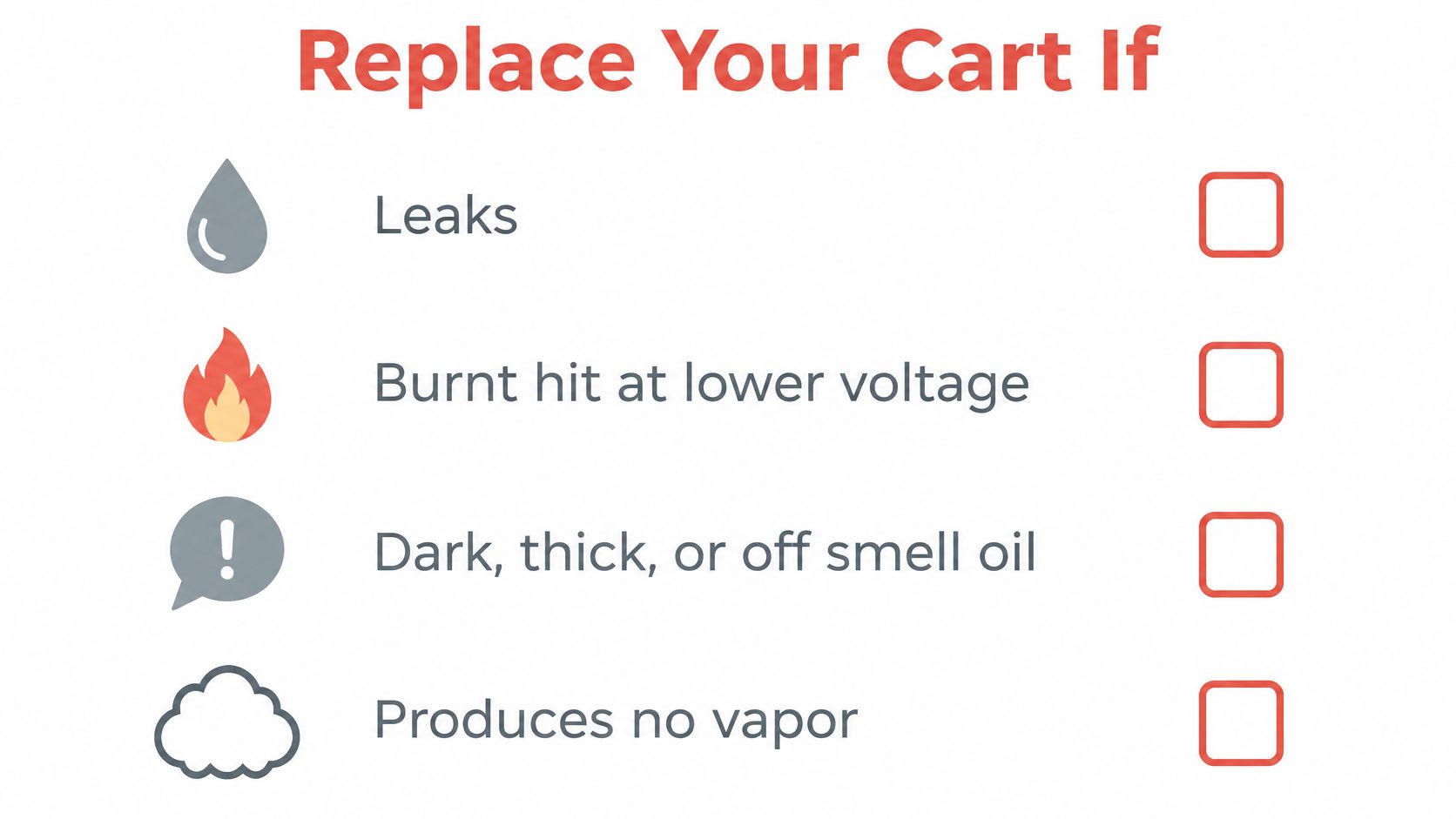
A charged battery does not make a damaged cartridge usable, and a fixed power problem does not mean the oil is still good. Treat the electrical check and the oil check as two separate questions.
For shelf-life calls, the guide to whether carts can expire covers what printed dates and batch information can tell you. When shopping for a replacement, ask for the third-party lab report for that batch and confirm it names the product on the shelf.
Retiring a cart also resets your division problem. Keep your daily puff count and the date you opened the cart noted on the package or in your phone. Those two numbers turn the next purchase from a guess into an estimate you can check against how you vape in practice.
Melt sells hemp-derived cannabinoid products, including all-in-one devices, alongside product education and published lab reports. Hemp-derived products fall under a different regulatory category than the marijuana-derived THC carts covered above, so confirm the cannabinoid content on the lab report before applying the same lifespan estimates. Visit Melt to review device specifications and lab reports, then compare them against the puff log and storage notes you recorded before choosing your next device.
Your cart is currently empty.