


Free Shipping All Orders Over $95
20 mg of delta-9 THC is too much for a new or infrequent user: it's eight times the suggested 2.5 mg beginner amount and twice the 10 mg greatest-caution threshold. Even regular users shouldn't drive after taking it.
The useful answer isn't whether you can tolerate a strong high. You also need to know what the package number means, how reliably the product was tested, and whether you've given an edible enough time to work.
For adults considering an edible, personal tolerance and product reliability are separate safety questions. A familiar-looking gummy doesn't answer either one.
For a first edible, skip the 20 mg serving. The Health Canada cannabis consumption guide recommends 2.5 mg THC or less for new or infrequent consumers, caution with 2.5–10 mg, and the greatest caution at 10 mg or more.
These are risk bands, not promises about exactly how you'll feel.
Delta-9 edible bands and whether 20 mg fits
| Dose | Health Canada stance | What it often feels like | Reasonable first edible? |
|---|---|---|---|
| 2.5 mg or less | Suggested start for new or infrequent consumers | Mild or minimal effects are possible, but sensitivity still matters | Yes, start here if choosing to consume |
| 2.5–10 mg | Use caution | Clearly noticeable intoxication is possible for a new user | Not as an initial experiment; assess the smaller amount on a separate occasion |
| 10 mg or more | Greatest caution because of higher impairment and adverse-effect risk | Strong intoxication becomes more concerning | No |
| 20 mg serving | Eight times the beginner suggestion and twice Canada's edible-container cap | Substantial intoxication, anxiety, dizziness, sedation, or vomiting are possible with low tolerance | No for new or occasional users |
The arithmetic matters because a small-looking edible can contain a comparatively large amount of THC. Health Canada's edible rules set a maximum per immediate container, not a universal amount that every adult can comfortably tolerate.
Nor does crossing that benchmark mean every person will have a medical emergency. Higher risk and certain harm aren't the same thing. An experienced adult may recognize the effects, while someone with little recent exposure may find them overwhelming.
Tolerance, body composition, metabolism, food, previous cannabis exposure, alcohol, and medicines can all change the experience. That's why the table ranks caution rather than assigning a guaranteed mild, medium, or strong high.
Practical rule: Choose an amount based on your own recent edible experience, not the amount a friend can comfortably take.
A common mistake is treating an edible like something you can assess immediately. If you don't notice much at first, that doesn't establish that the serving was weak.
Taking more before the original serving develops makes it harder to understand what you've consumed and harder to stop at a comfortable level. You can put the remaining edible away, but you can't remove the amount you've already swallowed.
If you've already taken a strong serving, don't redose. Check the onset and full-effect timing before even considering more THC.
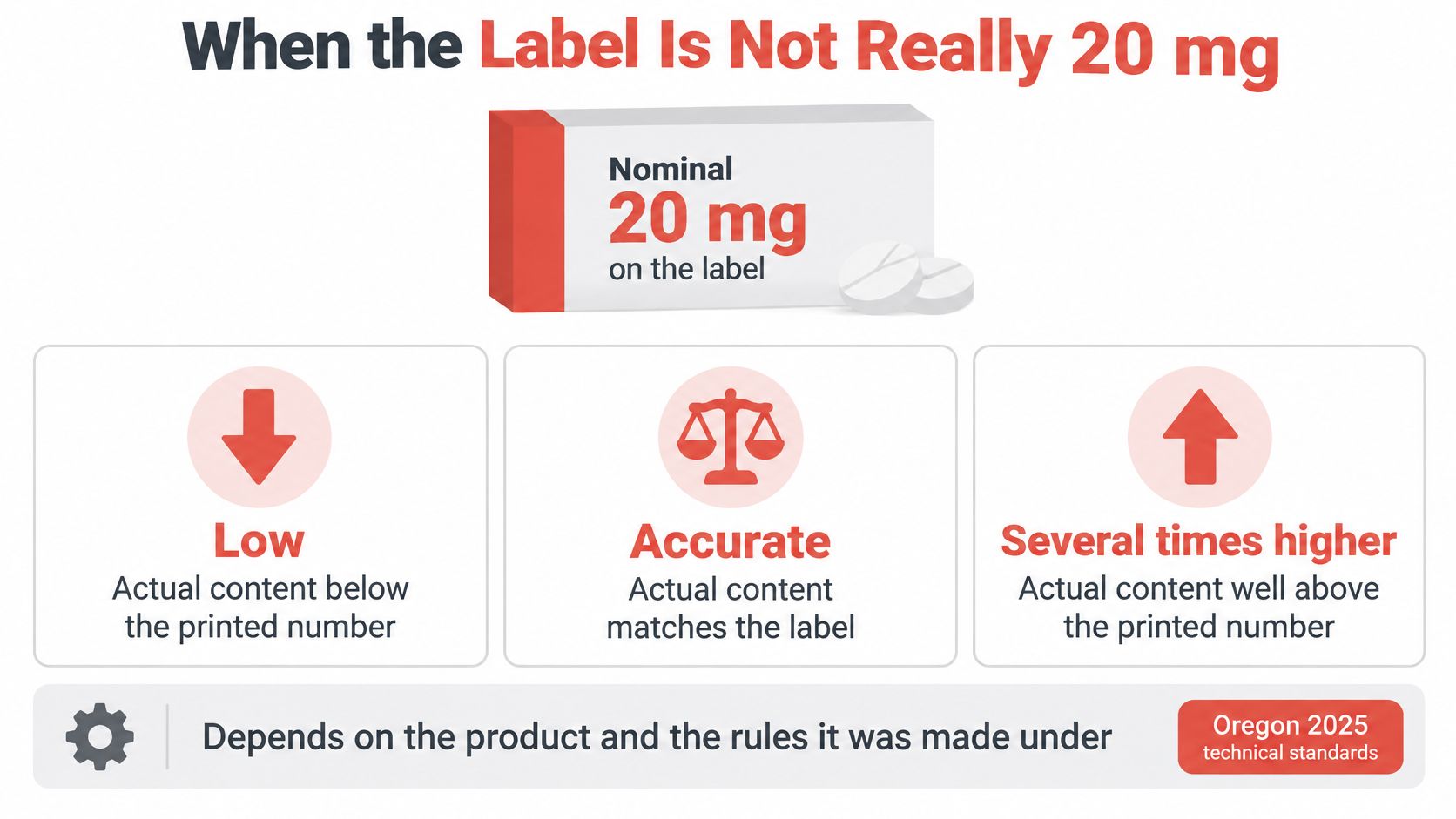
A 20 mg edible can feel mild to one adult and overwhelming to another. That's a risk band, not a promise: recent experience with edibles, sensitivity, and the product itself all affect how the serving feels.
The same amount is like the same cup of coffee offered to people with different caffeine habits. The dose is identical, but familiarity and sensitivity aren't. Recent experience with the same type of product matters more than confidence. Someone who regularly uses edibles has a different reference point from someone who occasionally smokes or hasn't used cannabis for a long time.
Smoking experience doesn't establish an equivalent edible amount. Swallowed and inhaled THC are processed differently, so counting puffs isn't a dependable way to choose an edible serving.
Food can also change the timing and experience. An unexpectedly quiet start doesn't show how the full serving will feel, and it isn't a reason to compensate with another piece.
What changes a 20 mg delta-9 edible
| Factor | How it changes the experience | Practical call |
|---|---|---|
| Prior cannabis exposure | Regular edible use gives a different reference point from occasional use or smoking | With little recent edible experience, choose a smaller serving |
| Oral versus inhaled | Swallowed THC follows a different absorption and metabolism pathway | Don't treat an edible as equivalent to a few puffs |
| Food | Food intake can change the onset and response | Don't judge potency from the early effects alone |
| Body composition and metabolism | These affect response but don't provide a dependable personal dosing formula | Don't assume body size or a fast metabolism protects you |
| Alcohol or sedating medicines | Combined effects can increase impairment and complicate symptoms | Avoid alcohol; ask a pharmacist about medication interactions |
| A plan to drive | Impairment affects safety regardless of familiarity | Take no THC if driving, traffic cycling, or machinery is required |
Your body isn't the only source of variation. Even if you know your usual response, a printed 20 mg serving may contain less, about the same, or more than that amount. A clear serving definition and credible batch testing help you understand what the label represents.
The infographic compares the printed 20 mg serving on a cannabis edible package with the actual tested potency per piece.
Don't calculate a personal safe amount from your weight, meal, or a friend's reaction. None provides a reliable conversion. Instead, ask whether you have recent experience with a clearly measured serving of a comparable product. If not, choose less rather than treating uncertainty as a test of tolerance.
Detected delta-9 THC ranged from 2 mg to 331 mg per package in tested hemp edibles in Oregon's 2025 technical report, which also found that only 25% of potency claims were within 10% of the detected amount. Those findings describe the tested products, not every hemp edible, but they show why the front label shouldn't be your only evidence.
The error can go in either direction. An edible may contain less THC than claimed, approximately the claimed amount, or more than claimed. Don't assume inaccurate labeling always means a secretly stronger product, and don't assume an under-strength experience makes the next package predictable.
A package total and a piece amount answer different questions. The package total tells you what's in the container; the piece amount helps you decide what you're about to swallow.
For a hypothetical example, a bag might spread its stated total across multiple gummies rather than placing that entire amount in each gummy. That calculation only helps if the piece count, serving instructions, and cannabinoid distribution are reliable.
Use the guide to dosing edibles to work through serving terminology before opening an unfamiliar package. Don't rely on the largest number printed on the front.
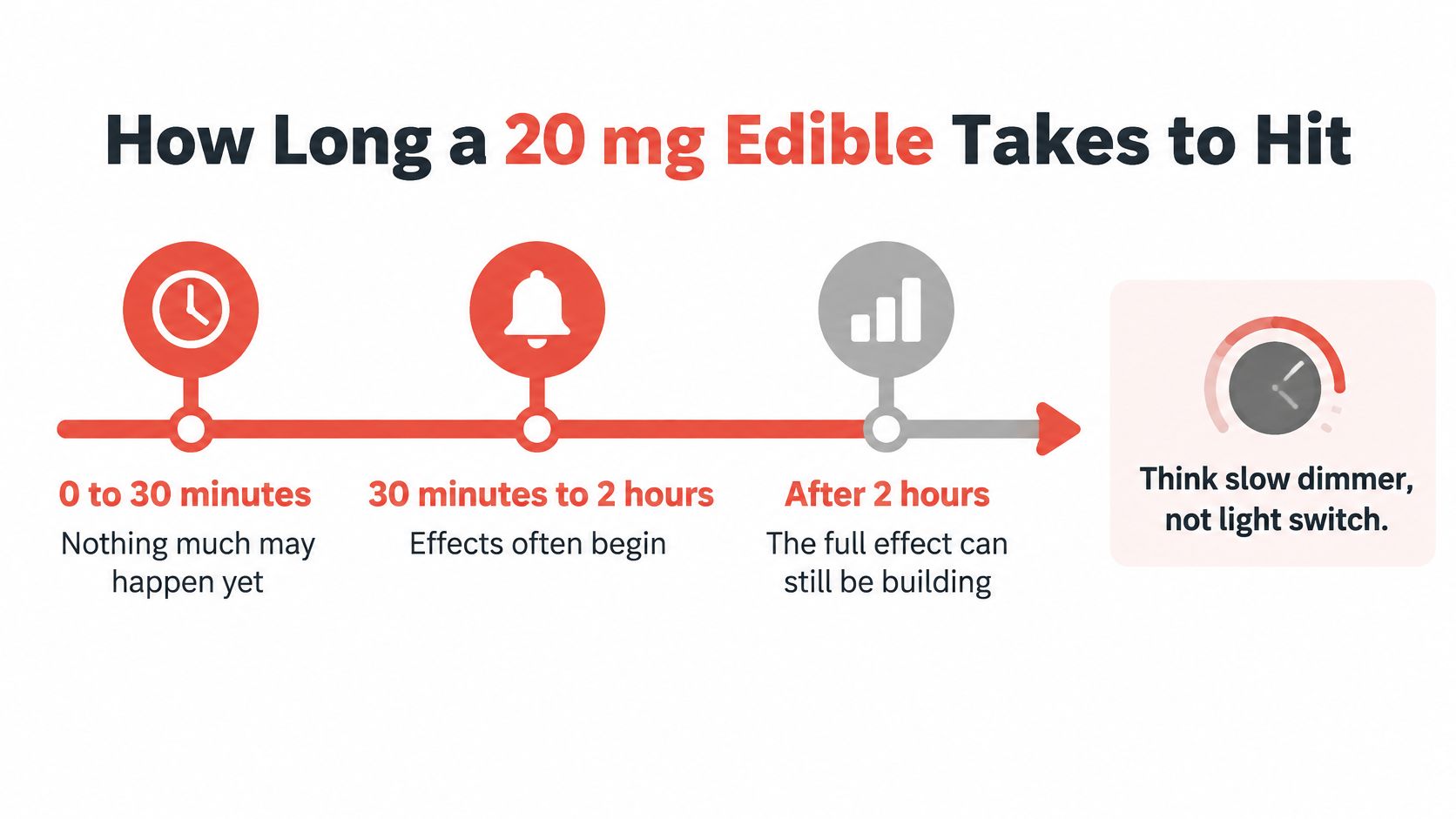
The timing visual below is another reason to resolve the serving amount before eating, rather than trying to correct it afterward.
A COA is useful evidence, not a guarantee about your personal response. Check what was tested, whether the report matches the product, and whether the units describe concentration or content per serving.
Product rules differ across jurisdictions, particularly for hemp-derived edibles. If the serving information is ambiguous or the batch report can't be matched, skip the product rather than guessing.
For additional viewing alongside those label checks:
An edible works more like a slow dimmer than a light switch. Effects may build gradually, so feeling little at first does not mean the serving has finished taking effect.
For a 20 mg edible, onset and full effect are separate milestones. The guide to how long edibles take explains why effects can take time to develop. Treat the timing as a reason to wait, not as a schedule that applies identically to everyone.
A randomized edible-THC driving-simulator trial tested 40 regular cannabis users who received 0, 2, 10, or 20 mg. At assessments 2 and 5 hours after ingestion, the 10 mg and 20 mg doses were associated with significant impairment, while the 2 mg dose did not produce statistically significant impairment compared with placebo. At the higher dose, lane-position variability increased by 3.3 cm, and blood THC peaks ranged from 1.6 to 3.4 ng/mL.
Clock for a 20 mg delta-9 edible
| Time after swallowing | What research and guidance describe | What to do |
|---|---|---|
| 0–30 minutes | Effects may be subtle at first; increased subjective effects at the early assessment occurred only with the highest tested dose | Don't take a second piece |
| 30 minutes–2 hours | Effects may begin during this period, but timing varies | Stay somewhere safe; involve a sober adult if you're unsure |
| Up to 4 hours | Effects may continue to build | Keep waiting rather than adding THC |
| 2 hours and 5 hours | The higher tested doses impaired simulator lane position at these assessments | Don't drive, cycle in traffic, or operate machinery |
| Blood peak | Measurable impairment occurred alongside comparatively low blood concentrations | Don't treat a low blood result as proof of safety |
The trial included regular cannabis users, yet familiarity did not prevent measurable impairment. Its results also do not establish a safe time to drive after the final assessment. A measurement shows what happened at that point, not that impairment ended immediately afterward.
Feeling less high isn't the same as being ready to drive.
Taking another piece while the first is still developing can make the effects overlap. If the experience becomes uncomfortable, you cannot separate the effects or reverse the added serving.
Use the clock to plan a quiet setting without driving or other responsibilities. The safety infographic below highlights risks associated with impairment.
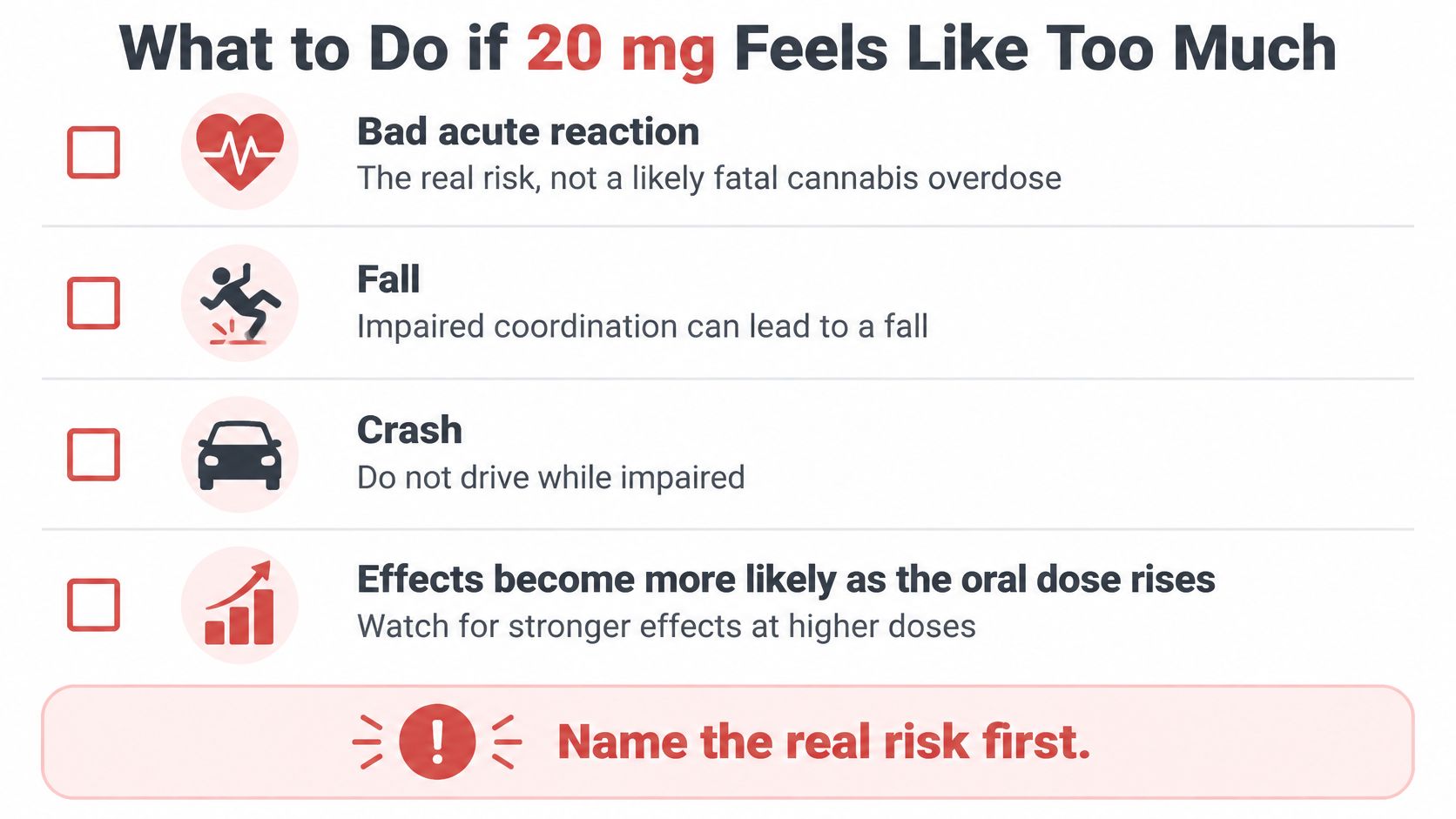
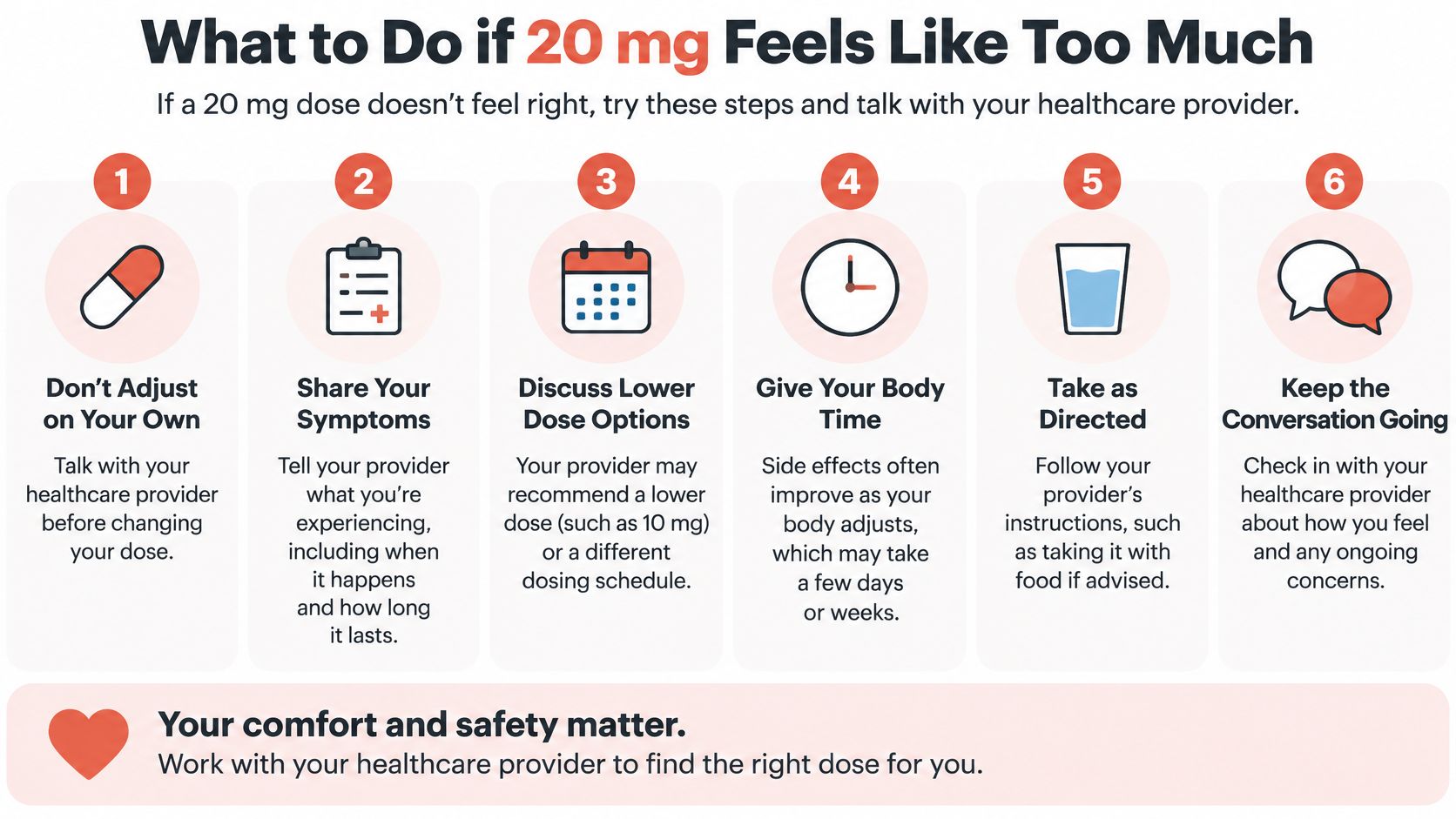
A 20 mg label cannot tell you how severe a reaction will be. If someone feels unwell after an edible, focus first on their symptoms and immediate safety. The CDC's cannabis FAQ describes possible effects of overconsumption, including extreme confusion, anxiety, panic, paranoia, a rapid heart rate, hallucinations or delusions, and severe nausea or vomiting.
Impairment can also lead to a fall, crash, or unsafe choice. A quiet setting and support from a sober adult can help reduce those risks.
If you're anxious but awake, breathing normally, and able to communicate, move to a calm place and ask someone sober to stay with you. Pay attention to changes in symptoms rather than assuming they are harmless.
A sober helper can use this checklist to keep the response clear.
Keep the package and batch information nearby. Tell medical staff what was taken, approximately when it was taken, and whether alcohol, medicines, or other substances were involved.
Don't drive yourself to get care. If someone loses consciousness, has trouble breathing, or has a seizure, call emergency services rather than trying to manage the reaction at home.
Get help based on symptoms, not the label. A reassuring package number doesn't make severe symptoms safe to ignore.
For additional supportive steps, read this guide to managing an uncomfortable high. It cannot replace urgent care, and no quick fix should delay help when serious symptoms appear.
The question “Is 20 mg of delta 9 too much?” becomes more useful when you attach it to a person and a decision. These hypothetical examples show why the same printed amount doesn't produce the same recommendation.
Alex has never used THC and is offered a gummy with a strong labeled serving before leaving for a social event. Friends say they take it comfortably, but Alex has no personal reference point.
Alex's decision is to skip that serving. A rideshare removes the need to drive, but it doesn't reduce the dose or make an unfamiliar high easier to manage in public.
If Alex already swallowed it, the useful decision changes from choosing a dose to staying somewhere safe with sober support. Taking more to match everyone else would add uncertainty, not confidence.
Jordan smokes on weekends and assumes that experience translates directly to gummies. Before the initial piece has developed, Jordan eats another.
Jordan's decision is to stop adding THC and arrange a safe place to wait. The mistake isn't that the product failed to work immediately; it's that Jordan used early sensation to judge a delayed product.
Smoking familiarity doesn't resolve the edible timing problem. Nor does feeling comfortable during the first part of the experience establish what the combined serving will feel like later.
Sam regularly uses edibles but notices that the new bag emphasizes the package total rather than the amount per piece. Sam checks the serving instructions and matching laboratory report before deciding.
A 2025 Colorado study of commercial cannabis potency found that edible labels claimed a median 10 mg THC, while laboratory testing measured a median 9.3 mg, with label claims generally higher than measured amounts. That difference is evidence against assuming every labeling error hides extra THC.
Sam's decision is to verify the individual serving. Experience with another product doesn't establish the contents of this one, and a laboratory result doesn't justify rounding upward to chase an expected effect.
| Adult | Main uncertainty | Better decision |
|---|---|---|
| Alex | No prior personal response | Skip the strong introductory serving |
| Jordan | Additional THC taken before full effects | Stop redosing and wait safely |
| Sam | Unclear piece amount and batch potency | Resolve the label and COA before consuming |
The distinction is practical: a new user needs a conservative starting point, someone who has stacked servings needs support and patience, and an experienced user still needs reliable product information.
Choose a clearly measured smaller serving rather than trying to make a strong edible work for you. If you're new or infrequent, drinking alcohol, or responsible for driving, traffic cycling, or machinery, the strong-serving option doesn't fit the situation.
For someone choosing to try an edible, the beginner suggestion is a ceiling for an initial cautious choice, not a target everyone must reach. There's no benefit to increasing the amount because a package offers a larger piece.
We sell federally compliant hemp with under 0.3% delta-9 THC by dry weight, under the 2018 Farm Bill. Every strain ships with a third-party Certificate of Analysis covering potency, pesticides, heavy metals, and delta-9 THC compliance.
Those credentials help you evaluate a product; they don't establish a comfortable edible amount. A dry-weight compliance percentage is not the same measurement as the milligrams you swallow.
This is education, not individualized medical advice. If medication interactions, health conditions, or a previous severe reaction complicate the decision, speak with a qualified clinician before using THC.
At Melt, we offer hemp-derived products with transparent testing information so you can evaluate more than a front-label number. Visit us to review product details and available lab reports, and choose only a clearly measured serving that fits your experience and plans.
Your cart is currently empty.