


Free Shipping All Orders Over $95
Most guides answer the linalool question the same way: it's the calming terpene, so if you want to relax, buy flower that smells like lavender and use more of it. That advice fails on two counts.
The first is that almost none of the human evidence tests linalool by itself. The trials showing a real anxiety signal used a standardized oral lavender-oil preparation, with linalool as one constituent among several. The second is that linalool doesn't behave like a volume knob. Recent animal work found inhaled linalool producing anxiety-like behavior under some conditions, which means the uniform-calm story is doing more work than the data behind it.
What follows sorts each claim by the kind of evidence supporting it: human trials, animal and cell studies, and user reports. By the end you'll know which linalool terpene effects are worth planning an evening around, which are still hypotheses, and why the milligram figures in the research can't be copied onto a product label.
Linalool is a monoterpene alcohol, a small oxygen-bearing molecule that carries a floral, lightly woody scent. It's the reason lavender smells the way it does, and it turns up in coriander seed, sweet basil, mint, bergamot, rose and rosewood as well. Hundreds of plant species produce it. Nothing about the molecule is unique to cannabis, and the version extracted from lavender is chemically the same compound you'll find in a jar of flower.
In cannabis, terpenes are the aromatic compounds that build up in the resin alongside cannabinoids. Think of a cultivar as a perfume: cannabinoids such as THC largely set the strength, while terpenes set the scent and probably shape the character of the session. Linalool is one of the most recognized of those notes, which is why floral and lavender-adjacent descriptions show up so often in strain write-ups.

That naming habit is where shoppers get misled. A cultivar called Lavender Kush or Do-Si-Dos doesn't guarantee a meaningful linalool percentage, because names are marketing conventions rather than chemical specifications. Two jars of the same strain from different growers can test completely differently.
Smell is a weak clue. A floral top note tells you something aromatic is present. It doesn't tell you how much, and it doesn't tell you what else is in the jar.
Terpene content is usually reported as a small share of dry weight, and linalool rarely leads a profile. The only reliable way to know what you're holding is a batch-level lab report that lists linalool by name with a percentage, not a general "high terpenes" badge. If you're new to how those panels are organized, this guide to what terpenes in weed actually are covers the basics before you start comparing numbers.
| Reported effect | Evidence level | Main evidence type | What it does not show |
|---|---|---|---|
| Relaxation and calm feelings | Widely reported, limited controlled data | User reports and animal models | A consistent effect from ordinary cannabis use |
| Anxiety reduction | Early human signal | Lavender-oil preparation trials | Proof for isolated linalool |
| Sleep support | Limited | Secondary outcomes in lavender-oil trials | A dose or timing for sleep |
| Pain relief | Preclinical only | Rodent and cellular channel studies | Clinical pain treatment in people |
| Neuroprotection | Hypothesis only | Mouse neurotoxicity model | Any benefit for human brain health |
| Anti-cancer activity | Cell culture only | Laboratory cell viability tests | Any effect in people |
Human trials carry the most weight. Randomization and blinding remove the two biggest reasons a treatment appears to work when it doesn't: people improving on their own, and people improving because they expect to. The trade-off is that trials are hard to run on inhaled products, so most of them test something easier to standardize, such as a capsule or a measured oil.
Animal and cell studies explain mechanism, not experience. They tell you which receptors a molecule touches and at what concentration. They can't tell you whether a person feels calmer after two puffs, because the exposures used are often far beyond what a consumer reaches and the species is different.
Anecdote is the weakest evidence and the most persuasive. Someone reports that a floral strain mellows them out, and they may be completely right about their own evening. The problem is that aroma, expectation, setting and the THC in the same flower all move together, so the credit can't be assigned to linalool alone.
Cell work is the thinnest tier of all. A 2026 paper in Scientific Reports reported approximately 30% inhibition of triple-negative breast-cancer-cell viability at a linalool concentration of 100 micrograms per milliliter. That's a dish result at a concentration with no established relationship to anything inhaled or eaten, and it belongs in the hypothesis pile, not the health-claims pile.
Linalool is a promising candidate for calm and anxiety-related effects, not an established treatment for any condition.
The strongest human evidence arrives with a caveat built in: it mostly isn't about linalool. It's about a standardized oral lavender-oil preparation called Silexan, which contains linalool plus other constituents, tested against an established anti-anxiety drug.
A randomized, double-blind, lorazepam-controlled trial enrolled 77 adults with generalized anxiety disorder and gave them 80 mg per day of the preparation for 6 weeks. The lavender preparation was reported to be non-inferior to lorazepam for reducing anxiety, and it also improved sleep, with only mild gastrointestinal adverse events in the summarized evidence. For a plant-derived product compared against a benzodiazepine, that's a notable result.
A later systematic review and meta-analysis covered five randomized, placebo-controlled trials and found that 80 mg per day for approximately 10 weeks significantly reduced somatic anxiety symptoms, insomnia and fatigue, while improving physical-health quality of life. The effect moved in the same direction across anxiety, sleep and energy, which is the pattern you'd expect from a genuine central-nervous-system effect rather than noise.
Then the limit. Every one of those trials used a multi-component oil, not purified linalool. Inhaled linalool from flower, an isolated terpene blend and a cannabis edible are different exposures with different absorption, and none of them was tested in those trials. The 2021 terpene review behind this evidence base concluded explicitly that the overall picture remains limited because well-designed clinical trials of linalool itself are lacking, as documented in the published review on linalool and anxiety research.
The defensible claim: linalool is associated with relaxation and anxiety-related effects in human research. It is not a clinically established treatment, and no label should imply otherwise.
Dose, route, formulation and the presence of other terpenes can each change the outcome materially. A lavender oil capsule is not a preroll, and treating them as interchangeable is how reasonable people end up disappointed.
The video below covers the receptor-level story in plain terms. It's the right frame for everything that follows, because linalool's best-supported action is neuromodulatory rather than a vague sense of "relaxing."
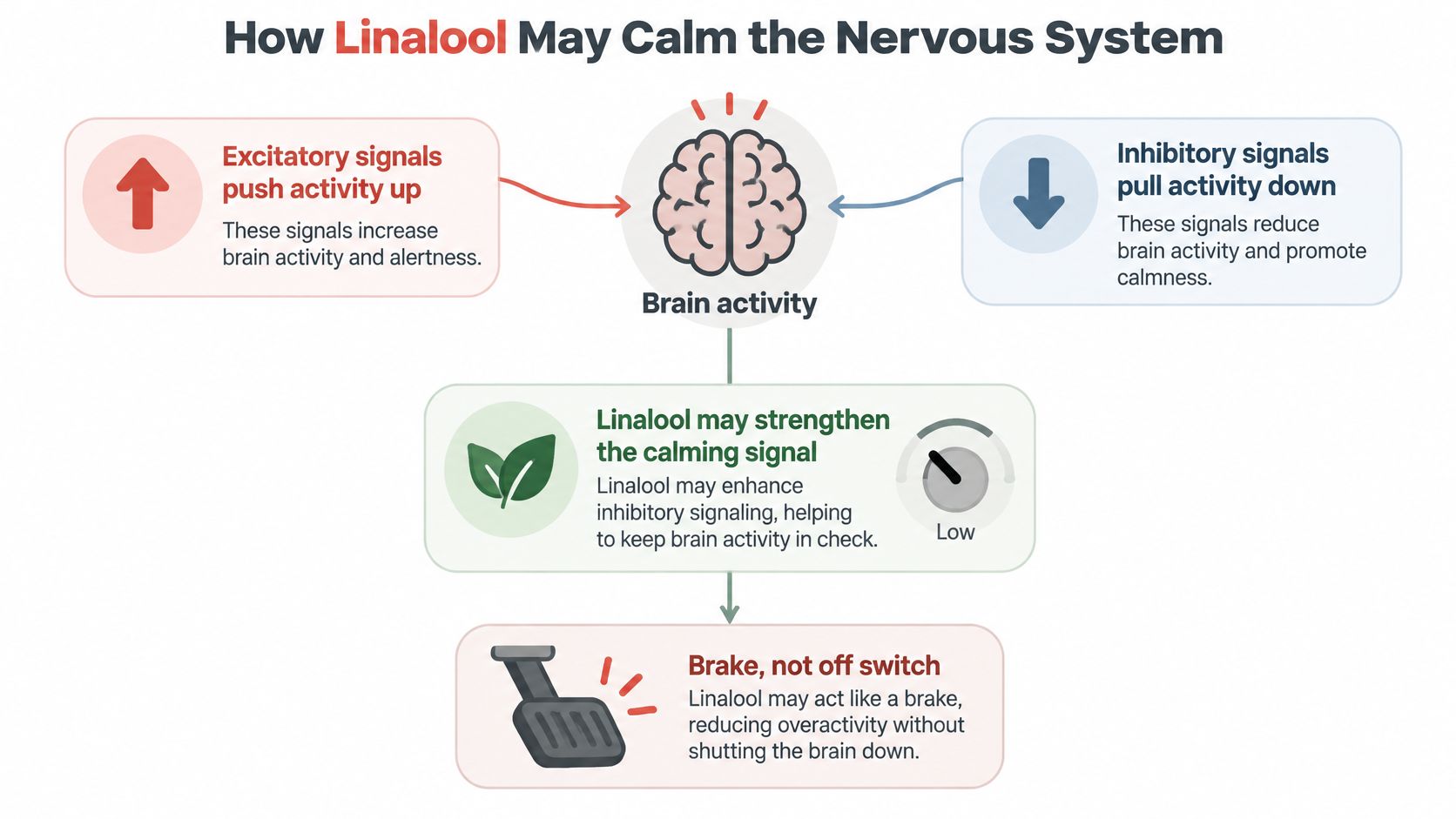
Think of brain activity as a car with an accelerator and a brake. Excitatory signals push activity up, inhibitory signals pull it down, and most sedating compounds work by pressing one pedal or easing off the other. Linalool appears to do both, gently.
On the brake side, electrophysiological and pharmacological evidence indicates that linalool can potentiate GABA-A receptor mediated inhibitory currents. That's the same receptor family targeted by some sleep and anxiety medicines, though linalool is far weaker and is not a drug. On the accelerator side, it reduces excitatory glutamatergic signaling through noncompetitive inhibition at the NMDA receptor channel site and competition with glutamate binding. The combination gives a plausible cause-and-effect basis for the sedative, anxiolytic, anticonvulsant and antinociceptive effects reported in preclinical models, as described in this review of linalool's receptor activity.
Analgesia gets a separate mechanism. Linalool is linked to suppression of nociceptive TRPA1 channels and voltage-gated calcium channels, which lowers peripheral sensory-neuron excitability. In plain terms, it makes pain-sensing nerves less trigger-happy at the source, rather than only quieting the brain's interpretation of their signals.
Neuroprotection has its own early signal. In a mouse neurotoxicity model, linalool was given at 12.5 or 25 mg/kg once daily for seven days before MPTP exposure, and treatment attenuated MPP+ associated neuronal injury in a dose-dependent manner while raising antioxidant and neurotrophic markers including Nrf2, HO-1, BDNF and NGF, per this study of linalool in a mouse neurotoxicity model. That points at oxidative-stress defenses and repair pathways, not just receptor-level sedation.
Every one of those findings comes from cells or animals. They show a pathway, not a proven human outcome. The practical reading is narrower: a linalool-rich product may be more likely to feel calming or drowsy, but terpene percentage alone cannot predict intensity, because route, dose, THC and CBD content, formulation, tolerance and individual pharmacokinetics all influence exposure. If you're mapping which compounds tend to land where, this breakdown of the best terpenes for relaxation puts linalool next to its usual neighbors.
Here's the mistake that follows every study write-up: reading a milligram figure and hunting for it on a label. Research doses are not serving sizes. They're controlled exposures chosen to answer a specific question in a specific population, and the settings differ enough that the numbers can't travel.
| Study setting | Route | Dose or exposure | Population or model |
|---|---|---|---|
| Lavender-oil trial for generalized anxiety | Oral lavender-oil preparation | 80 mg per day for 6 weeks | 77 adults with generalized anxiety disorder |
| Meta-analysis of placebo-controlled trials | Oral lavender-oil preparation | 80 mg per day for about 10 weeks | Five randomized trials in people |
| Human absorption study | Capsule | About 50 mg linalool | 39 adults, 23 women and 16 men aged 19 to 64 |
| Mouse neurotoxicity model | Administered dose, route not stated | 12.5 or 25 mg/kg once daily for 7 days before MPTP | Mice |
| Mouse vapor study | Inhalation | 5% linalool for 30 minutes, 6-second pulls every 5 minutes | Mice, sex-specific anxiety-related behavior |
The capsule row is the closest thing to a human anchor. That study enrolled 39 adults, 23 women and 16 men aged 19 to 64, and gave a capsule containing approximately 50 mg of linalool so researchers could investigate human pharmacokinetics under controlled conditions. Pharmacokinetics is the boring part that determines everything practical: how fast the compound gets in, and how fast the body clears it. That clearance rate is what governs how long a felt effect might plausibly last, and it's the piece no label ever tells you. The full account sits in this pharmacological review of linalool research.
A 1990 human study cited in that review found transdermal linalool reduced systolic blood pressure and skin temperature compared with placebo, yet it did not improve participants' subjective health ratings. Measurable physiology moved. Felt experience didn't. That gap is the whole argument against assuming a bodily change equals a mood change.
Earlier work, including a 1991 study of lavender-oil constituents, linked linalool and related compounds with reduced physical activity, lower anxiety, sleep-related effects and central-nervous-system activity in humans and laboratory animals. Preclinical inhalation studies have reported anxiolytic-like activity in rodent light-dark, aggression and social-interaction models. Oral, transdermal, capsulated and inhaled exposures all differ in absorption and in how much reaches the brain.
Reader rule: start with a small amount, wait longer than seems necessary before using more, and never assume a higher terpene percentage means a stronger effect.
A percentage on a label describes concentration, not dose. The amount reaching your body depends on how much you use, how it's heated or inhaled, and what else is in the product. Two questions settle most of it: how much linalool is in one serving, and by what route is it used. If a seller can't answer both, the number came from a marketing deck.
The assumption worth challenging is that linalool only ever calms. Emerging animal evidence supports a more conditional picture, and it's the part most guides skip.
A 2026 animal study reported that linalool inhalation produced both anxiety-like and depression-like behaviors. The striking detail is the split: the anxiety-like behavior occurred independently of olfactory perception, while the depression-like behavior required olfactory input. Two different routes to two different outcomes from the same exposure. That doesn't prove typical human exposure causes anxiety, but it does directly contradict the idea that more linalool always means more relaxation, and it's documented in this toxicological assessment of linalool inhalation.
A 2024 mouse vapor study published by the Society for Neuroscience used 5% linalool for 30 minutes, with 6-second vapor pulls every 5 minutes, and reported sex-specific anxiety-related behavioral effects, according to the vaporized linalool behavioral study. Sex-specific results are common in preclinical work and often get flattened into a single headline. Here the flattening matters, because it hides the fact that responses vary by individual rather than scaling neatly with dose.
More is not calmer. A higher linalool number is a concentration claim, not a promise about how you'll feel.
Safety communication has a hole in it too. Australia's industrial-chemicals assessment says available information is insufficient to conclude acute inhalation toxicity for linalool. Read that carefully: it's not a finding of danger, and it's not a clearance either. It means the specific question hasn't been answered.
| Combined with | Why it matters | Practical caution |
|---|---|---|
| Alcohol | Possible additive sedation | Avoid combining in the same session |
| Benzodiazepines | Possible additive central-nervous-system depression | Ask a clinician before use |
| Sleep medicines | Possible additive drowsiness | Do not use together without medical advice |
| High-THC products | Stronger overall intoxication, hard to predict | Start with a low amount and wait |
| CBD products | Interaction effects not well characterized | Check with a clinician if on other medicines |
| Anxiety medicines | Possible additive effects on mood and alertness | Speak to a prescriber first |
A 2026 pharmacology review notes that linalool's sedative or anxiolytic properties could create additive effects with central-nervous-system depressants such as alcohol and benzodiazepines. The plain takeaway is to stop stacking calming substances casually. If you take prescribed medication for mood, sleep or anxiety, that conversation belongs with your clinician before it belongs with a budtender.
The decision you can act on today is whether a linalool claim is verifiable. Work through these in order, and stop at the first one that fails.
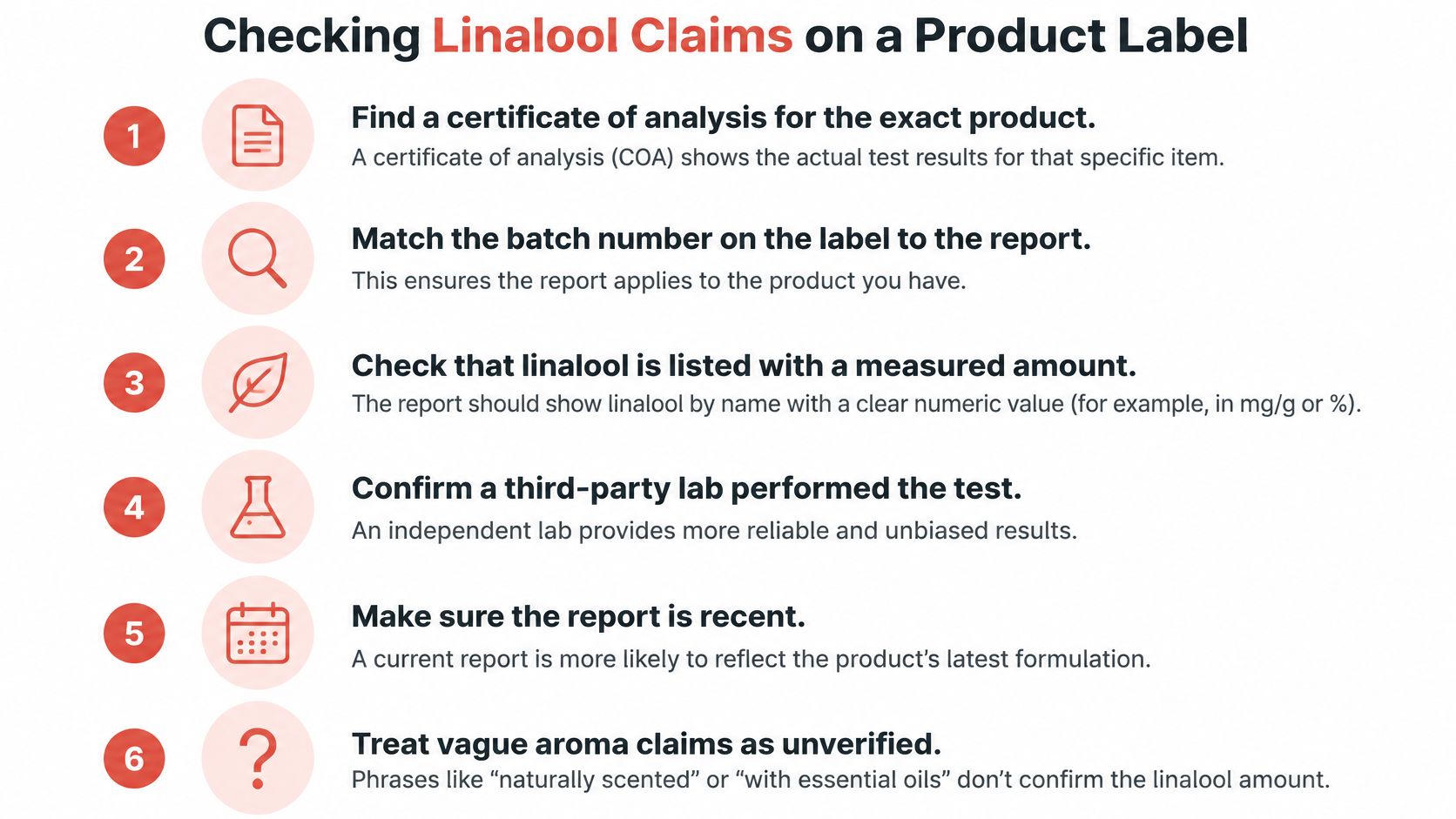
Batch-level testing is the difference between a story and a number. Our flower, prerolls, edibles and other products are lab-tested, and every Melt Exotic Preroll is tested by a third party for cannabinoid potency, residual solvents, heavy metals and pesticides. If you want to get fluent at reading those reports, this walkthrough of how to read a certificate of analysis covers what each panel means.
If linalool is the reason you're buying, do three things: read the batch report before you commit, start with a small amount, and ask the seller how much linalool is in one serving and by what route it's meant to be used. Those answers separate a product built around chemistry from one built around a lavender illustration.
Linalool is worth paying attention to precisely because the evidence is uneven: a real anxiety signal from lavender-oil trials on one side, and a pile of animal and cell work on the other. If you want to try it in flower form, our Melt lineup includes strain-specific terpene profiles and batch reports you can read before you buy, so you know what's in the jar rather than what the name suggests. Start small, check the panel, and treat the calming claim as a reasonable bet rather than a guarantee.
Your cart is currently empty.