


Free Shipping All Orders Over $95
The most repeated tip on sativa edibles is simple. Eat one for daytime energy, and if 45 minutes pass with nothing, eat another. That tip ignores the clock. It is also the mistake that turns a mild plan into a long, messy afternoon.
Sativa edibles effects follow digestion, not the word on the bag. The label is a weak hint. An upbeat mood does not clear you to redose, drive, finish a shift, or count on easy sleep. Elapsed time and ordinary function do.
Put the strain name aside for a minute and look at the route. Inhaled cannabis reaches peak blood THC in under 10 minutes. Swallowed THC usually shows up in blood about 0.5 to 2 hours later, and blood levels often peak around 1 to 2 hours. A gummy is not a slower version of a puff. It is a different trip.
| Route | First noticeable effects | Peak | How long effects can last |
|---|---|---|---|
| Inhaled cannabis | Within minutes | Under 10 minutes (blood THC) | Shorter than edibles; often faded while an edible is still active |
| Oral edible, common public range | 30 minutes to 2 hours; full effects sometimes up to 4 hours | Blood THC often peaks around 1–2 hours | Typically 4–12 hours |
| Oral edible, infrequent users in research | Often 30–60 minutes | About 1.5–3 hours | Decline through about 6–8 hours; baseline sometimes 6–20 hours |
| Washington ingestion summary | 1–4 hours | Later than inhalation | 4–12 hours |
Public ranges are wider than any single lab session. New York's Office of Cannabis Management puts onset at up to 2 or more hours, with a typical duration of 4 to 12 hours. Other government guidance uses 30 minutes to 2 hours to start, and says full effects can take as long as 4 hours. Washington's regulated-cannabis materials summarize ingestion as a 1 to 4 hour onset and a 4 to 12 hour duration, against a faster and shorter inhaled course.
In infrequent users, effects often appear at 30 to 60 minutes and peak around 1.5 to 3 hours, according to a controlled pharmacokinetic review. Subjective effects can decline through about 6 to 8 hours. Some people are not fully back to baseline until 6 to 20 hours later.
Think of inhalation as a direct flight through the lungs. An edible is a ferry. It has to cross the stomach and stop at the liver before THC reaches the blood. Feeling nothing at 45 minutes is normal on that ferry. The same milligram shifts with body weight, metabolism, sex, food in the stomach, and whether the piece is a gummy, a belt, or a drink.
Practical rule: Block the rest of the day before you judge the piece. The milligram on a sativa gummy does not predict an immediate response.
If you want the route contrast in more detail, the edibles versus smoking comparison is the right side reading. Silence in the first hour is a reason to wait, not a reason to stack.
Shop floors still sell a shortcut. Sativa means daytime energy. Indica means sedation. Once the product is eaten, that shortcut fails.
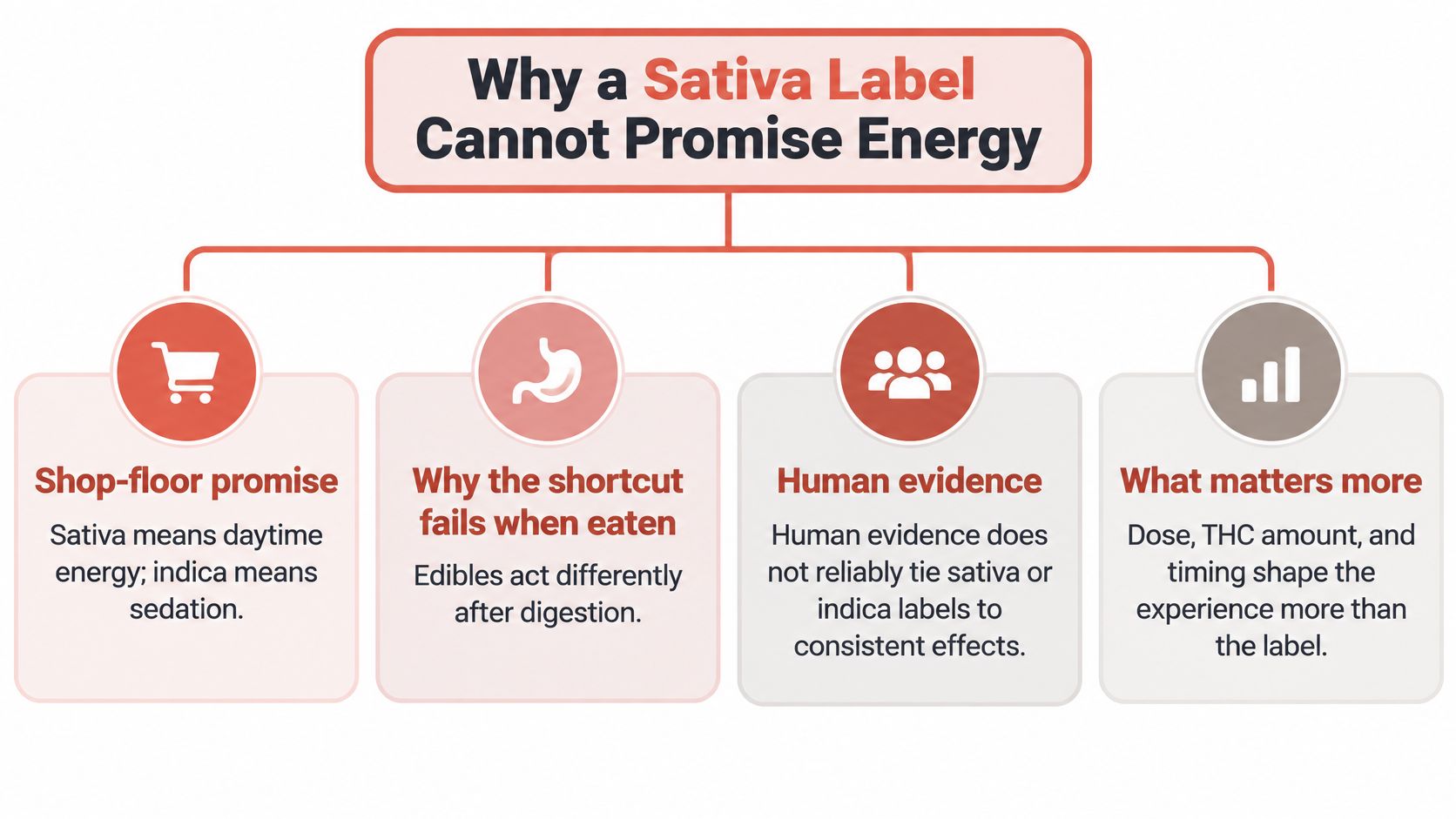
Human evidence does not reliably tie those labels to how people feel, how they behave, or which side effects show up. A 2026 review of label-based cannabis claims found the associations with subjective effects, symptoms, behavior, neurophysiology, and side effects to be inconsistent. A bag can say sativa and still land relaxing, anxious, sleepy, or foggy.
Swallowed THC moves through the gut and is converted in the liver to 11-hydroxy-THC. That metabolite is tied to a stronger, longer feeling than the THC someone inhales. The cultivar word may describe a plant or a marketing mood. The session is shaped by milligrams per piece, tolerance, metabolism, body size, an empty or full stomach, other cannabinoids, and any terpenes the label lists.
Say two adults split the same 5 mg sativa gummy after lunch. One gets chatty. The other gets heavy-eyed. The liver and the dose did more work than the word on the bag.
A little THC may feel bright. Too much of that same product can become racing thoughts, anxiety, or a long sleepy fog. “Energizing” is not a protected setting. It is a possible early note that higher exposure can overwrite.
Read these before the strain name:
Sativa edible effects are a probability, not a guarantee.
The sativa, indica, and hybrid breakdown is useful for how those words got onto packages. It is not a promise that lunch will feel energetic.
After the peak, the range is wide. People often report a lifted mood, faster or more scattered thoughts, talkativeness, brighter sensory detail, and a sense of energy that fits low-stakes time. Music, cooking, or a walk can feel easier. That is a description of common reports, not a promised daytime buzz.

The same product can narrow attention, blur short-term memory, slow reaction time, and make coordination clumsy. Body signs often include a dry mouth, red eyes, dizziness, a faster heart rate, and a stronger appetite. Higher doses add unpleasant turns that contradict the label: anxiety, racing thoughts, nausea, and a heavy sedentary feeling.
Feeling high, feeling energetic, and being unimpaired are different states. An upbeat sativa mood does not clear someone to drive, use tools, or make high-stakes decisions. You can feel chatty and still miss a step, lose a sentence, or brake late.
A review of oral THC and impairment reports oral bioavailability of only about 6 to 18%, largely from breakdown in the stomach and first-pass liver metabolism. Blood THC stays lower than after smoking, yet 11-hydroxy-THC can make the subjective effect feel stronger and last longer. Impairment may persist after blood THC falls below detection. Peak blood levels can sit under common legal per-se cutoffs while observable impairment is still there.
Judge recovery by elapsed time and ordinary function. Clear thinking and steady coordination matter more than the mood at the peak. Leave alcohol and other intoxicants out. They stack with this profile.
A short explainer on why swallowed THC feels different from inhaled THC:
Buy the piece you can measure before you plan the feeling. Confirm the package lists THC per piece and total THC, plus a batch-matched third-party certificate of analysis. Confirm sales are age-gated for adults 21 and older, and confirm the product is legal where you live. Pick the smallest labeled piece that fits the plan, not the brightest flavor name.
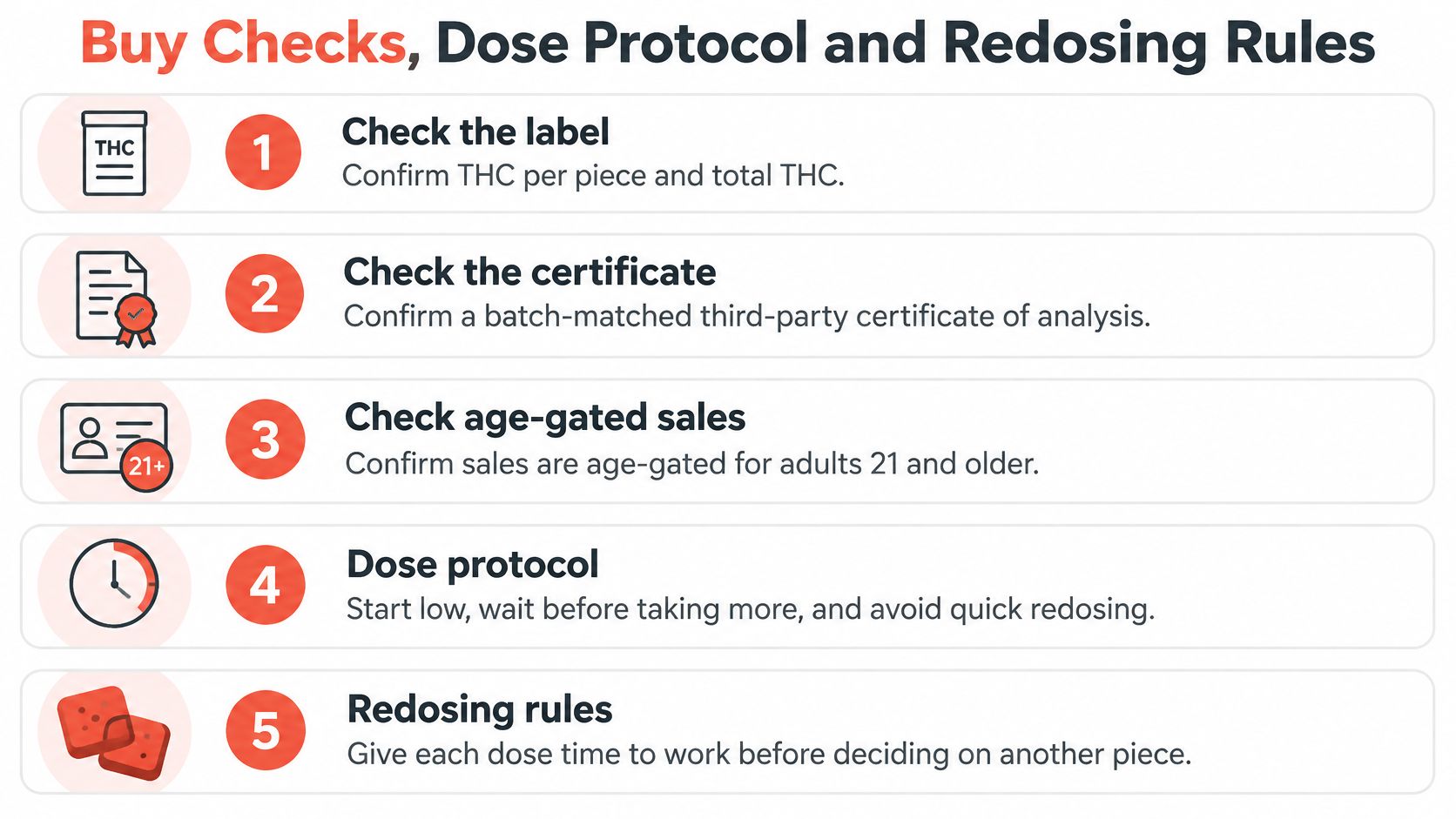
An adult who is new to edibles, or coming back after a break, starts at 2.5 mg THC or less. January 2025 guidance for adults beginning or resuming use recommends less than 5 mg, and British Columbia's cannabis edibles safe-use fact sheet fits the same caution: onset is often 30 minutes to 2 hours, full effects can take up to 4 hours, effects can last up to 12 hours, and residual impairment can run into the next day.
Block at least 12 hours plus the next morning. No alcohol. No other drugs. Store the package where children cannot reach it.
Stacking is the trap. 5 mg at noon plus 5 mg at 1 p.m. can peak together nearer 10 mg, because the first ferry has not docked when the second one leaves. Liver metabolism to 11-hydroxy-THC is why that second piece can feel stronger and longer than a similar inhaled amount.
| What you notice | Redose? | Work or drive? |
|---|---|---|
| Nothing at 30–90 minutes | No | No |
| Mild effect before 2 hours | No | No |
| Clearly mild after 2–3 hours, day is clear | A small planned addition only | Still no |
| Energetic but thoughts or coordination are altered | No | No |
| Strong, anxious, or sleepy | No; stop for the day | No, including the next morning if residue remains |
An energetic or “I feel functional” sativa edible does not establish driving safety. The goal of the first sessions is a known personal dose and a clock you trust.
Three ordinary afternoons show why the sativa word is the least useful note in the log.
Empty stomach, first try. An adult new to edibles eats 2.5 mg of a sativa gummy before a late errand, with no food since lunch was skipped. Effects creep in near an hour. Thoughts feel busy rather than sleepy. The mood is upbeat, and driving is still a bad idea. The variable that set the pace was the empty stomach, which is why the empty-stomach edible timing guide belongs in the plan before the flavor does.
Same person, full meal, higher milligrams. A week later they take 5 mg after a full meal. Onset drifts later. The peak feels softer. They decide the product is weak. What changed was food plus a modest dose increase, not a “bad sativa.” A softer peak on a full stomach is not proof you need a bigger piece next time.
Tolerance, a big belt, and a second piece. Someone who uses often takes a large piece from a high-potency sour belt. Little shows up for 90 minutes, so they add more. The evening turns anxious and couch-bound, and the morning is groggy. Tolerance shrank the early buzz. It did not shorten the tail. The second dose, not the strain name, built the stack.
A bright, familiar room and a free calendar make a mild mental lift easier to sit with. A crowded obligation, a work deadline, or a need to sleep early can turn that same lift into racing thoughts. Change one variable per session. Write the milligrams and the clock. If a stack goes badly, drop the dose next time instead of chasing a different name on the bag.
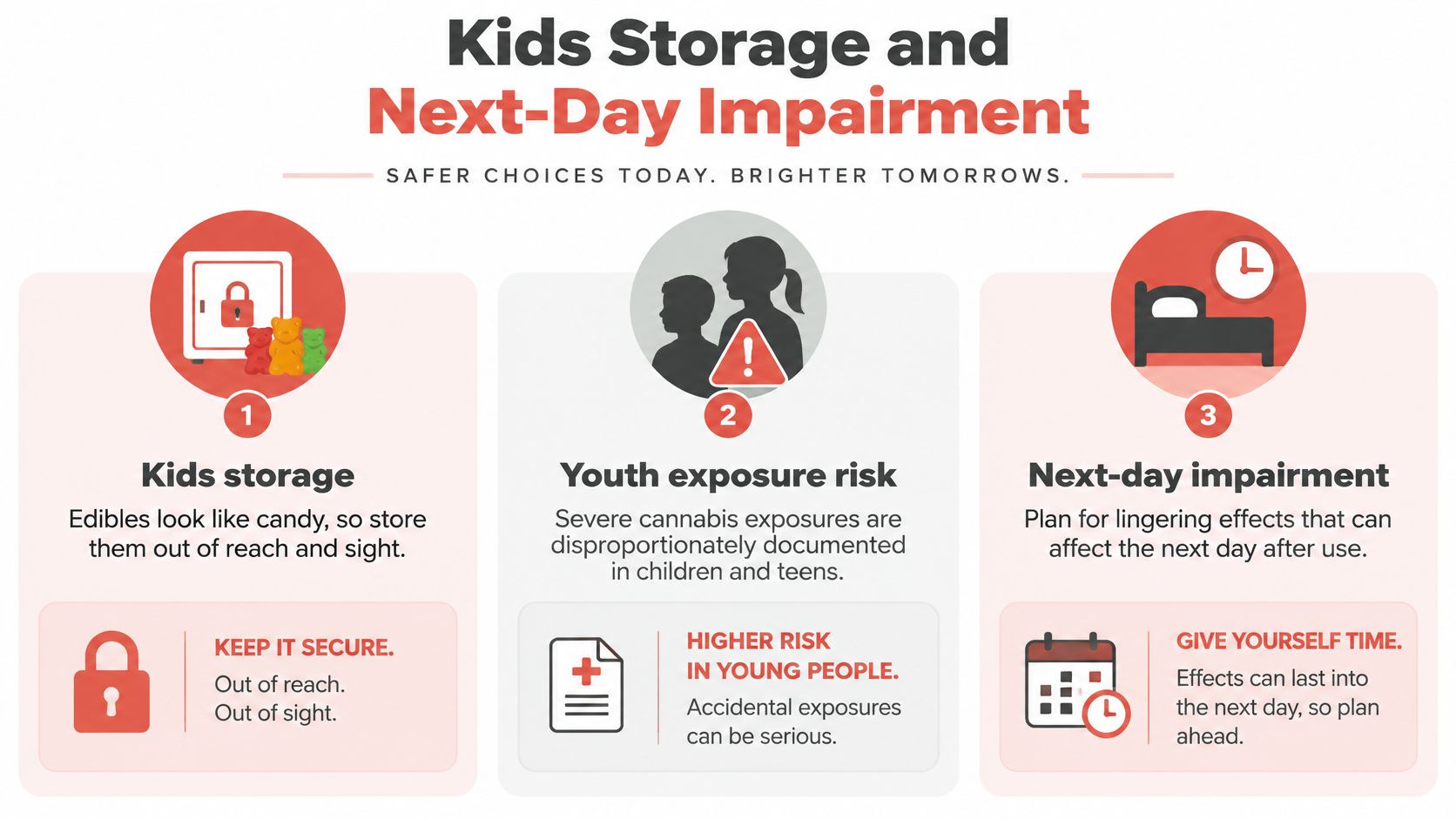
The planned adult session is not the only person who can meet the dose. Edibles look like candy. Severe cannabis exposure is documented disproportionately in children and teens, even when the package was meant for adults.
From January 1 through July 31, 2021, CDC Health Alert Network surveillance recorded 661 U.S. delta-8 THC exposure cases. 119 cases (18%) needed hospitalization. 258 cases (39%) involved patients younger than 18. Serious pediatric effects included deep sedation, slowed breathing, a heart rate that rose and then slowed, and low blood pressure.
Separate emergency-department surveillance covering 1,671 hospitals found cannabis-related visits among children younger than 11 rose from an average of 20.9 per 10,000 emergency visits in 2019 to 65.6 per 10,000 in 2022, a 214% increase. These figures are not all sativa edibles. They are why delayed-onset products need age checks, child-resistant storage, and honest THC labels.
A 4 to 12 hour window can leave slower thinking and clumsy coordination after sleep. The next-day rule matches the evening rule. No driving and no safety-sensitive work until ordinary function is back. Potent products sold for a long body effect need the strictest storage and the clearest potency disclosure. If the morning still feels off, the clock has not finished, no matter how energetic the night felt.
Melt's hemp-derived gummies, including measured sour belts, are built for adults who want a labeled milligram, a batch lab report, and a flavor they can plan around rather than a strain slogan. If you are comparing pieces by THC per serving and third-party results, start with the education on Melt and match any edible to a free day, a low first dose, and a locked cabinet.
Your cart is currently empty.