


Free Shipping All Orders Over $95
Shopping for THCA pre rolls online by choosing the highest THCA percentage is a poor buying strategy. That number doesn't establish whether the product can legally reach your address, whether the lab report belongs to the batch you'll receive, or how much THC you'll consume.
Shipping eligibility, total THC and batch-matched testing deserve priority over advertised potency. Fast delivery is convenient, but it doesn't resolve any of those questions. Treat each order as a separate legal and technical purchase, even when you've bought the same strain before.
Before comparing strains or pack sizes, establish whether the order can legally reach your address. A retailer accepting payment isn't the same as a state permitting possession or a carrier accepting the shipment.
Start with these questions:
You need compatible answers to all of them. If the shipping page and checkout disagree, pause the purchase and request written clarification rather than treating the checkout screen as legal advice.
The Congressional Research Service's hemp overview explains that the 2018 Farm Bill removed hemp from the federal Controlled Substances Act's marijuana definition, defined hemp as Cannabis sativa L. and its covered components containing no more than 0.3% delta-9 THC by dry weight, and directed USDA to establish hemp-production oversight.
That framework matters, but it isn't a blanket authorization for every product described as hemp. Measured cannabinoid content, compliant production and the rules governing the destination still matter. A label can't substitute for those checks.
For destination questions, consult the state agency responsible for hemp or cannabis regulation. Look specifically for guidance covering smokable products and consumer shipments, not just agricultural cultivation licenses. A page explaining how farmers obtain a hemp license doesn't necessarily answer whether you can receive finished pre-rolls.
Our THCA shipping exclusions include Hawaii, Arkansas, Idaho, Minnesota, Oregon, Rhode Island, Utah and Vermont. We can't ship THCA products to those states. Absence from that list shouldn't replace checking current destination rules before ordering.
Our guide to THCA shipping legality provides additional context for evaluating eligibility. Use it alongside current agency guidance, rather than relying on a saved screenshot or an old search result.
Before paying: Read what happens if a package is refused, returned or seized. Don't assume a shipping confirmation guarantees delivery or a refund.
Ask whether the policy distinguishes a failed delivery from a prohibited shipment. Check who pays return costs and whether opened or intercepted packages qualify for reimbursement. If the seller doesn't explain these situations, you haven't yet established the financial risk of the order.
THCA is like unbaked dough: it isn't the finished product. Heat acts like the oven, converting THCA into delta-9 THC through decarboxylation. The analogy explains the transformation, not the dose you'll receive.
The sequence is simple: unheated THCA, applied heat, then formation of intoxicating THC. This diagram illustrates that distinction.
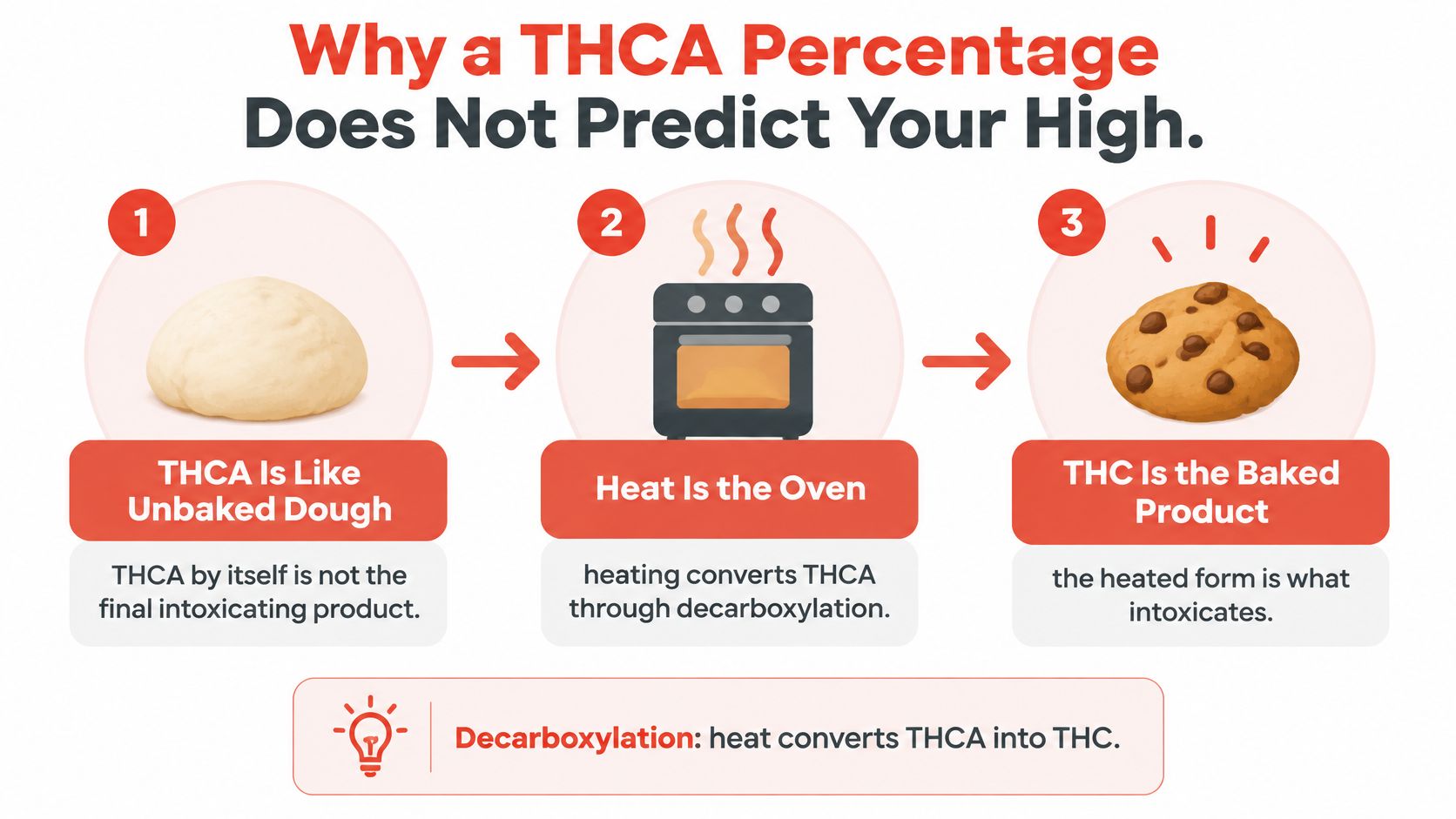
The FDA regulatory document describes the federal hemp distinction and the USDA total-THC approach, which accounts for conversion using total THC = delta-9 THC + (THCA × 0.877).
The conversion factor means you shouldn't read a THCA percentage as an identical percentage of active THC. It also means a low delta-9 result, considered alone, doesn't answer a total-THC compliance question.
Total THC from listed THCA content
The following hypothetical label comparisons apply that formula on a dry-weight basis and assume zero delta-9 THC.
| Listed THCA (dry weight) | Under 0.3% total THC? |
|---|---|
| 0.3% | Yes, close to the limit |
| 1% | No |
| 15% | No |
| 25% | No |
These are arithmetic comparisons, not legal classifications of particular retail products. Hemp-production testing and finished-product restrictions must be evaluated under the applicable rules; a calculated result doesn't identify which legal standard governs your order.
Total potential THC is more informative than an isolated THCA headline, but it still isn't a prediction of your high. It describes cannabinoid potential in the tested material, not the amount ultimately delivered to you.
A useful distinction is composition versus exposure. The report can describe what the sample contained. It can't reproduce how you'll consume the product or guarantee your response.
Look for an explicitly reported total-THC result, its measurement basis and the testing method. If the seller presents only a large THCA percentage, you don't yet have enough information to assess either the relevant compliance claim or the product's potential intoxicating strength.
A certificate of analysis, or COA, records a laboratory's findings for a submitted sample. For a purchase decision, the important question isn't whether a brand has ever commissioned testing. It's whether the document identifies the batch being sold and includes the relevant analytical panels.
We lab-test our flower, prerolls, edibles and other products. That credential doesn't eliminate the buyer's need to inspect the individual report, because product categories and testing panels aren't interchangeable.
Start with the sample description, batch identifier and dates. Then review the analytical sections in order. A cropped potency screenshot can leave out information you need to interpret the result.
COA checks for a THCA pre-roll
| Report section | What to confirm | Red flag |
|---|---|---|
| Potency | THCA, delta-9 THC and total THC with dry-weight basis | No total THC figure or no batch number |
| Terpenes | Named terpenes with percentages or mg/g | Only a total terpene figure |
| Pesticides | Pass result for the listed panel | Panel missing or marked not tested |
| Heavy metals | Results for lead, arsenic, cadmium and mercury | Metals section absent |
| Residual solvents | Pass result for the solvent panel | Missing for solvent-extracted products |
| Microbials | Yeast, mold, E. coli and Salmonella results | Results older than the batch |
| Moisture | Moisture content or water activity listed | Missing |
| Lab identity | Lab name, accreditation body and accreditation number | Unnamed lab or a reused report |
Treat these as document checks, not a universal testing statute. A missing result isn't a passing result, and a pass applies to the substances, methods and limits specified on that report.
Potency and contaminant testing answer different questions. Knowing cannabinoid concentrations doesn't establish that the sample was screened for pesticides or metals. Likewise, a contaminant pass doesn't establish that the advertised potency matches the batch.
The batch number on the package must match the report. Before delivery, request the batch identifier allocated to your order if the product page doesn't make that connection clear. After delivery, compare the package again before using it.
Read dates in context. A report dated before pre-roll packaging may reflect testing of the source flower, so ask what material was sampled and how it relates to the finished product. A chronology that can't be explained is a reason to stop, not something to overlook because the report looks professional.
Flower, infused pre-rolls and edibles can call for different analytical panels. For an infused product, identify the added material and determine whether the available testing covers it. Don't assume a flower-only report describes every ingredient in the finished joint.
Use our guide to reading a certificate of analysis for help interpreting the document. Verify the laboratory's accreditation number in the accrediting body's public directory, including whether its listed scope covers the relevant testing.
A laboratory name is an identity claim. Accreditation and an authentic, batch-linked report require separate checks.
For a quick initial review, prioritize batch match, report date, total THC and laboratory identity. If any is missing, resolve the gap before spending time comparing strain descriptions.
Terpenes are aromatic compounds that help shape cannabis smell and taste. A named profile lets you compare products more precisely than descriptions such as sweet, fruity or gassy, which aren't standardized measurements.
Treat visual strain comparisons as starting points, not substitutes for the current batch report.
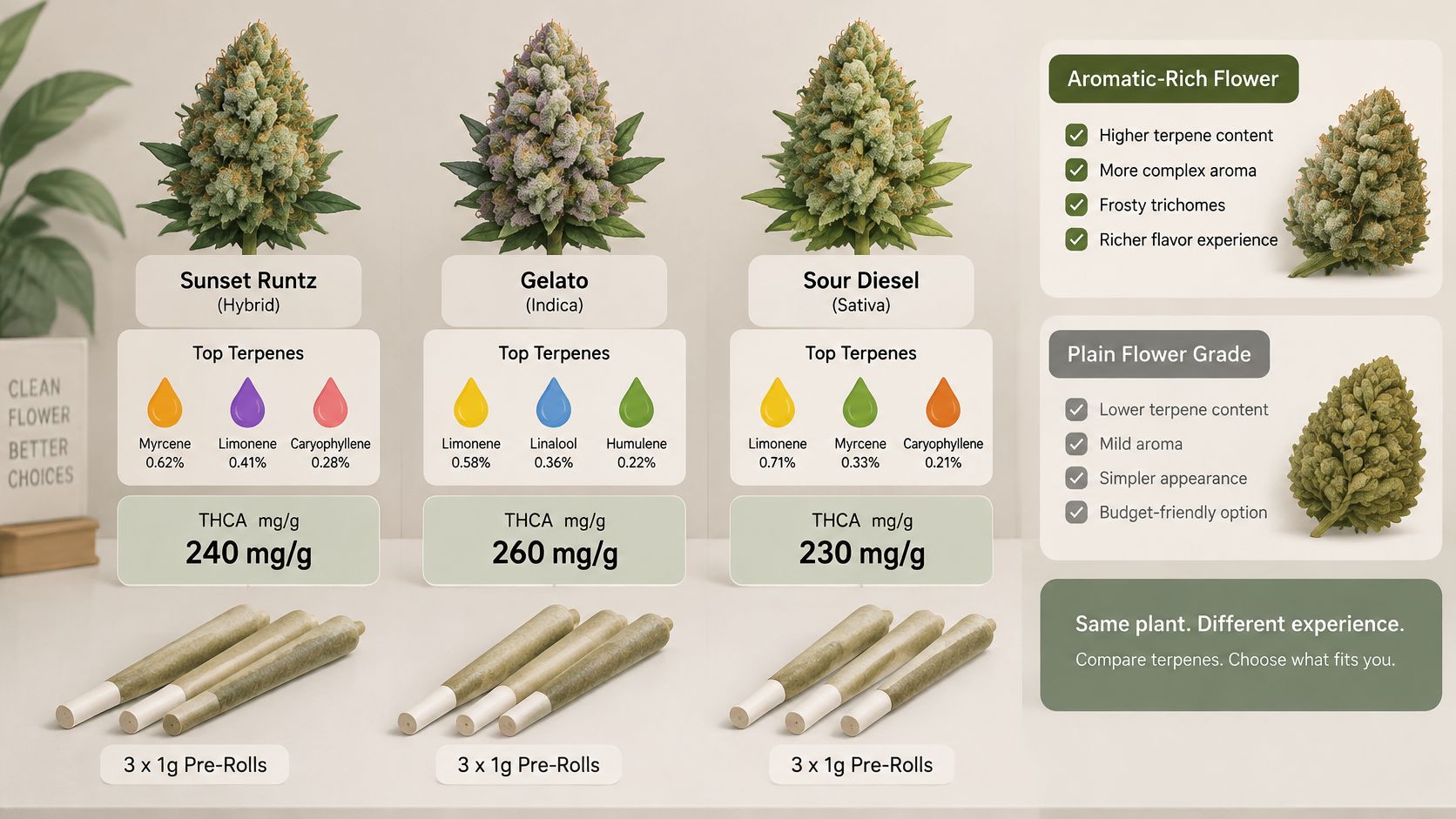
Packaging format and cultivation method describe different things. A single joint or multi-pack tells you how the product is portioned; indoor or sun-grown describes the flower's production setting.
Pre-roll formats compared
| Format | What you get | Best for | Verify before buying |
|---|---|---|---|
| Single pre-roll | One joint | Trying a strain | Named terpene list and batch number |
| Multi-pack pre-rolls | Several joints in one pack | Regular use | Whether all joints share one batch |
| Indoor craft flower | Controlled indoor grow | Buyers prioritizing consistent potency and terpenes | Total THC and terpene report for the batch |
| Sun-grown flower | Outdoor or greenhouse grow | Buyers comparing lower-cost-per-gram options | Pesticide and heavy metal panels |
A single pre-roll limits your commitment when you're trying an unfamiliar strain. With a multi-pack, establish whether the package contains a single batch or a selection requiring separate reports. Don't extend one joint's documentation to everything in a mixed pack.
Indoor cultivation may appeal to buyers looking for controlled growing conditions, but indoor isn't a laboratory result. For sun-grown options, compare the actual cost per gram rather than assuming the cultivation label guarantees a lower price. Apply contaminant checks regardless of growing method.
Named terpenes with individual concentrations let you distinguish products that share similar flavor descriptions. They don't guarantee relaxation, creativity or any other personal response. Our explanation of terpenes in cannabis provides background for reading those profiles.
Smaller buds aren't automatically a different strain or a poorer chemical match. Ask which flower batch went into the pre-roll rather than inferring quality from bud size or a premium label. If comparing indoor and sun-grown offerings, confirm current availability and evaluate each batch independently.
For another format of product education, the following video is available to view.
Choose the format by intended use and compare strains through documented composition. Flavor language can help describe a preference, but it shouldn't decide the purchase by itself.
Fast delivery is a weak trust signal. More useful signs are clear shipping exclusions, batch-specific documentation and refund terms that explain what happens if an order cannot be fulfilled.
The Congressional Research Service's hemp legal analysis describes how federal and state rules can differ. Age-verification requirements also vary by jurisdiction and may change, so check the rules that apply to your destination and the seller's current checkout requirements.
An entry age gate does not show what verification takes place at checkout. Read the purchasing requirements before paying, including what identification the seller may request before fulfillment.
Look for a shipping page that names exclusions, product pages connected to lab reports, and a business address with a working contact channel. These details give you ways to investigate discrepancies; they do not, by themselves, establish product quality.
Melt Exotic Prerolls are hand-packed with THCA indoor flower and strain-specific terpenes. Melt Duo prerolls use top-shelf indoor THCA flower with no trim, no shake and no prep. These descriptions clarify the formats, while batch documentation helps you assess the specific order.
Check the refund policy, too. It should explain how the seller handles refused or intercepted shipments rather than leaving you to infer coverage from a general returns statement.
Buying standard: Prefer an answer you can verify over a reassurance you can't.
Each warning sign leaves a specific question unresolved:
Do not resolve conflicting claims by choosing the more convenient one. Save the product description, relevant report and order terms, then ask the seller to explain any mismatch in writing.
If the seller will not identify the batch before purchase, consider what recourse remains after delivery. A return policy that excludes opened products can make it harder to address a discrepancy. Clarify how you can check the shipment while preserving any available remedy.
Before submitting payment:
Compare shortlisted products on total THC, terpene information and destination eligibility. Buy only if the order passes the full checklist. If it does not, postpone the purchase rather than treating faster delivery as a reason to accept unresolved questions.
The number on the package doesn't specify the dose you'll receive from smoking. The University of Illinois Institute of Government and Public Affairs policy review highlights how THCA labeling can mislead when it omits the implications of heating; combustion, moisture, burn efficiency and incomplete conversion also make delivered THC variable.
That uncertainty calls for conservative use, not an attempt to calculate a precise personal dose from the label. Storage should preserve the product without creating false confidence that a well-kept joint will deliver a predictable experience.
Use a simple storage routine:
Don't treat smell as a safety test. A normal aroma can't establish that a product passed contaminant screening. Inspection is an additional precaution, not a replacement for the report.
If the joint burns unusually or tastes wrong, stop using it. Don't compensate for poor burning by consuming more aggressively or assume that a familiar strain name means the product is unchanged.
Store pre-rolls securely away from children and pets, preferably in locked storage. A convenient tube isn't necessarily a child-resistant container. Keep the label and batch information available so the product remains identifiable.
Don't drive or operate machinery after use. Avoid combining cannabis with alcohol or sedatives without medical advice, and consult a clinician about medication interactions or individual health concerns. Smoking is not risk-free even when the material is sold within a hemp framework.
Check local age and consumption rules, including restrictions on where smoking is permitted. Delivery to a private address doesn't establish permission to consume everywhere.
Start with a small amount, pause long enough to judge your response, and don't make finishing the joint the goal.
Track how you respond before using more, including any unpleasant effects. If your response differs from what you expected, stop rather than relying on the advertised percentage to tell you what should happen.
Melt offers THCA pre-rolls made with indoor flower and strain-specific terpenes, alongside lab-tested flower and other cannabinoid products. Visit Melt to compare available options, review the relevant batch documentation and confirm shipping eligibility before placing your order.
Your cart is currently empty.