


Free Shipping All Orders Over $95
A 15 mg THC dose isn't a casual edible serving. It sits above the commonly used 10 mg benchmark, and current dosing guidance describes 10 to 15 mg as the maximum single-piece range for products such as gummies, mints, and chocolate pieces. At that level, people without much cannabis experience may notice impaired coordination and altered perception, while controlled research has measured cardiovascular effects beginning at the 15 mg starting dose (Leafly's edible dosing guide).
That distinction matters because the number on the label doesn't tell you the entire story. A 15 mg edible, beverage, tincture, vape session, and smoked dose can produce very different experiences. Your previous exposure, food intake, body chemistry, product formulation, and environment all influence what happens after you consume it.
This guide breaks down what 15 mg THC means, how long it takes to work, why redosing causes so many uncomfortable experiences, how tolerance changes the response, and how a Certificate of Analysis, or COA, helps you check whether the product contains what the package claims.
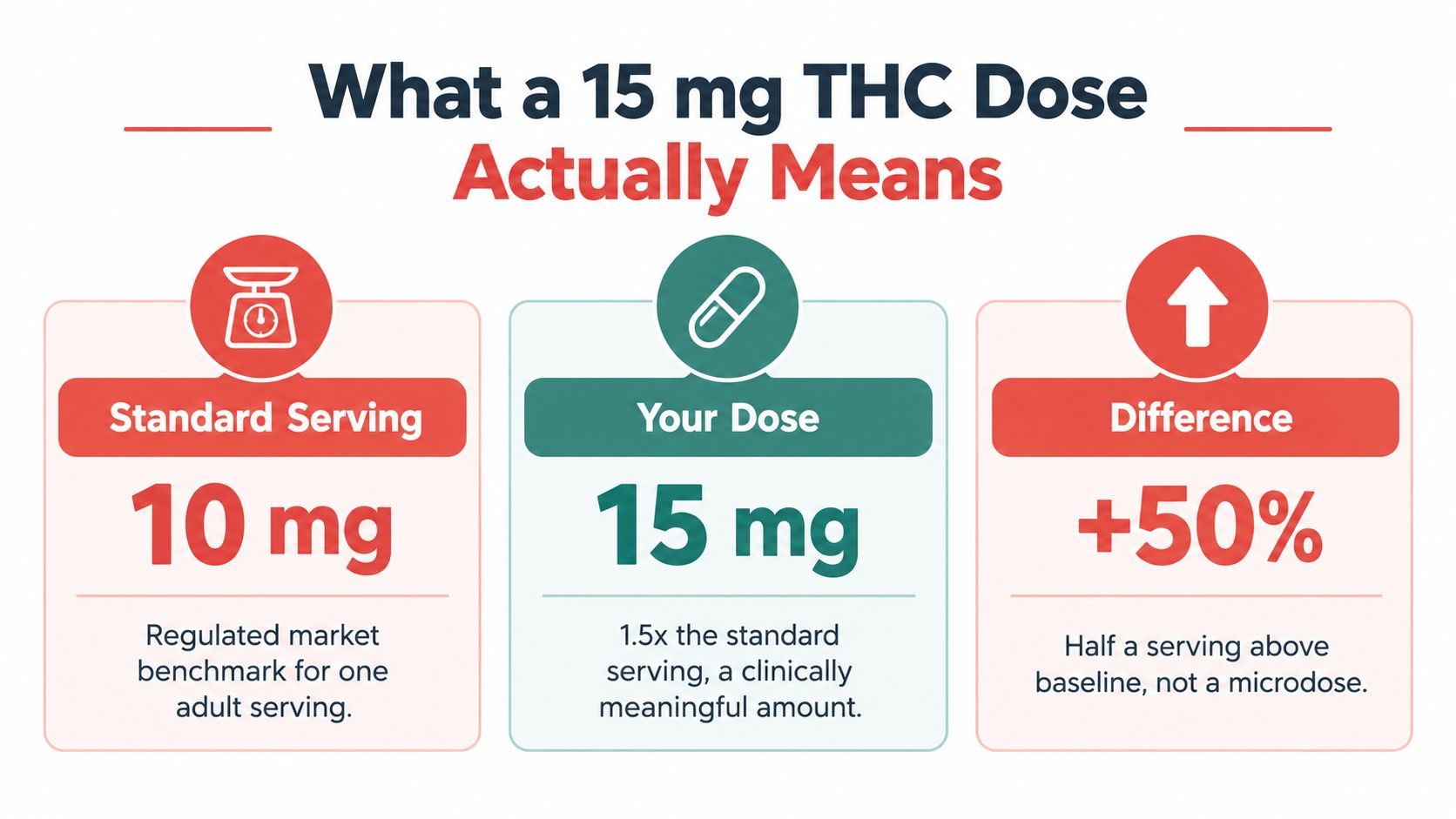
A 15 mg THC dose is 50 percent more than a standard 10 mg serving, so the label represents a meaningful psychoactive amount rather than a minor adjustment. The comparison is shown in this 15 mg THC dosage graphic.
Start with what the label measures. Milligrams of THC refer to the amount of THC itself, not the total weight of a gummy, the quantity of cannabis extract, or the combined weight of all cannabinoids. A 15 mg label may describe one serving or the entire package, so check that wording before consuming anything.
The same number does not produce the same result across every format. Fifteen milligrams eaten isn't equivalent to 15 mg smoked or vaped. Inhaled THC reaches the bloodstream through the lungs, while an edible passes through digestion and liver metabolism before its effects fully develop.
That digestive process can change both intensity and duration. The body converts part of ingested THC into metabolites that may contribute to a longer, sometimes stronger experience. A person who feels comfortable after inhaling cannabis may therefore find a 15 mg gummy unexpectedly intense.
Format matters in other ways too. A solid gummy, infused drink, tincture, and sublingual product can release THC at different speeds. Food in the stomach and the product's formulation also affect onset. These differences explain why a label cannot predict the exact moment effects will begin.
Redosing is a common source of trouble. Someone may take an edible, feel nothing during the early onset period, and assume the dose was too small. Taking another portion before the first one has fully developed can turn a planned 15 mg experience into a much larger total dose. Keep track of the amount, format, and time consumed.
Treat 15 mg as a meaningful psychoactive dose that requires planning, not as a promise of a specific feeling. The number tells you how much THC is present, while your prior exposure, food intake, body chemistry, formulation, and surroundings shape the response.
A laboratory report, often called a Certificate of Analysis, helps check whether the product's measured THC content matches its label. Look for the tested serving or package amount and confirm that the report applies to the product you purchased.
For a closer comparison with the standard serving, read this guide to 10 mg edible effects. The useful questions are how much THC is present, how it is delivered, how long it may take to act, and what activities should wait until the effects have ended.
A 15 mg THC dose commonly produces a clearly psychoactive experience, rather than a barely noticeable change. Many adults may notice euphoria, relaxation, stronger sensory impressions, altered time perception, and less reliable short-term memory. Attention can become narrower, so a task that feels easy while sober may demand more effort under the influence.
Coordination and reaction speed may also decline. Driving, cycling, cooking over an open flame, operating machinery, and making important decisions should wait until the effects have ended.
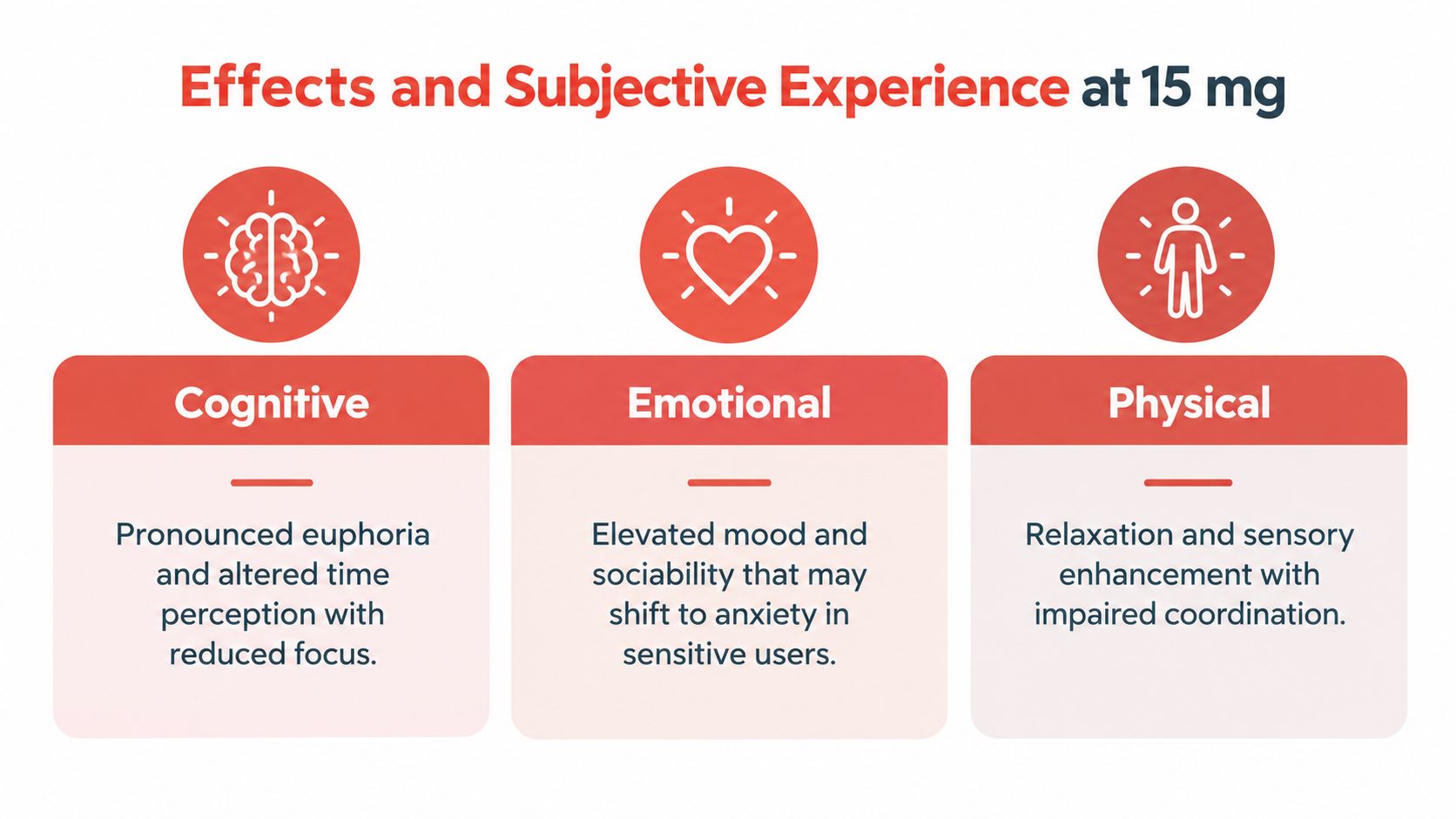
The mental experience usually combines several changes. Music, food, conversation, or private thoughts may hold your attention more strongly. Time can seem slower, and keeping track of what you intended to say may become harder.
Your mood and surroundings can shape how those changes feel. A familiar, calm setting may support relaxation, while stress or unfamiliar company can make altered perception feel threatening. THC may also draw attention toward bodily sensations. A faster heartbeat or lightheadedness can then become the focus of concern, even when the sensation is temporary.
For someone with little prior exposure, 15 mg may feel overwhelming. Leafly's guidance on edible dosing warns that consumers unaccustomed to THC may experience impaired coordination and altered perception at this range.
Physical effects may include heaviness, relaxation, dry mouth, drowsiness, and heightened sensitivity to sound, light, or touch. Other responses include dizziness, nausea, or a racing heartbeat. People with cardiovascular concerns should seek medical advice before using THC.
The same labeled amount can feel stronger or weaker from one person to another. Body size and biological differences may contribute, but body weight alone cannot predict an appropriate adjustment. Metabolism, previous exposure, medications, food, and the product's composition also influence intensity.
Safety boundary: If the experience becomes uncomfortable, do not take more THC to correct it. Move somewhere quiet, sip water, and avoid alcohol or other intoxicants. Seek urgent medical help for severe or unusual symptoms.
A delayed onset can make these effects seem absent at first, which is how redosing mistakes happen. Someone may take part of a 15 mg serving, feel little, and add more before the first amount has fully developed. Record the amount and time consumed, then wait according to the product's directions rather than judging the dose too early.
The biggest edible mistake is treating a delayed onset as a failed dose. Oral THC commonly begins to register in roughly 30 to 90 minutes, reaches its strongest effects around 2 to 3 hours, and may last 4 to 12 hours, according to this overview of cannabis edible timing. Those are broad ranges, not a personal stopwatch.
Solid products such as gummies and brownies generally take longer to register than beverages. A drink may move through the stomach more quickly, while a gummy's digestion can be slower and more variable. A person who feels nothing after the first hour may still be approaching the strongest part of the experience.
| Format | Onset | Peak | Duration |
|---|---|---|---|
| Solid edible, such as a gummy or brownie | Commonly about 30 to 90 minutes | Often around 2 to 3 hours | Commonly about 4 to 12 hours |
| Infused beverage | Often faster than a solid edible | Can arrive earlier than a traditional edible | May vary with formulation |
| Sublingual product | May begin sooner than a swallowed edible | Depends on how much is absorbed directly and how much is swallowed | Varies by product and person |
| Smoked or vaped cannabis | Rapid compared with oral products | Usually arrives much sooner than an edible | Usually shorter than an edible experience |
The table describes general timing, not a guarantee. Food, formulation, and individual digestion can move the experience earlier or later. A fast-absorbing beverage may feel more immediate, while a solid edible can remain quiet for a substantial period before intensifying.
An empty stomach may make an edible feel quicker, while a meal can alter the pace and intensity of absorption. Fat-containing food may increase absorption for some oral THC products, so “I ate first” doesn't always mean the experience will be weaker.
Set a timer when you take the dose. Recent consumer guidance recommends waiting at least two hours before taking more, and waiting longer may be appropriate when the product is a solid edible or your response is uncertain. The redosing trap looks like this: a person takes 15 mg, feels little, adds another serving, and then experiences both doses as the first one reaches its peak.
Read the practical explanation of how long edibles take before choosing an edible format. A clear onset window protects you from confusing delayed absorption with low potency.
Experience changes the response because the brain adapts to repeated THC exposure. A person who uses cannabis intermittently may notice a pronounced shift from 15 mg, while a daily consumer may describe the same label as muted. That difference doesn't mean the dose is safe for everyone, and it doesn't mean a tolerant user is unaffected.
| Experience Level | Typical Effects at 15 mg | Functional Impact | Recommended Adjustment |
|---|---|---|---|
| Unaccustomed consumer | Strong euphoria or unease, altered perception, dizziness, nausea, or a racing heartbeat | Coordination, judgment, and attention may be noticeably impaired | Consider a lower amount or skip the dose |
| Intermittent consumer | Clear psychoactive effects, relaxation, altered time perception, and sensory enhancement | Routine tasks may feel manageable but driving and complex activities remain unsafe | Use one measured serving and avoid stacking |
| Daily consumer | Effects may feel less dramatic or shorter subjectively | Tolerance can mask impairment, especially during familiar activities | Don't increase automatically. Review potency, purpose, and medical guidance |
The first group has the least information about how their body responds. For them, 15 mg can cross from pleasant intoxication into anxiety or physical discomfort. A calm setting and a sober person nearby can reduce practical risk, but they can't remove the pharmacological effect.
Intermittent users often occupy the most misleading middle ground. They may recognize the sensations and assume they can judge the peak accurately, yet edible onset remains delayed even for experienced consumers. Familiarity can improve preparation without eliminating impairment.
Repeated exposure can reduce sensitivity to THC through changes involving CB1 receptors. A daily user may seek more THC for a similar subjective effect, but tolerance to feeling high doesn't necessarily eliminate every effect on memory, reaction time, coordination, sleep, or cardiovascular function.
That creates a dangerous mismatch between felt intensity and actual impairment. Someone who says “15 mg barely affects me” may still need to avoid driving, mixing substances, or taking another serving before the dose has fully unfolded.
The label tells you the amount in the product. Your experience level helps determine how that amount may feel, but neither one replaces cautious timing and an environment that supports safe recovery.
Medical dosing data places 15 mg near a meaningful tolerance boundary for many patients. In one state medical-cannabis dosing report, patients started at 15 mg THC per day, increased by 5 mg THC per day, and could reach a maximum of 30 mg per day. Among 50 patients, half could not tolerate more than the starting dose, while only about one-third reached 25 mg per day or more (the Minnesota medical-cannabis dosing report).
The findings do not establish a universal medical limit. They show why a labeled serving is not automatically a comfortable dose for every adult. For some patients, 15 mg may mark a practical therapeutic ceiling. For others, it may cause unwanted effects before the benefits justify continuing.
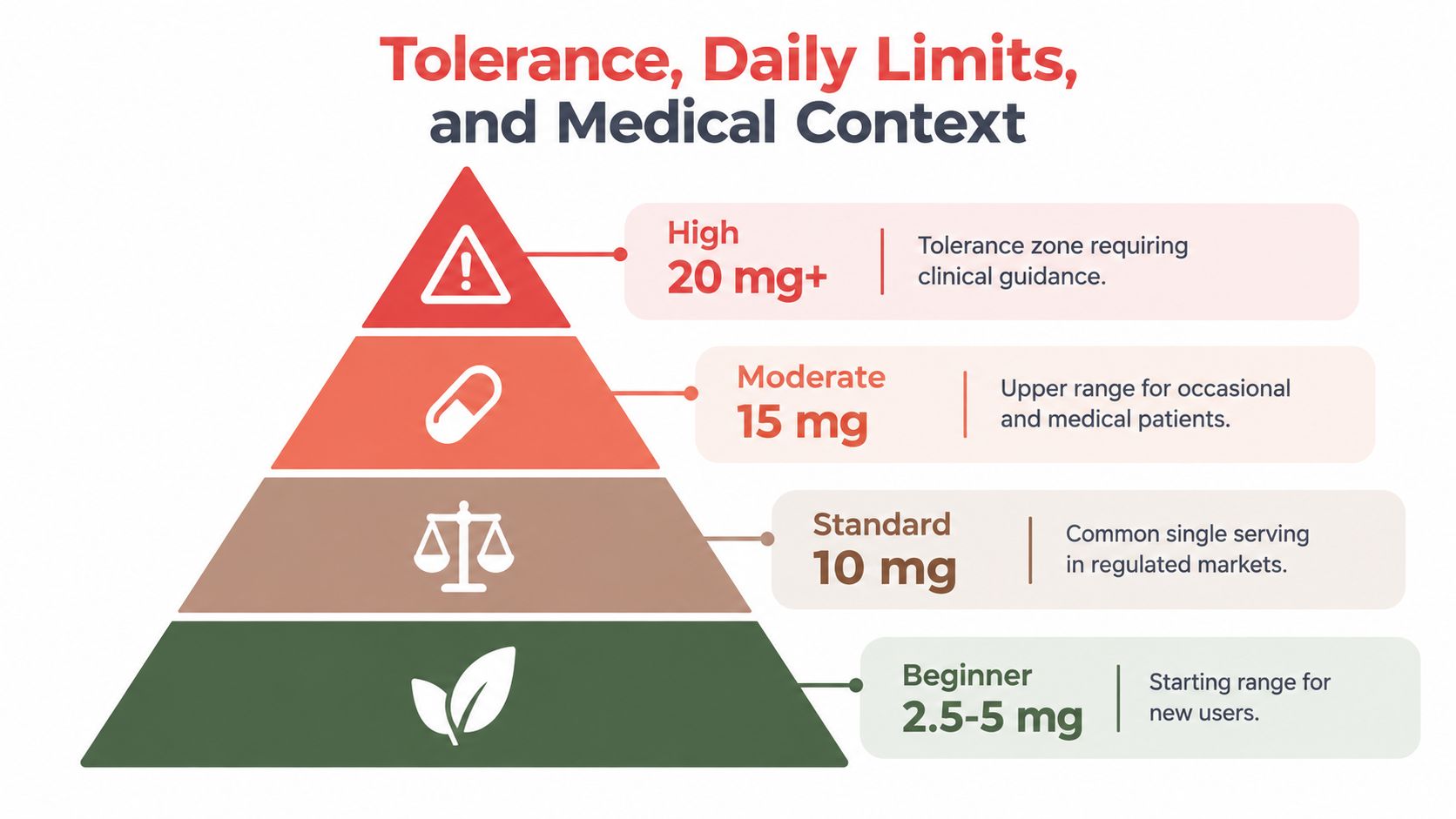
A medical plan separates the intended symptom target from unwanted effects. In an insomnia trial using THC and CBD oil, participants were titrated up to 15 mg THC with 22.5 mg CBD nightly. Half tolerated that maximum, while 20 percent reported benefit without side effects at a lower range of 4 to 6 mg THC with 6 to 9 mg CBD, as reported in the same medical-cannabis dosing report.
The practical lesson is simple: the effective dose may be lower than the maximum tolerated dose. Increasing THC because the first amount feels subtle can add side effects without improving the result. It can also make redosing mistakes more likely when an edible has not reached its full effect.
Daily use creates additional questions that a serving label cannot answer. Repeated consumption may increase tolerance and encourage escalation, while cognitive or physical effects can continue. A clinician can assess the reason for use, medication interactions, cardiovascular concerns, pregnancy, and mental health history.
Legal rules, workplace policies, and drug testing vary by location and employer. A legal product may still conflict with driving, safety-sensitive work, prescribed sedatives, or pregnancy. A 15 mg serving is a measured quantity, not medical clearance.
A product label is only as dependable as the testing and batch controls behind it. A Certificate of Analysis identifies what an independent laboratory measured in a particular lot, helping you compare the printed claim with the tested cannabinoid profile.
Start with the cannabinoids panel. Look for delta-9 THC and the report's total THC calculation, then check whether the result is expressed per serving or per package. A package labeled 15 mg may contain 15 mg total, while another product may contain 15 mg in each serving. The serving size must appear beside the potency result.
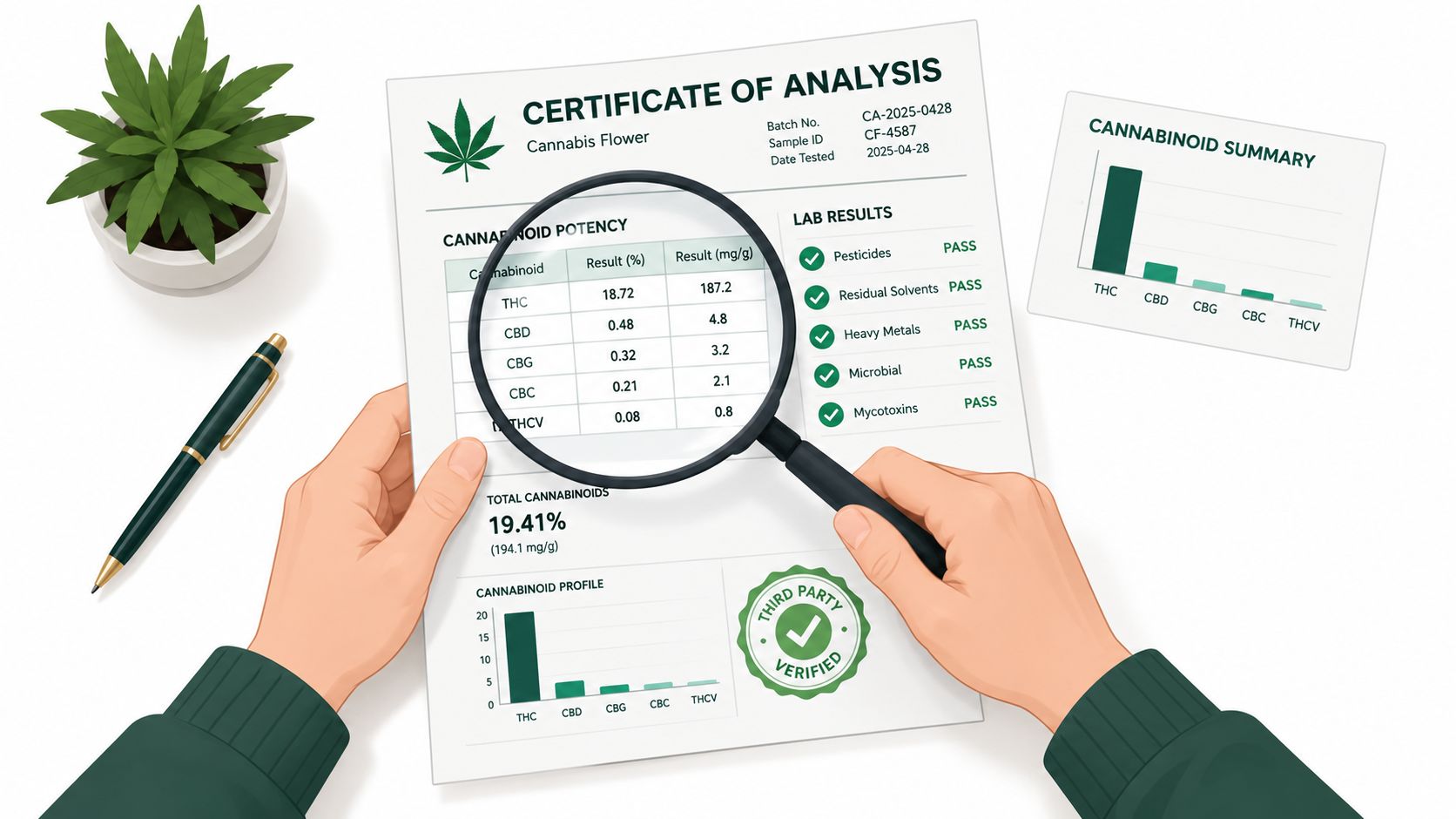
The guide to reading a Certificate of Analysis can help you locate these fields without treating the COA as decorative paperwork. If the report is missing, the lot number doesn't match, or the cannabinoid panel is unreadable, you can't confidently verify that a 15 mg claim is accurate.
Storage matters after testing, too. Heat, light, oxygen, and time can affect cannabinoid stability, so keep edibles sealed in a cool, dark place and follow the product's storage instructions. Independent testing doesn't freeze potency permanently, but it gives you a traceable starting point.
Safe use begins before the package opens. Verify the potency, identify whether the label describes the serving or the whole package, choose a format whose timing fits your schedule, and make sure you can remain in a private, familiar environment for the full experience.
A light meal may make the onset less abrupt for some people, but food can also alter absorption and intensity. The more important rule is to avoid guessing. Take one measured serving, record the time, and wait at least two hours before considering any additional amount, with extra caution for solid edibles and unfamiliar products.
How experienced am I?
If you're new to THC or have previously felt anxious, dizzy, nauseated, or physically uncomfortable, 15 mg may be too much. A lower amount or skipping the dose is the safer decision.
What format am I using?
A beverage, tincture, gummy, vape, and smoked product don't follow the same timing curve. If you can't stay available through a delayed peak, don't choose a format that may keep intensifying after you expect it to be over.
Have I eaten recently?
An empty stomach can change onset, while a meal can alter absorption. Treat food as a variable, not a guarantee that the dose will be weaker.
Is my environment safe and my schedule clear?
Don't drive, work, care for children, use machinery, or combine THC with alcohol or sedatives. Keep products locked away from children and pets, and inexperienced users should consider having a sober person available.
The practical rule: One dose, one timer, one safe setting. Stacking servings before the first dose peaks is how a measured plan becomes accidental overconsumption.
If the answer to all four questions is yes, you can still choose to reduce the dose. If any answer is no, postpone or skip 15 mg. A cautious decision isn't a missed opportunity. It's how you preserve control over an experience that can last for hours.
Melt offers hemp-derived cannabinoid products with product-specific dosage guidance and third-party lab-report information, giving shoppers a way to compare format and potency before purchase. Visit Melt to review its current collection and verify the product details that matter before choosing an edible.
Your cart is currently empty.