


Free Shipping All Orders Over $95
Yes. Delta-8 does expire in practice, and the timeline can range from about 1 day in high heat, 14 days at 20 °C, or many months to 1 to 2 years when products are cool, dark, and well sealed. If you're staring at an old gummy in the back of a drawer or a half-used cart from months ago, the question usually isn't “Is there a magic expiration date?” It's “How much has this changed, and is it still worth using?”
That confusion makes sense. Delta-8 doesn't expire like milk, where one day it's fine and the next day it's obviously bad. It ages more like olive oil, perfume, or dried herbs. It slowly shifts. The potency can drop, the flavor can flatten, the color can darken, and the cannabinoid profile can drift.
There's also a newer wrinkle. In 2026, “expired” may describe two different things at once. One clock is chemical freshness. The other is legal shelf life, because projected federal hemp rule changes are expected to affect delta-8 availability and shipping in late 2026.
You pull an old cart from a backpack pocket, or spot a lone gummy in the back of a jar. The label date may still look reassuring, but that does not answer the question. What you want to know is whether the product has changed.

Delta-8 expires in the practical sense. It loses freshness, its chemistry shifts, and the experience can become weaker or less pleasant over time. That process works more like olive oil aging in a cupboard than milk spoiling overnight. The change is gradual, and storage conditions decide how fast it happens.
That is why "expired" can mean several different things at once.
A printed date often compresses three separate questions into one:
Those answers do not always match. A gummy can still be chewable but noticeably weaker. A vape cart can still heat up but taste harsher. A tincture can stay pourable and look fine while slowly losing punch.
Main idea: Delta-8 expiration usually means declining freshness and shifting chemistry, not one universal stop date.
The easiest way to understand delta-8 shelf life is to picture two clocks running side by side.
The first is the chemical clock. Heat, light, oxygen, and time keep nudging cannabinoids away from their starting form. Each product format ages a little differently because its ingredients and packaging create different conditions. A sealed tincture bottle, a half-empty vape cart, and a fruit-flavored gummy do not age at the same speed.
The second is the legal clock. In 2026, some consumers may also face a separate kind of shelf life. A legal analysis suggests federal hemp-definition changes are projected to be delayed until December 11, 2026, while products viewed as synthetic or manufactured cannabinoids may face earlier pressure under the current interpretation (2026 delta-8 legal status analysis).
So a delta-8 product can be chemically fresh enough to use, yet still be harder to reorder, ship, or find later.
Before you use older delta-8, check the format it comes in:
That quick check helps you read both clocks. One tells you what the chemistry may have done. The other reminds you that replacement may not stay simple forever.
A delta-8 product usually ages the way cooking oil or fresh herbs age. The material is still there, but the aroma, flavor, and chemistry slowly shift. With delta-8, that shift matters because the experience can change before the product looks obviously old.
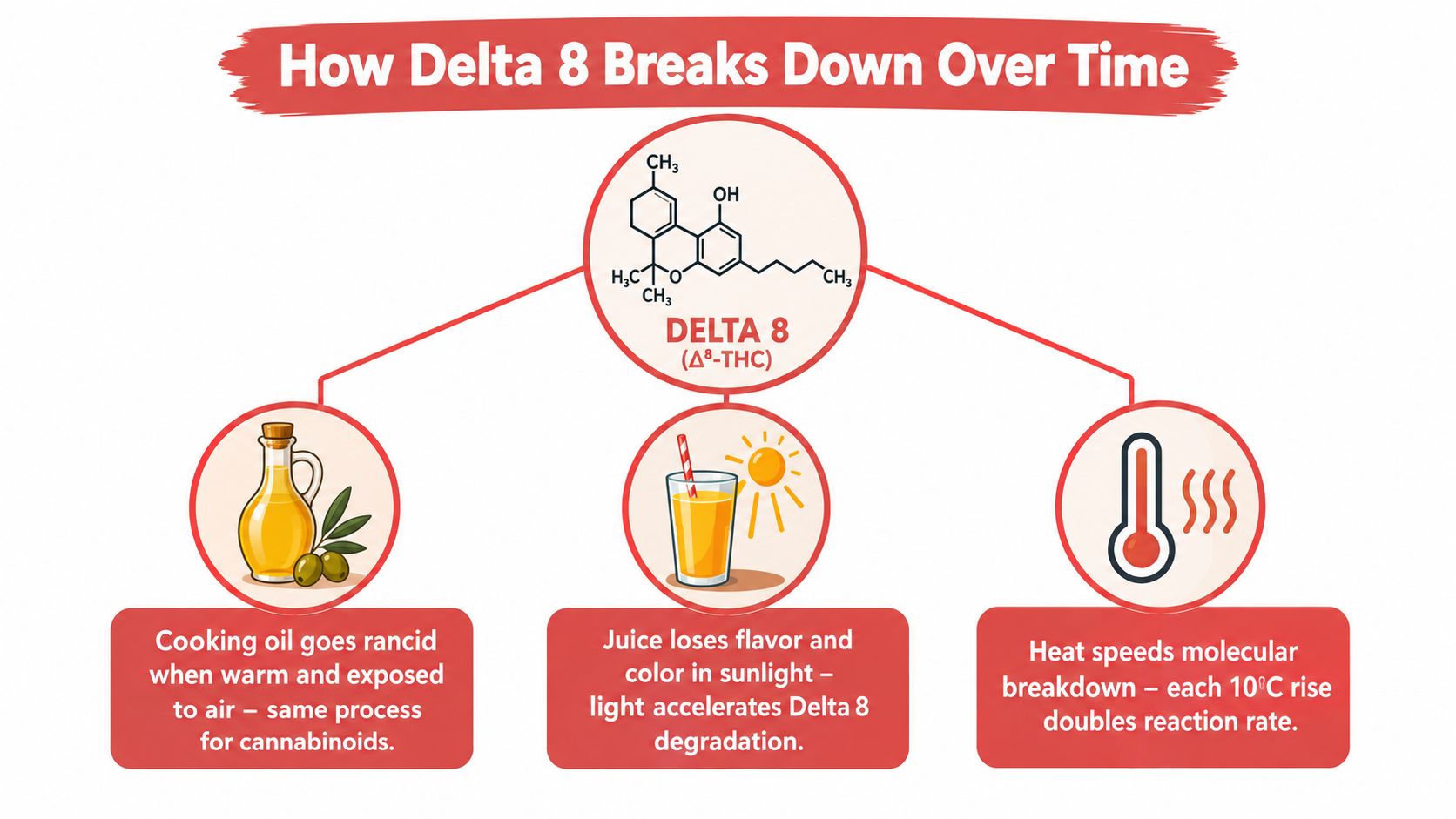
Cannabinoids rarely disappear all at once. They react, oxidize, and convert into other compounds over time. Earlier cannabis stability work, as noted earlier, found that THC and related cannabinoids tend to decline gradually at room temperature rather than dropping to zero overnight.
That distinction clears up a common point of confusion. An older delta-8 cart is not always just a "weaker" version of its younger self. It may also taste harsher, feel different, or lose some of the character it had when fresh, because the formula around the cannabinoid is changing too.
Product format shapes that process. A gummy has sugars, flavoring agents, and a chewy matrix. A tincture has carrier oil and a cap that may limit air exposure. A vape cart deals with thick oil, repeated warming, and small amounts of air entering over time. Same cannabinoid. Different aging environment.
Printed dates matter less than the conditions the product actually lived through.
Four forces usually do the work:
A simple comparison helps here. A sealed tincture in a dark cabinet ages more like a book sitting on a shelf. A half-used vape cart carried in a pocket, left in a car, and opened often ages more like fruit on a counter. Both are still the same item in name, but one experiences far more stress.
Later in this section, it helps to see the concept in motion:
The chemistry of delta-8 is only part of the shelf-life story. The rest comes from the formula and package wrapped around it.
Controlled lab work discussed in a delta-8 stability thesis found that Δ8-THC could remain stable across a range of pH conditions under tightly managed settings, while separate analytical testing in oral-fluid samples showed better stability under refrigeration than at room temperature (delta-8 stability thesis and analytical discussion). That contrast is useful because it shows why consumers get mixed messages about expiration.
Lab samples live quiet lives. Real products do not.
A bottle at home gets opened, recapped, warmed by your hand, jostled in a bag, and exposed to air every time you use it. That is why storage science has to be mapped to the format itself. Vapes face heat and oxidation stress. Edibles also deal with moisture and ingredient staling. Tinctures depend heavily on cap seal and carrier oil stability. Flower brings in plant material, terpene loss, and mold risk.
This is the chemical clock in plain language. Delta-8 breaks down gradually, but it does not break down the same way in every product.
Temperature is where delta-8 shelf life stops feeling abstract. The same product can act almost like two different products depending on whether it lived in a cool drawer or a hot car.
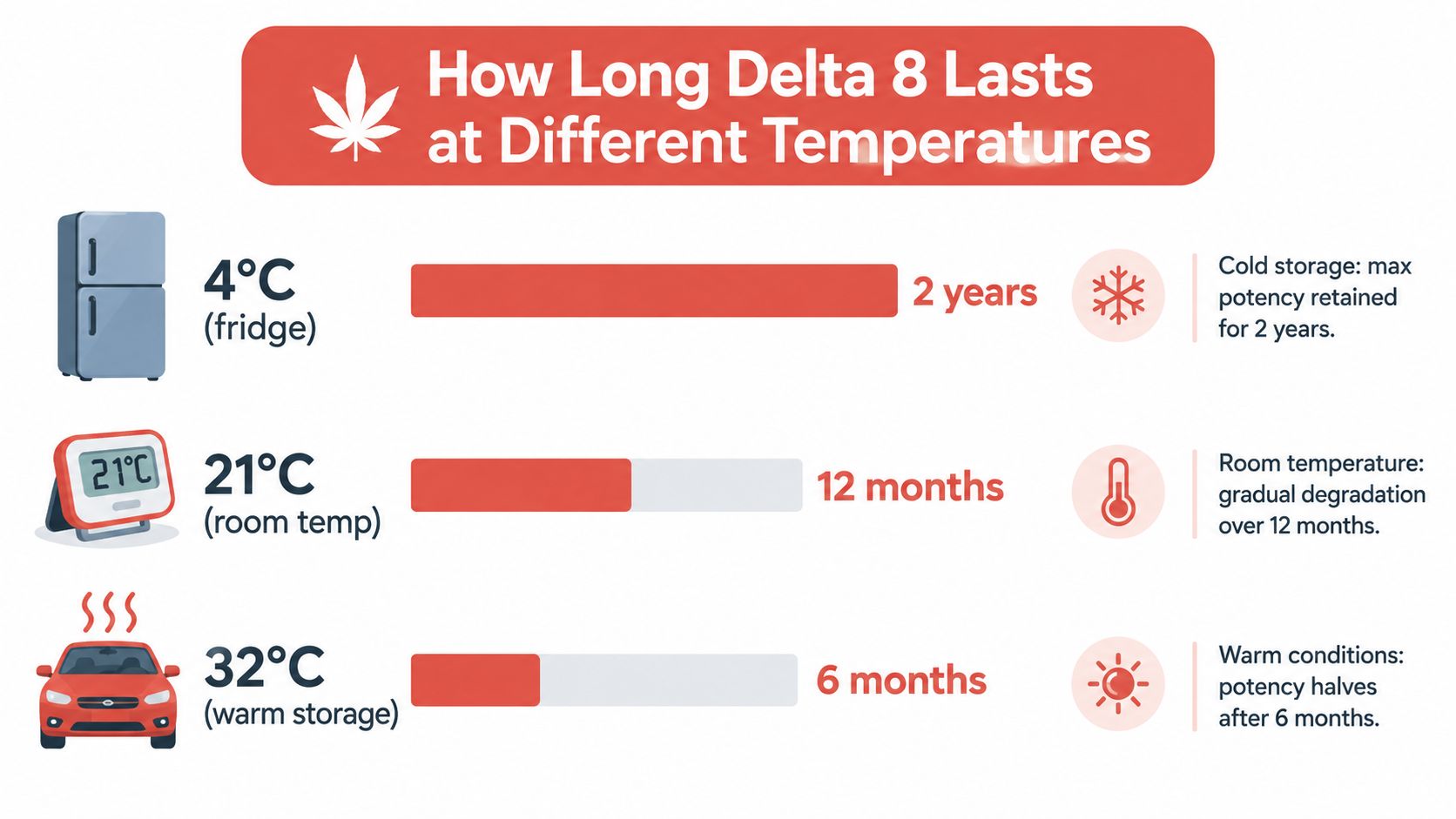
A peer-reviewed review reported that Δ8-THC stored at 4 °C showed only about a 30% instrument-response decrease over 7 days, with no notable further decline reported afterward. At 20 °C, the response fell by more than 70% over 7 days and became undetectable by day 14. At 45 °C, Δ8-THC was not detectable after a single day (temperature-dependent delta-8 stability summary).
Those numbers are dramatic, but they also match what many consumers notice in ordinary life. Keep a cart cool and protected, and it often stays pleasant much longer. Leave it in a glove box or on a sunny windowsill, and the decline can feel sudden.
A broader review of cannabis stability summarized two practical ideas that are worth remembering:
| Storage idea | What it means in plain language |
|---|---|
| Lower temperature extends shelf life | A long-term stability paper reported that shelf-life at 85% potency roughly doubles with each 5 °C reduction in storage temperature |
| Good storage buys real time | Carefully stored extracts can remain reasonably stable for 1 to 2 years in the dark at room temperature |
Both points come from a peer-reviewed review that also summarized long-term drift in cannabinoid composition over time (long-term cannabis extract stability review).
Practical rule: If you want delta-8 to last, treat heat as the main enemy and light as its sidekick.
Two people can buy the same delta-8 product on the same day and have very different results months later. One stores it in the original package inside a dark cabinet. The other keeps it in a backpack, car console, or bright room. Both will swear they had “the same product,” but they didn't have the same storage history.
That's why asking only “How old is it?” misses the point. The better question is, “What temperatures did it live through?”
A delta-8 cart, a gummy, and an infused flower jar don't age the same way. Format changes surface area, packaging, headspace, and how often oxygen gets introduced. That's why one old product may feel fine while another tastes stale or hits weak.
| Product Format | Typical Freshness Window | Key Sensitivity |
|---|---|---|
| Vapes and carts | Often many months when sealed and kept cool and dark | Heat exposure, repeated warming, extra air space after use |
| Gummies and edibles | Often many months when sealed and stored away from heat and light | Texture changes, candy base drying out, flavor fading |
| Tinctures and oils | Often among the more forgiving formats when tightly sealed | Oxygen exposure from repeated opening, light hitting the bottle |
| Flower and prerolls | Usually less forgiving than sealed oils or candies | Air exchange, light exposure, drying, terpene loss |
Vape oil has a lot working against it once you start using it. The device heats the oil, the chamber develops headspace, and people often carry carts in warm pockets, cars, or bags. Even if the cannabinoids are still present, the oil can darken and the taste can turn harsher.
If you want a deeper look at device aging, this guide on whether carts can expire is useful because carts have their own storage quirks beyond cannabinoid chemistry alone.
Gummies are often sturdier than people expect if they stay sealed. The weak point is usually not just delta-8. It's the whole edible system. Sugar absorbs moisture from the air, gelatin or pectin textures shift, flavors flatten, and repeated opening lets in oxygen and humidity.
A stale gummy may still have cannabinoids in it, but the eating experience tells you it's past its best moment.
Tinctures tend to do well because the oil is enclosed and the container is usually easy to seal. Amber bottles help by limiting light. The catch is user behavior. If the cap is left loose, the bottle sits in a bright bathroom, or the dropper gets contaminated, freshness falls faster.
For many adults, tincture is one of the simplest formats to store well because the routine is so controllable.
Flower has more exposed plant material, more aroma compounds to lose, and more room for texture changes. Delta-8 flower is also often infused or coated, which can create uneven aging if it isn't stored carefully. Prerolls add another issue. Once rolled, they have more surface exposure than bud kept whole in a sealed jar.
If your goal is longest-lasting freshness, flower usually asks for the most attention.
Good storage isn't complicated. You don't need a lab setup. You need a few habits that protect the product from the four things that age it fastest.
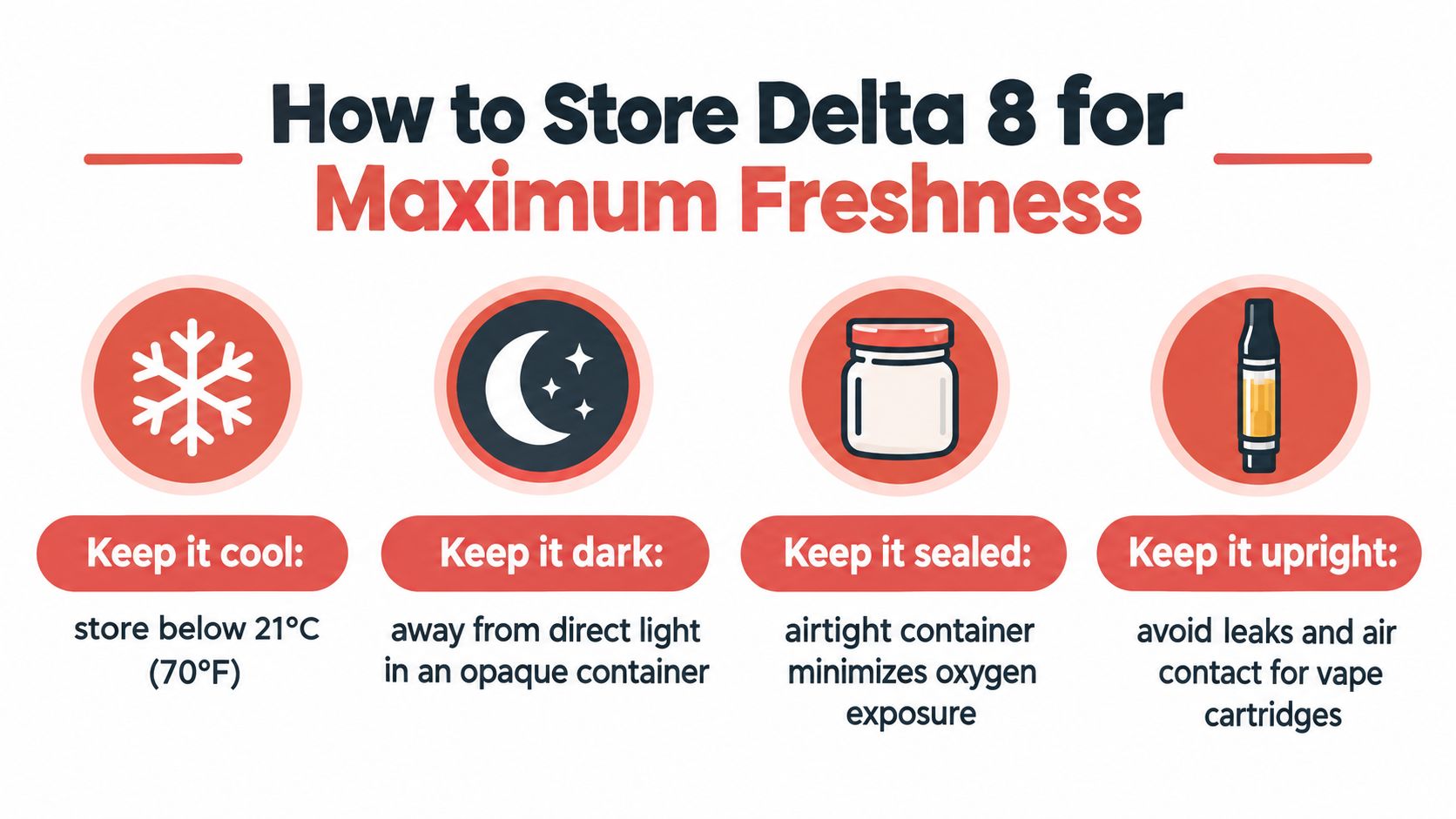
Use this as your quick screen:
A lot of delta-8 “expiration” starts with normal everyday habits.
For flower storage habits, a practical guide on using a mason jar for weed can help, especially if you're deciding between decorative storage and freshness-first storage.
The best storage spot is boring. Stable temperature, low light, minimal air exchange.
A few format-specific choices make a real difference:
People often ask about refrigeration. Cooler storage can help chemically, but moisture management matters. If you chill products, keep them sealed well and avoid repeated in-and-out temperature swings that create condensation.
You don't need lab equipment to catch the obvious signs. Your eyes, nose, and the way the product performs can tell you a lot.
Aging often shows up in small ways first.
None of these signs alone proves danger. Sometimes they just mean the product is no longer at peak quality. But if several show up together, especially after rough storage, that's your clue that freshness has moved on.
Think in two buckets.
Probably just aged: a darker cart, a less fragrant gummy, or a tincture that seems milder than before.
Time to toss: anything with visible contamination, leakage that suggests package failure, a seriously off odor, or signs that the non-cannabinoid ingredients have deteriorated. With flower, any hint of mold or mustiness is a stop sign. If you need a smell reference point, this guide to what moldy weed smells like helps separate stale from suspect.
If a product smells wrong, tastes wrong, and was stored badly, trust that combination more than the date on the package.
A third-party COA is useful, but mostly as a starting snapshot. It can tell you what the product tested like near production. It doesn't prove the product still matches that exact profile after months of storage in your drawer.
Still, a COA helps you ask better questions:
If a fresh product already looked poorly controlled on paper, age won't improve it.
You open a drawer, find an old delta-8 cart, and realize there are really two different questions hiding inside one simple one. Is the oil still fresh enough to use, and is this product still worth keeping as rules around delta-8 continue to shift?
That is the useful way to frame expiration. Delta-8 has two clocks. One is chemical freshness. The other is legal shelf life.
Start with the chemistry clock first. It works a lot like food quality rather than a light switch. A product usually does not jump from fresh to unusable in one day. It gradually loses aroma, flavor, texture, or potency. Then check the legal clock. In 2026, projected rule changes could affect how some delta-8 products are sold, shipped, or stocked, especially products made through chemical conversion.
Put those together and you get a more practical replacement test than a package date alone.
| Decision | What it usually means |
|---|---|
| Keep | Stored well, package still intact, and the product seems normal for its format |
| Use soon | Mild drop in freshness or potency, but no clear warning signs |
| Replace | Noticeable decline, poor storage history, damaged packaging, or legal uncertainty makes holding it less useful |
A quick scan often tells you more than the calendar.
Keep an eye on these clues:
This checklist matters because each format ages differently. A gummy can lose flavor while staying fairly stable. A cart can look mostly fine but taste harsh because heat and oxygen have been working on the oil. Flower is the most visually honest. If it looks or smells wrong, trust that signal.
There is also the stash question that did not matter as much a few years ago. How long do you even want to keep a delta-8 product in a category with changing rules?
As noted earlier, legal analysts expect federal hemp rule changes tied to synthetic cannabinoids to keep developing through 2026, with broader hemp-definition changes projected for December 11, 2026. That does not mean every delta-8 product becomes unavailable on one date. It does mean compliance, shipping, and product availability may change enough that buying very old backup stock can be less practical than buying smaller amounts more often.
So replacement is not only about whether a product can still work. It is also about whether it still makes sense to keep it.
If your stash checks both boxes, chemically fresh and still realistic to keep under changing rules, hold onto it. If it fails either clock, freshness or legal shelf life, replace it and start with a newer, better-stored product.
If you want products that make freshness easier to judge, Melt offers third-party tested hemp products with transparent lab reports, plus educational guides that help you store and compare formats more confidently. To explore current options and learn more about quality, compliance, and storage, visit Melt.
Your cart is currently empty.