


Free Shipping All Orders Over $95
A vape device can usually fly in carry-on baggage under the 100 Wh lithium-battery limit, but a cartridge is a separate legal question. If its delta-9 THC content exceeds the federal 0.3% dry-weight threshold, TSA may treat it as federally illegal cannabis and refer the matter to law enforcement.
The popular advice, “TSA doesn't look for weed,” is incomplete enough to get travelers into trouble. TSA's job is aviation security, not routine drug hunting, but that doesn't create immunity if an officer discovers a suspected illegal substance during a bag inspection.
The practical rule is simple: the device usually passes, the cartridge decides the risk. A compliant battery belongs in your carry-on. The oil inside the cart determines whether you're carrying a federally permitted hemp product or cannabis that can create a legal problem at screening.
“TSA doesn't look for weed” sounds reassuring because it leaves out the part that matters. Screening officers may not be searching every bag specifically for cannabis, but they inspect baggage for aviation-security reasons. If a bag is opened and an officer sees a cartridge, packaging, residue, or another item that appears to involve an illegal controlled substance, the encounter can move beyond ordinary screening.
TSA's guidance on electronic cigarettes and vaping devices says TSA officers don't search for marijuana, but discovered illegal substances may be referred to law enforcement. That distinction is the difference between “TSA wasn't looking for it” and “nothing can happen if TSA finds it.” The first may be true. The second isn't.
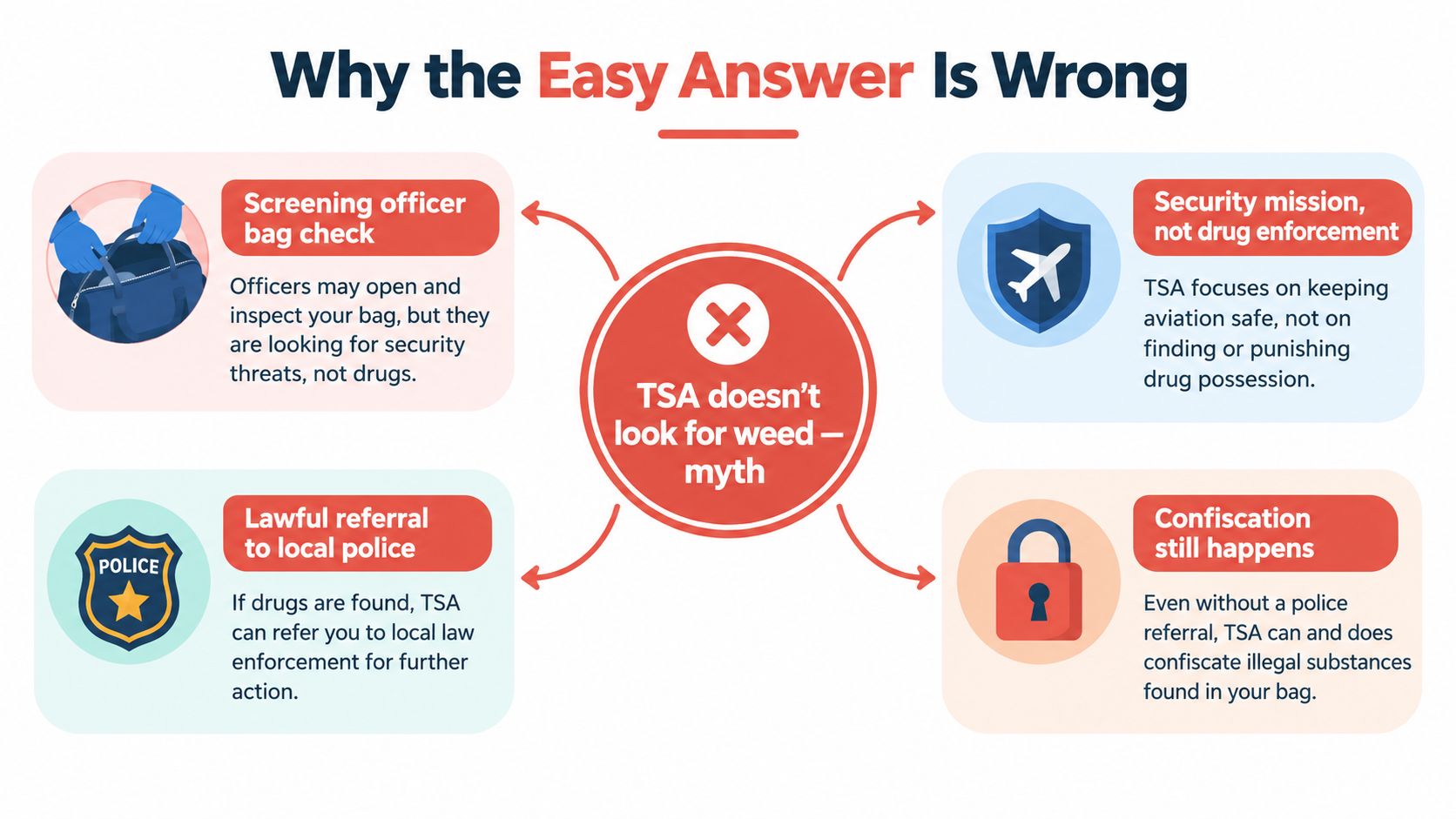
A screening officer's primary task is to identify security threats. That doesn't mean the officer can ignore an apparent violation discovered during that process. The officer may inspect the item, ask questions, involve a supervisor, or contact local law enforcement, depending on the circumstances and airport procedures.
That's why Reddit-style reassurance fails as travel advice. Travelers can face delays, missed flights, confiscation, or a law-enforcement interview even when the battery itself complies with carry-on rules. There's no reliable “TSA usually lets it through” strategy that turns an illegal cartridge into a legal one.
Practical rule: Don't confuse a low chance of inspection with permission to carry prohibited contents.
Ask two separate questions before you leave home:
A state-legal THC cart can therefore be compliant as a piece of hardware and still create federal exposure because of what's inside it. That's the central answer to can you fly with carts. You can usually fly with the device when it's packed correctly. You shouldn't assume the same answer applies to an active THC cartridge.
The federal dividing line is 0.3% delta-9 THC by dry weight. The 2018 Farm Bill removed hemp from the federal controlled-substances framework when it contains no more than that amount of delta-9 THC on a dry-weight basis. Products above the threshold fall outside the federal hemp definition, even if a state permits cannabis sales.
TSA's medical-marijuana guidance applies that federal framework during screening. TSA officers don't function as a laboratory at the checkpoint, so labels, packaging, visible product characteristics, and the surrounding circumstances can influence how an item is treated. A certificate of analysis can help explain a hemp product, but it isn't a guaranteed shield from inspection or referral.
The distinction is easier to understand in a comparison:
| Cart Type | Delta-9 THC | Federal Status | TSA Treatment |
|---|---|---|---|
| Hemp-derived cart meeting the federal definition | No more than 0.3% by dry weight | Federally classified as hemp | May be treated as a lawful hemp product, subject to inspection and applicable rules |
| Cannabis-derived or hemp-labeled cart above the threshold | More than 0.3% by dry weight | Federally illegal cannabis | May be referred to law enforcement if discovered |
| CBD-dominant cart with compliant hemp documentation | Must meet the same federal hemp threshold | Potentially lawful hemp | Packaging and documentation can help establish classification |
| Empty cartridge | No active oil | No cannabis content | Primarily an accessory or electronic-device question |
Marketing language doesn't replace the legal test. “Farm Bill compliant,” “legal THC,” or “hemp-derived” on a package isn't enough if the product's actual delta-9 content doesn't meet the federal definition. For additional context on the federal treatment of hemp-derived cannabinoids, see this guide to taking delta-9 on a plane.
A cart can be lawful under a state retail system and still create a federal problem during air travel. State legality answers what that state permits. It doesn't automatically authorize carrying cannabis through a federally regulated airport or across a route that involves another jurisdiction.
The battery rule is the straightforward part. Electronic smoking devices must go in your carry-on baggage or on your person, never in checked luggage. The FAA's PackSafe guidance for e-cigarettes and vaping devices also requires protection against accidental activation and limits lithium-ion batteries to 100 Wh, with airline approval required for batteries in the higher permitted range up to 160 Wh.
Most ordinary 510-thread batteries are below the 100 Wh limit, but that doesn't make loose batteries safe to toss into a pocket. Exposed contacts can touch keys, coins, or other metal objects and activate or short-circuit.
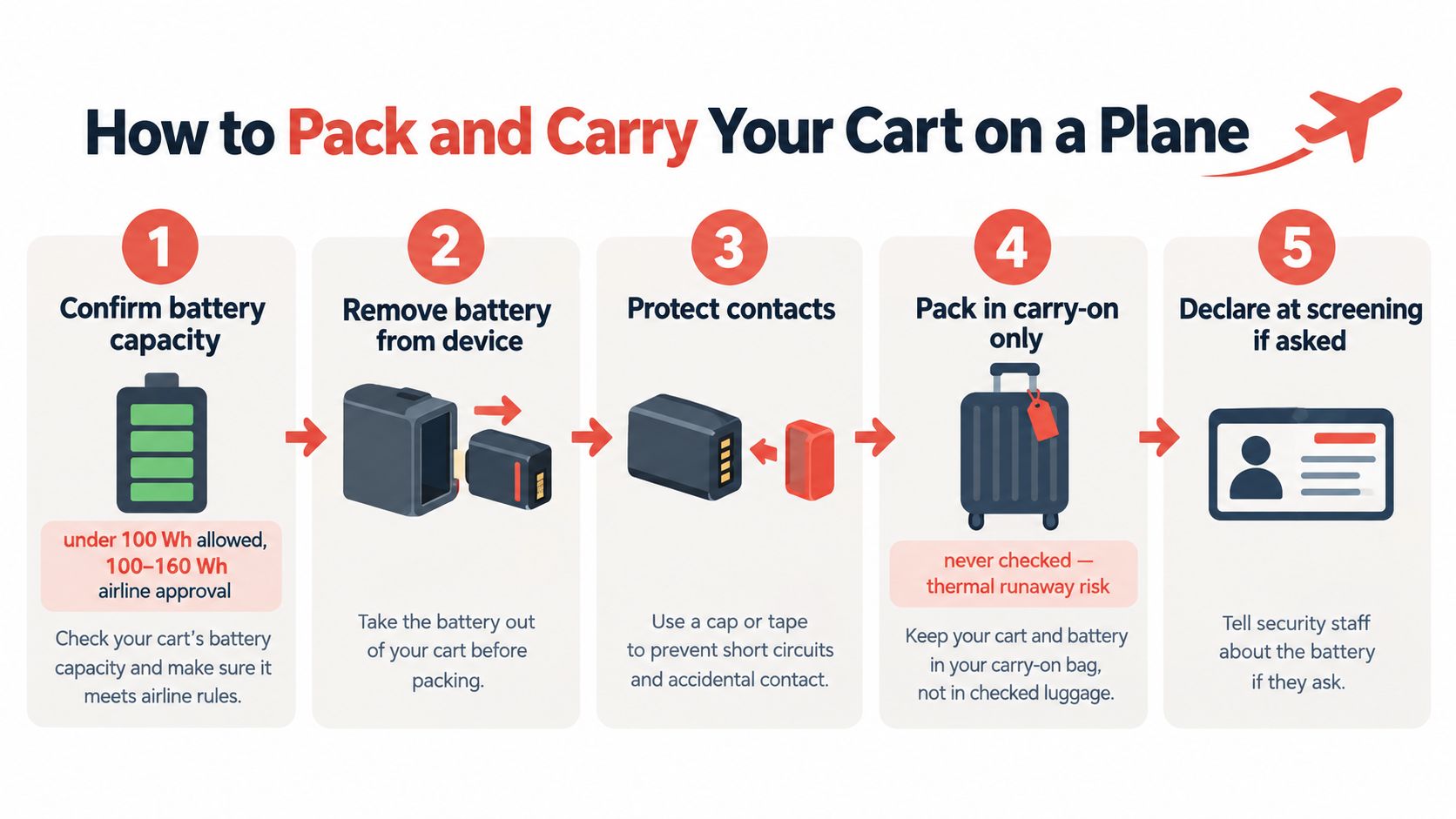
Use this routine for a compliant device:
Don't use or charge the device on the aircraft. Preserve the original label and packaging for any product you're carrying, and keep a certificate of analysis available when the product is hemp-derived. Those documents can clarify what you bought, but they can't guarantee how an individual officer will respond.
There isn't a dependable confiscation or release percentage for carts at TSA. Outcomes depend on what the officer sees, the product's documentation, local law-enforcement response, and the route. Treat any claim that a particular cart “always passes” as marketing, not compliance advice.
The useful comparison is risk level, not internet anecdotes:
| Cart Type | TSA Classification | Referral Risk | Practical Advice |
|---|---|---|---|
| Empty cart or residue-free device | Electronic accessory or vape hardware | Lowest of these options because there's no active cannabis oil | Carry it with the battery protected and keep the device in carry-on baggage |
| Sealed hemp-derived cart that can be documented as compliant | Potentially lawful hemp product | Lower than an above-threshold THC cart, but not zero if classification is unclear | Preserve packaging, keep the COA available, and verify both states' rules |
| State-legal THC cart above the federal hemp threshold | Federally illegal cannabis if discovered | Real risk of referral, even where state law permits possession | Don't rely on a medical card, a dispensary receipt, or a sealed package as protection |
| Loose oil or a leaking cartridge | Unclear liquid and possible cannabis product | Higher practical exposure because the contents are harder to identify cleanly | Leave it at home rather than trying to explain it at the checkpoint |
The safest low-risk choice is an empty device. The next most defensible domestic option is a sealed hemp-derived cart with clear documentation showing compliance with the federal threshold. A typical high-potency THC cart doesn't become hemp because the retailer used the word “legal.”
For a related look at cannabinoid classification, review whether THCA is illegal, but don't treat a product article as a substitute for checking the current rules where you're traveling.
A medical card changes your status under some state laws. It doesn't erase the federal framework that applies to airport screening or make an international border treat a THC cartridge as ordinary medication.
Consider a traveler flying from one cannabis-legal state to another with a state-issued medical card. TSA screening still operates under federal rules, and the card doesn't automatically authorize transporting cannabis. If an officer discovers the cart, local authorities may respond differently from one airport to another, but that variation is not legal protection. The traveler has accepted referral and delay risk before reaching the gate.
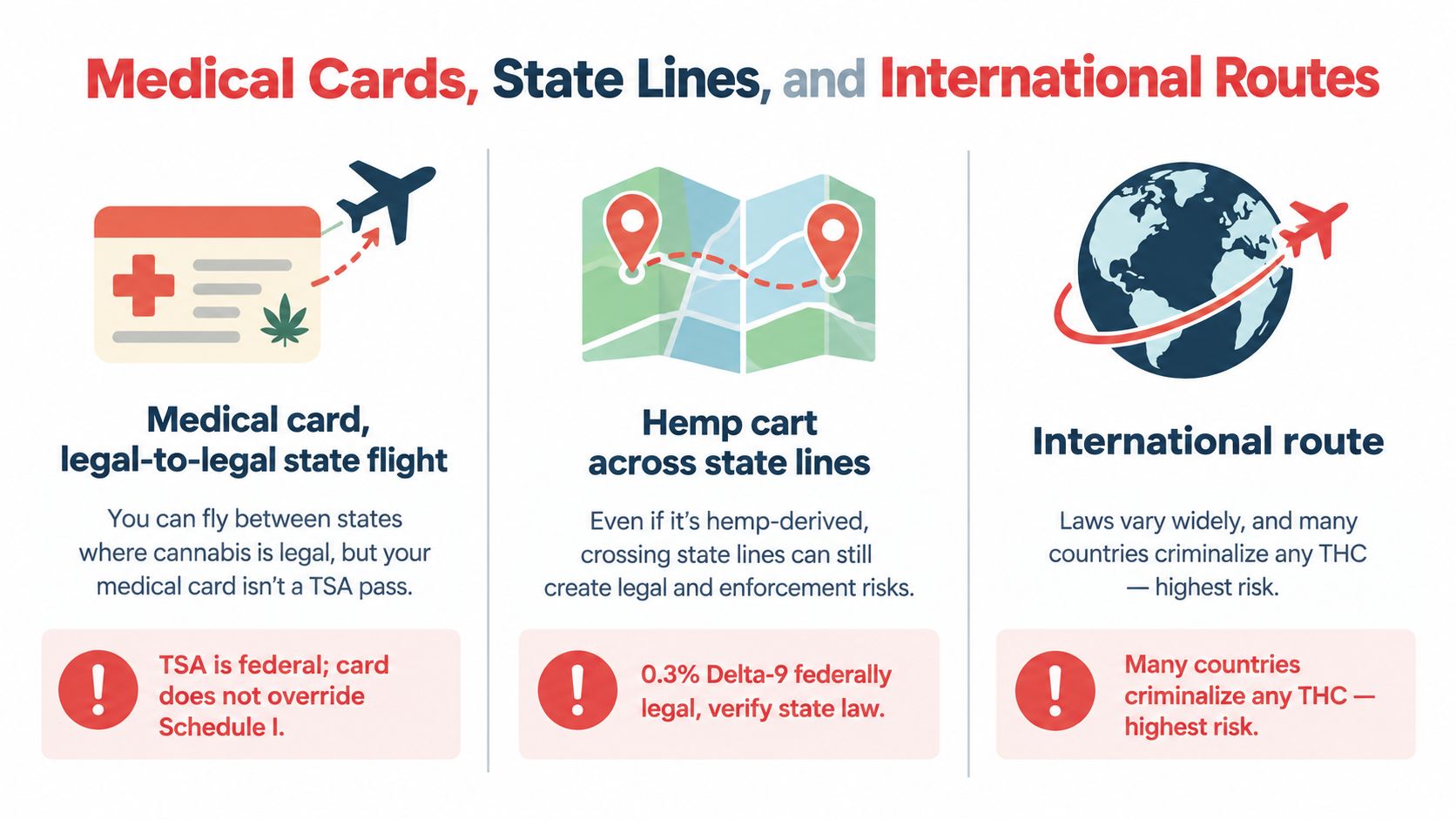
Domestic with a compliant hemp cart is the lowest-risk active-product scenario, provided the product meets the federal hemp definition and the destination permits it. Check the destination's law separately. Federal classification doesn't guarantee every state treats every cannabinoid product the same way.
Domestic with a THC cart above the threshold is a poor gamble. A departure state's dispensary system, a medical card, and a sealed package may explain lawful possession under state law, but they don't remove the possibility of federal referral during screening. Flying into a prohibition state adds another layer of exposure after arrival.
International travel is the highest-risk route. A home-state medical authorization doesn't control the destination country's customs law. The State Department's travel guidance on cannabis and international travel warns that U.S. state legality doesn't authorize taking cannabis products abroad, and foreign authorities may apply severe penalties.
A domestic medical card is documentation of state authorization, not a passport for cannabis.
For travelers who want to avoid meaningful legal exposure, two choices stand out: a properly documented domestic hemp cart after checking destination rules, or an empty device with no cannabis oil. Don't bring an active THC cart across an international border.
Run this check before leaving for the airport. If you can't verify the product's classification, the simplest compliant decision is to leave the cartridge behind.
For related screening questions, see whether TSA can detect edibles, but remember that detection and legal classification are separate issues.
If an officer stops you, provide identification and follow screening instructions. Don't obstruct the inspection or invent an explanation. You can allow TSA to contact law enforcement if the officer believes a referral is required, and you shouldn't volunteer speculative claims about THC content or quantity.
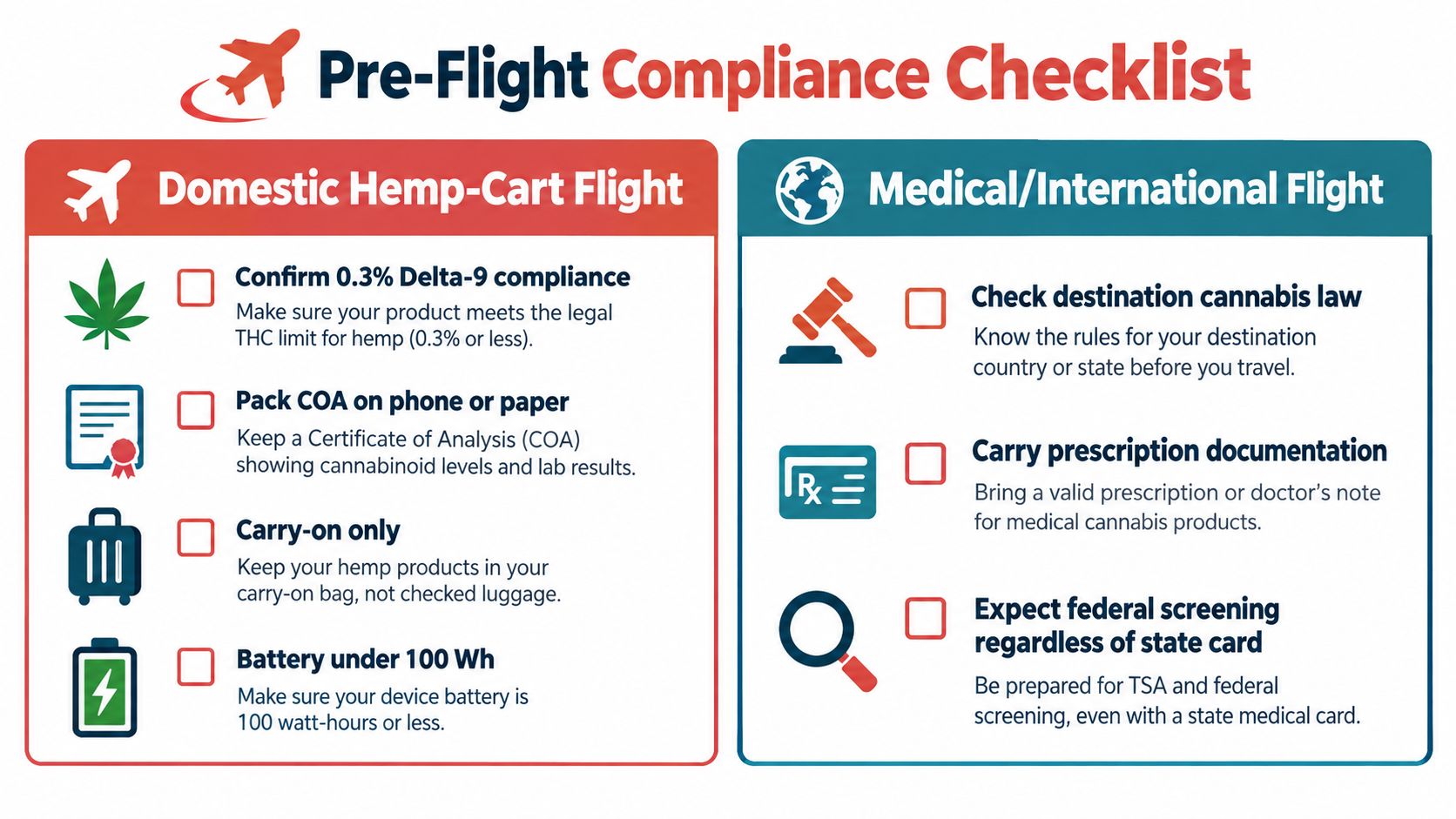
The answer to can you fly with carts depends on two different objects: the electronic device and the cartridge content. The device generally belongs in your carry-on, with the heating element protected from accidental activation. The cartridge must be evaluated under the federal hemp threshold, which is no more than 0.3% delta-9 THC by dry weight, rather than by a retailer's broad “legal” label.
That creates a practical risk ladder. An empty cart, a residue-free device, and a standard battery protected in carry-on baggage are the easiest options. A fully sealed, documented hemp-derived cart that meets the federal definition can be a lower-risk domestic option, although destination-state rules still matter. A THC cart above the federal threshold, loose oil, or any active cannabis cartridge on an international route carries substantially greater exposure to referral, confiscation, or customs enforcement.
Airport screening officers don't need to perform laboratory testing for you to face complications. They may rely on packaging, labels, visible contents, and the circumstances of the inspection, then refer suspected illegal substances to law enforcement. A medical card or state-legal purchase receipt may explain your situation, but neither should be treated as a federal shield.
Rule of thumb: Carry the battery, verify the oil, and leave an above-threshold THC cart at home.
Possession at your destination is a separate legal question from getting through airport screening. Recheck TSA, FAA, airline, departure-state, arrival-state, and destination-country rules before every trip because policies and enforcement practices can change.
Melt offers hemp-derived cannabinoid products with third-party testing and transparent lab reports, which can help adult consumers review product documentation before making travel decisions. Visit Melt to review the available products and compliance information before your next trip.
Your cart is currently empty.