


Free Shipping All Orders Over $95
You pick up your vape cartridge, expecting clear oil and an easy draw, but the glass looks frosted from the inside. The first thought is usually simple: why is my cart foggy, and does that mean the oil has gone bad?
Usually, a hazy appearance points to temperature change, condensation, or a shift in the oil's physical state, not contamination by itself. High-purity and terpene-rich formulas can also become cloudy when their ingredients respond to cold storage or repeated warming and cooling. The useful distinction is between a temporary visual change that resolves with careful handling and a cartridge showing other signs of a genuine problem.
You leave a cartridge in a cool car, bring it indoors, and notice that the oil no longer looks transparent. A pale veil appears across the glass, while the mouthpiece may feel slightly damp or the airflow may seem tighter than usual. Nothing else about the cartridge has changed, so the appearance can feel alarming.
That reaction makes sense. A clear cart suggests freshness and cleanliness, while fogginess can look like suspended particles, spoiled oil, or moisture trapped in the hardware. Yet foggy or cloudy vape-cart appearances are commonly linked to condensation and temperature changes rather than contamination alone, according to practical guidance from vape hardware troubleshooting resources.
A cartridge is a small system containing oil, a heating element, an airway, and a mouthpiece. When the device moves between warm and cold environments, the oil's viscosity changes and moisture can condense on the glass or inside the airway. Those tiny droplets can scatter light, making the cartridge look hazy or frosted.
The oil itself can contribute to the effect. Cannabis extract thickens in colder conditions and becomes more fluid as it warms. Changes in thickness alter the way light travels through the liquid, so an oil that looks clear at room temperature may appear dull or milky after exposure to cold.
Practical rule: A cloudy appearance alone doesn't tell you that a cartridge is unsafe. Check how it responds to stable room-temperature conditions and look for other warning signs.
A consumer might reasonably compare two carts stored in different places. One stays upright in a temperate room and remains clear. The other rides through temperature swings in a pocket, vehicle, or bag and develops a haze. That contrast doesn't prove the oil quality differs. It may just show how the hardware and formulation reacted to their surroundings.
The first step, then, is to avoid judging the product from appearance alone. Observe whether the haze changes gradually, whether the oil still moves normally, and whether the cartridge has an unusual smell, discoloration, leakage, or persistent performance problem.
Cold changes cannabis oil in two related ways. It makes the extract more viscous, so the liquid moves slowly, and it can encourage some cannabinoids or terpenes to separate from the surrounding mixture. At the same time, moisture from warmer air can condense on a cooler cartridge, much like a cold drink developing droplets on its outside.
The result is a visual effect rather than a single chemical event. Light passes cleanly through a uniform liquid, but droplets, crystals, or unevenly distributed material scatter that light. The cart can therefore look cloudy even when the oil hasn't been contaminated.
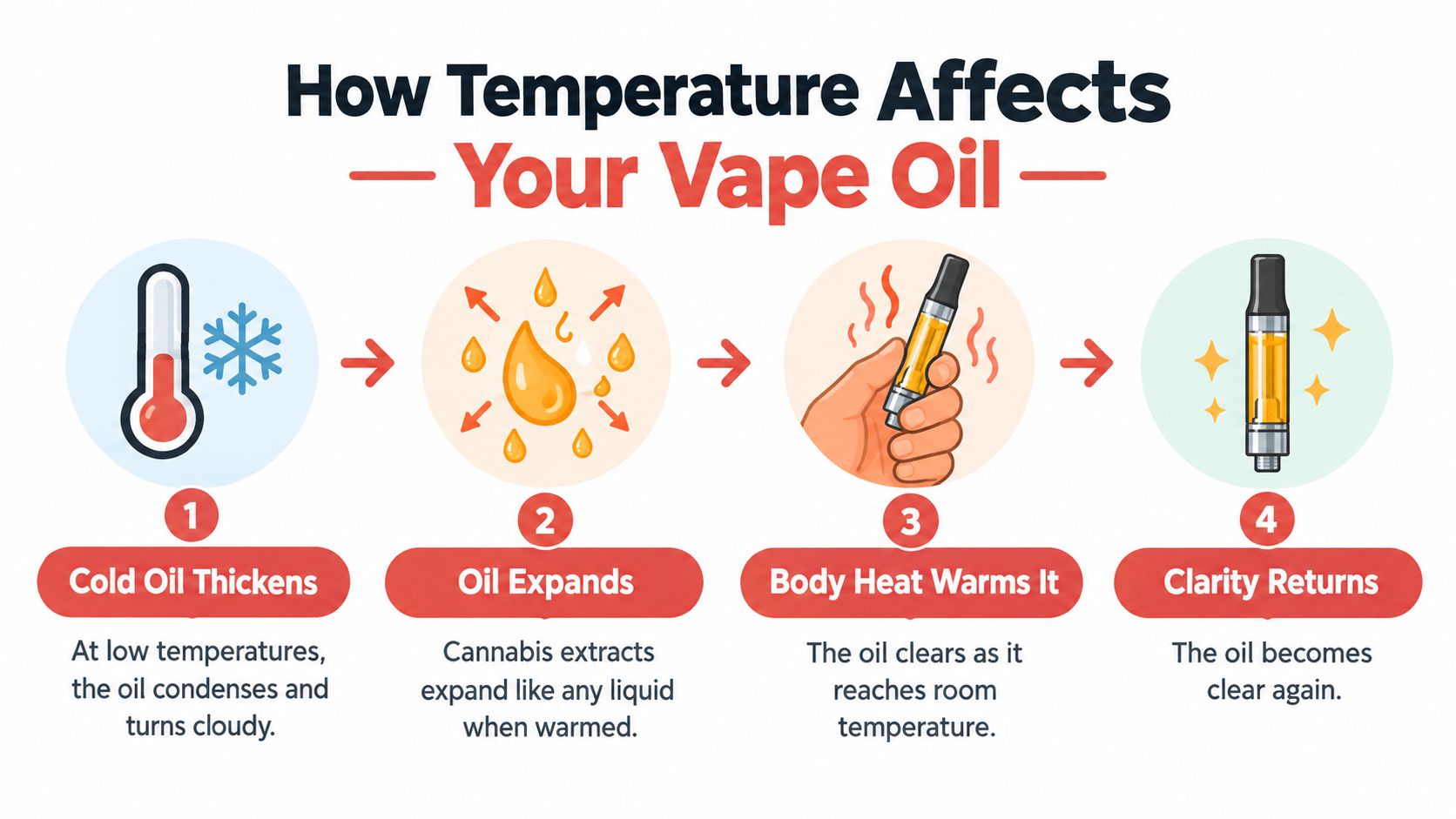
Cartridge formulations have become more varied as hemp and cannabis products expanded. Thicker materials such as live resin, rosin, and other high-viscosity oils behave differently from lighter distillates. Technical guidance from cartridge and vape-device makers identifies higher viscosity, non-uniform particulate distribution, and possible recrystallization as reasons these formulations can clog more often.
Think of the cartridge like a narrow drinking straw filled with honey rather than water. If the honey cools, it moves slowly and clings to the sides. If it warms, it flows more freely, but some of it may already have collected near the mouthpiece or airway. Repeated draws can then move residue into places where it restricts airflow.
Storage orientation matters too. A cart left on its side can allow thicker oil to sit against the mouthpiece, where condensation and residue may accumulate. That doesn't mean every sideways cart will clog, but it creates a less forgiving setup for dense extracts.
For a more precise approach to heat management, compare the device instructions with Melt's guide to the best temperature for vaping. The goal isn't to force the oil hot. It's to keep the cartridge within a stable range that supports smooth flow without overheating the extract.
A gentle return to room temperature often tells you more than a quick visual inspection. If the oil becomes more uniform and the draw improves, temperature and viscosity were likely involved.
A high-purity cartridge can be less visually stable than a heavily blended one. That sounds counterintuitive, because shoppers often associate perfect clarity with quality, but clarity depends on formulation as well as cleanliness. An oil with fewer materials added to keep it permanently fluid may respond more visibly to cold conditions.
Cloudiness in a cannabis cart is often a phase-change issue, not necessarily contamination. When the temperature drops, cannabinoids and terpenes can partially fall out of solution and scatter light. In a THCA-rich formulation, that may produce a milky appearance or visible crystallization, particularly after cold storage or repeated temperature swings, as described in this explanation of why cannabis carts can look foggy.
A solution stays clear when its components remain evenly distributed. Cooling can reduce that stability. Some material may begin forming small crystals, while other components become thicker and less able to keep the mixture uniform. The crystals don't automatically indicate foreign debris. They can reflect the behavior of the cannabinoids already present.
Terpenes add another layer. These aromatic compounds affect flavor, scent, viscosity, and the way an extract behaves under changing conditions. A terpene-rich oil may look different from a simplified blend because its components interact rather than behaving as one perfectly uniform liquid.
This creates a real product-design tradeoff:
| Appearance | Possible interpretation |
|---|---|
| Clear at room temperature | The formulation is currently uniform and fluid |
| Cloudy after cooling | Cannabinoids, terpenes, or moisture may be reacting to the temperature shift |
| Visible crystals that soften with gentle warming | Possible recrystallization in a high-purity formula |
| Persistent opacity with other defects | A reason to stop and seek product guidance |
Some shoppers assume that a clear cart must contain more thinning material, while a cloudy cart must be impure. Neither conclusion follows from appearance alone. A product can be clean and still crystallize, and a clear product can owe that look to its particular formulation.
This is why understanding how terpenes work helps when you evaluate a cart. Treat clarity as one observation, not a complete quality test. The more useful questions are whether the cartridge returns toward normal at room temperature, whether the oil smells as expected, and whether the hardware functions properly.
Start with the least aggressive solution. Remove the cartridge from a cold location, keep it upright, and allow it to reach a comfortable room temperature gradually. Holding it in your hand or placing it in an inner pocket can provide mild body heat without exposing the oil to a sudden temperature spike.
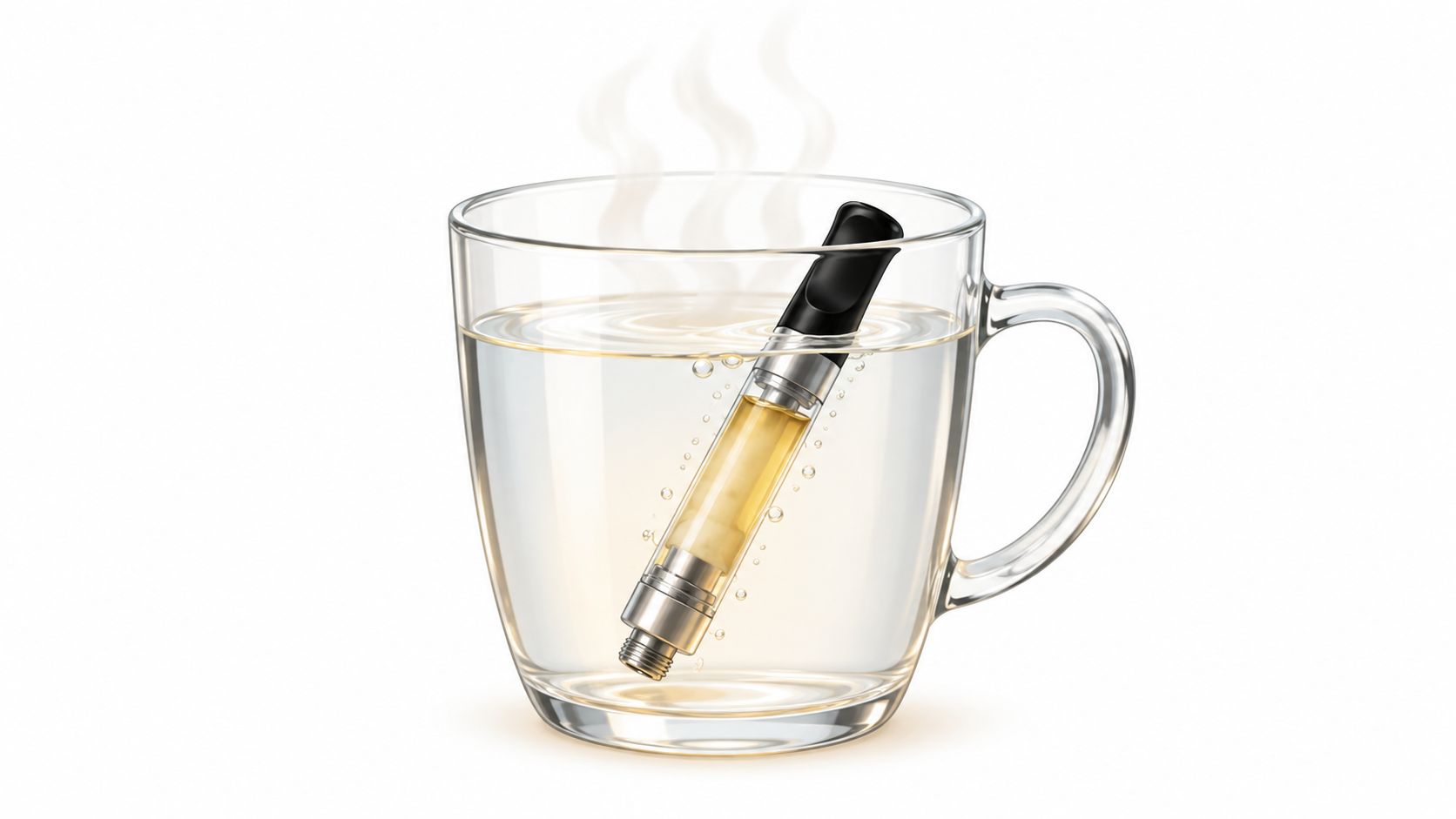
Don't shake the cartridge aggressively or poke the mouthpiece with a sharp object. Those actions can push oil into the airway, damage the hardware, or turn a temporary restriction into a leak.
If gentle warming doesn't improve the appearance or function, stop troubleshooting rather than escalating the heat. A cartridge isn't a kitchen container, and forcing it warm can create a separate hardware or oil-quality problem.
Stable storage prevents many fogging episodes before they begin. Keep cartridges away from direct sunlight, freezing conditions, hot vehicles, and places where the temperature changes rapidly. A consistent indoor location is generally more predictable than a windowsill, glove compartment, or exterior pocket.
Store the cartridge upright whenever possible. Sideways storage allows oil to remain against the mouthpiece, increasing the chance that residue or condensation will collect in the airflow path. This matters more with dense extracts, which don't move away from narrow openings as easily as thinner oils.
For travel, use a protective case or a secure compartment inside your bag. The case won't control the temperature completely, but it can reduce abrupt environmental changes and protect the glass from impact. Avoid leaving a loaded device in a parked car, where the internal temperature can shift sharply.
A simple routine helps:
Good storage won't guarantee perfect clarity. It reduces the environmental stress that makes cloudiness and airway buildup more likely.
Cloudiness deserves closer attention when it appears alongside other changes. A cart that remains opaque after gentle warming, develops an unusual odor, shows unexpected discoloration, leaks, or repeatedly clogs may have a formulation, packaging, or hardware problem rather than a simple temperature response.
High-purity CBD and THCA-style formulas can naturally form crystals or recrystallize after temperature swings, so visible cloudiness doesn't automatically mean “bad oil.” This distinction is supported by ingredient guidance on cannabinoid crystallization. The key is to assess the whole cartridge, not just the color or transparency.
If the haze changes as the cart returns to room temperature, the oil smells normal, and the device draws as expected, careful use and better storage may be reasonable. If the cartridge stays severely cloudy and performs poorly, don't keep heating or forcing draws.
Set it aside and contact the retailer or manufacturer. Ask for product-specific guidance and review available third-party lab documentation, especially if the cartridge was purchased through an unverified channel. When the appearance and performance both remain abnormal, replacing the product is safer than trying increasingly aggressive home fixes.
Melt offers legal hemp-derived cannabinoid products, including THCA options and all-in-one devices, with product information and third-party lab-report access for shoppers who want clearer details about formulation and testing. Visit Melt to review the available products, storage guidance, and purchasing options before your next session.
Your cart is currently empty.