


Free Shipping All Orders Over $95
If you can divide the milligrams on an edible package by the number of gummies inside, do you know your dose? You've solved the arithmetic, but you haven't necessarily confirmed what the label measures, how evenly the cannabinoids are distributed, or when you'll feel the full effects.
The useful answer to how many mg in edibles isn't a single number. It's a method for understanding the package, checking the serving, and giving your body enough time before making another decision.
You open a package of gummies, take a piece, and put the bag away. Only afterward do you wonder whether the large number on the front describes that gummy, the whole package, or a blend of different cannabinoids.
Then comes the uncomfortable uncertainty. If you don't notice anything, was the piece weak, or are you judging too early? If it feels stronger than expected, did you misunderstand the serving size?
This is a hypothetical situation, not a customer story. It illustrates how someone can follow an apparently simple instruction, eat a gummy, and still have no clear idea what they consumed.
Think of package, piece, and serving as separate terms. The package is everything you bought, a piece is a physical unit, and a serving is the amount the manufacturer identifies for consumption.
Those terms might line up neatly, but you shouldn't assume they do. A large gummy or a continuous sour belt needs clearer portion instructions than its appearance alone can provide.
The confusion gets worse when people compare products by the biggest number on the front. Without checking what that number refers to, they're comparing incomplete information rather than comparable servings.
Practical rule: Before eating an edible, be able to explain what the label's milligram number measures and how much of the product you intend to take.
A useful approach is to ask different questions instead of treating them as interchangeable:
You don't need to become a chemist. You need enough information to recognize when a product is straightforward and when the seller hasn't given you a usable answer.
Start on the back or side of the package, not with the largest text on the front. Look for total THC, servings per package, and THC per serving. Then check whether the manufacturer defines a serving as a whole piece or a smaller portion.
Use the illustration as a reminder of where to look, rather than as a substitute for the actual product instructions.
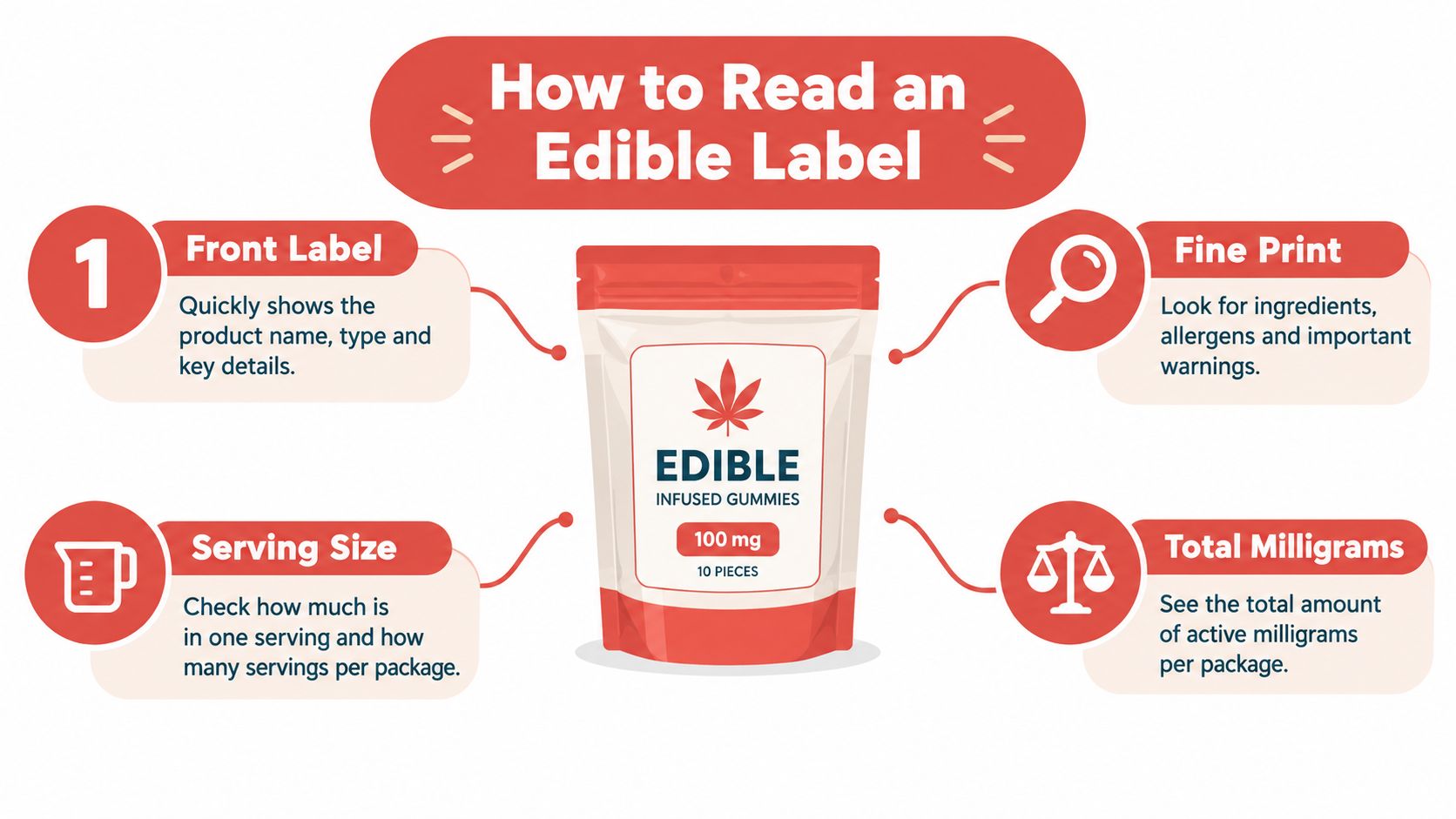
A label that says total cannabinoids hasn't necessarily told you the amount of THC. If the product contains a blend, look for the amount of each named cannabinoid rather than assigning the entire total to THC.
Likewise, don't interpret CBD milligrams as THC milligrams. Keep each ingredient's amount separate when comparing products, and don't assume matching totals across different formulations mean matching experiences.
This distinction matters particularly when shopping for hemp-derived gummies. If the front describes a blend but the detailed label doesn't explain its components, ask the manufacturer for clarification before choosing a portion.
| Label detail | What to establish |
|---|---|
| Total package content | Which cannabinoid the total describes |
| Serving size | How much physical product constitutes a serving |
| Amount per serving | The labeled amount of each relevant cannabinoid |
| Product category | Whether you're looking at an edible or another cannabis product |
Under Health Canada's cannabis composition requirements, the federal framework introduced in 2019 limits edible cannabis to 10 mg total THC per immediate container, which could mean two units containing 5 mg each or five units containing 2 mg each; cannabis extracts have a different package ceiling of 1,000 mg, while remaining limited to 10 mg per unit or dispensed amount.
The important distinction is product category and package scope. An extract package and an edible package aren't interchangeable just because both display milligrams.
A legal ceiling also isn't a recommendation to consume everything permitted in the container. Read a regulatory maximum as a product rule, not a personalized dosing instruction.
If the front and back of a package appear inconsistent, don't choose whichever interpretation seems more appealing. Set it aside until the seller can explain the discrepancy clearly.
Once you've identified the relevant cannabinoid total, the calculation is straightforward:
Labeled milligrams per piece = labeled package milligrams ÷ number of pieces
The word labeled matters. This calculation estimates the amount represented by the packaging; it doesn't independently measure what's in your gummy.
The visual below uses CBD packaging to demonstrate the arithmetic. Apply the calculation separately to the cannabinoid you are checking.
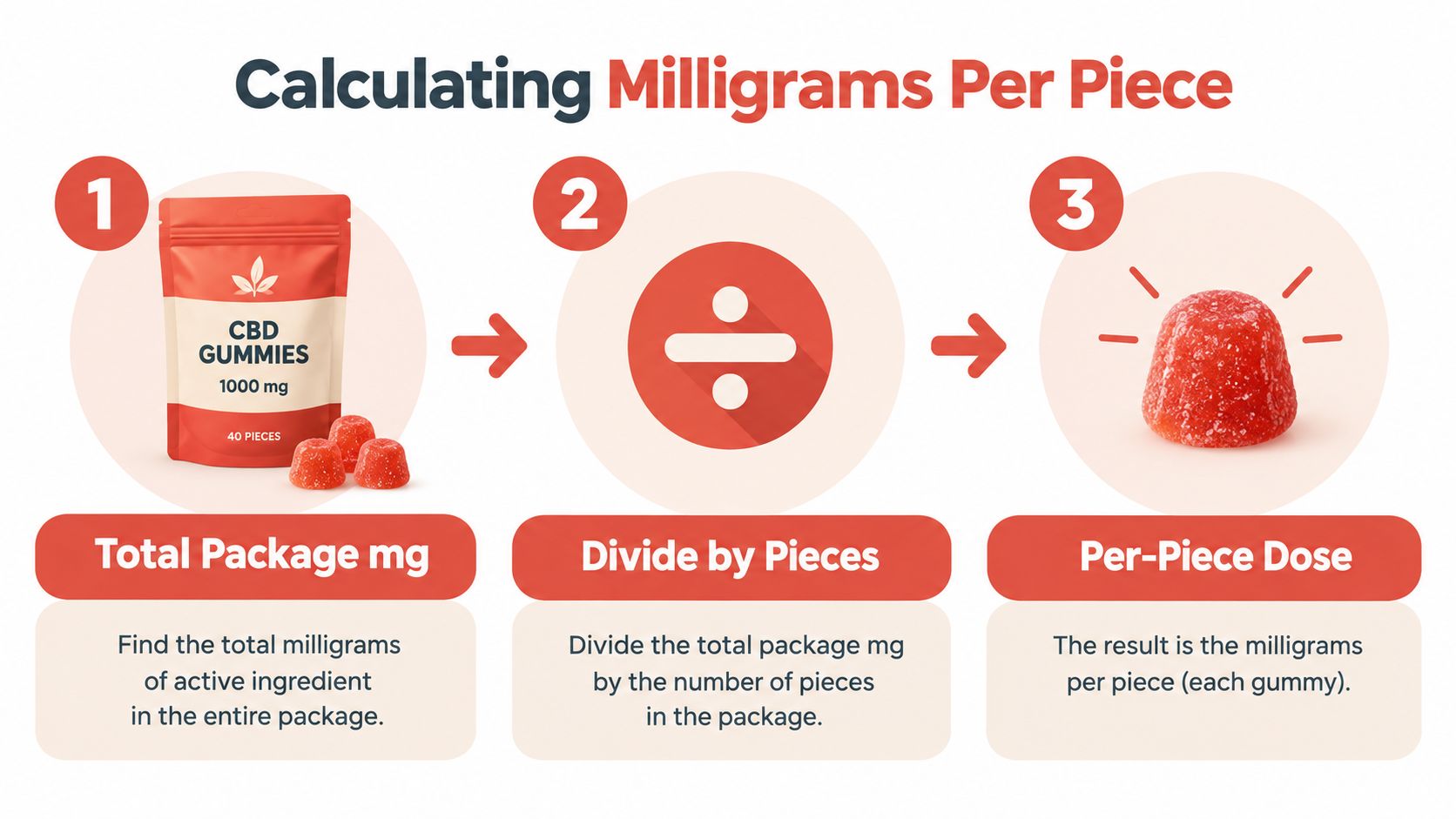
Using the package-and-portion examples in this cannabis safety reference, a 1,000 mg package divided into 20 equal pieces gives 50 mg per piece, while 1,000 mg divided into 100 equal pieces gives 10 mg per piece, assuming the label is accurate and the contents are evenly distributed.
The package total hasn't changed. The physical portion has, which is why the front-label number alone can't tell you what you're about to consume.
Before dividing, check that the package contains identical pieces with the same formulation. If it includes different strengths or different products, a package-wide average won't identify the amount in a particular piece.
Count intact, identical pieces only when that count meaningfully matches the manufacturer's serving information. For a continuous belt, irregular confection, or broken product, look for a serving weight or clearly marked portion instead.
If the manufacturer provides neither a reliable count nor usable portion instructions, don't improvise a precise dose from appearance. A kitchen scale can measure product weight, but it can't establish cannabinoid content without dependable concentration information.
A visual explanation may help you follow the division process:
For splitting, use the manufacturer's portion markings when available and a clean cutting surface. Keep leftover portions in their original labeled packaging so the information stays with the product.
Cutting an edible into equal-looking portions is a portioning technique, not a laboratory test.
If you'd need to cut a highly concentrated piece into tiny fragments to reach your intended amount, a lower-strength, clearly portioned product is a more practical choice. Don't confuse careful cutting with proof of uniform cannabinoid distribution.
Your ideal amount isn't something you can calculate from the package alone. Treat tolerance as personal context, not permission to follow someone else's serving.
A useful framework focuses on what you know about your response. Being familiar with cannabis is different from having a documented, comfortable experience with the particular edible formulation you're considering.
A progress illustration can suggest a simple ladder, but edible use doesn't need to follow one.
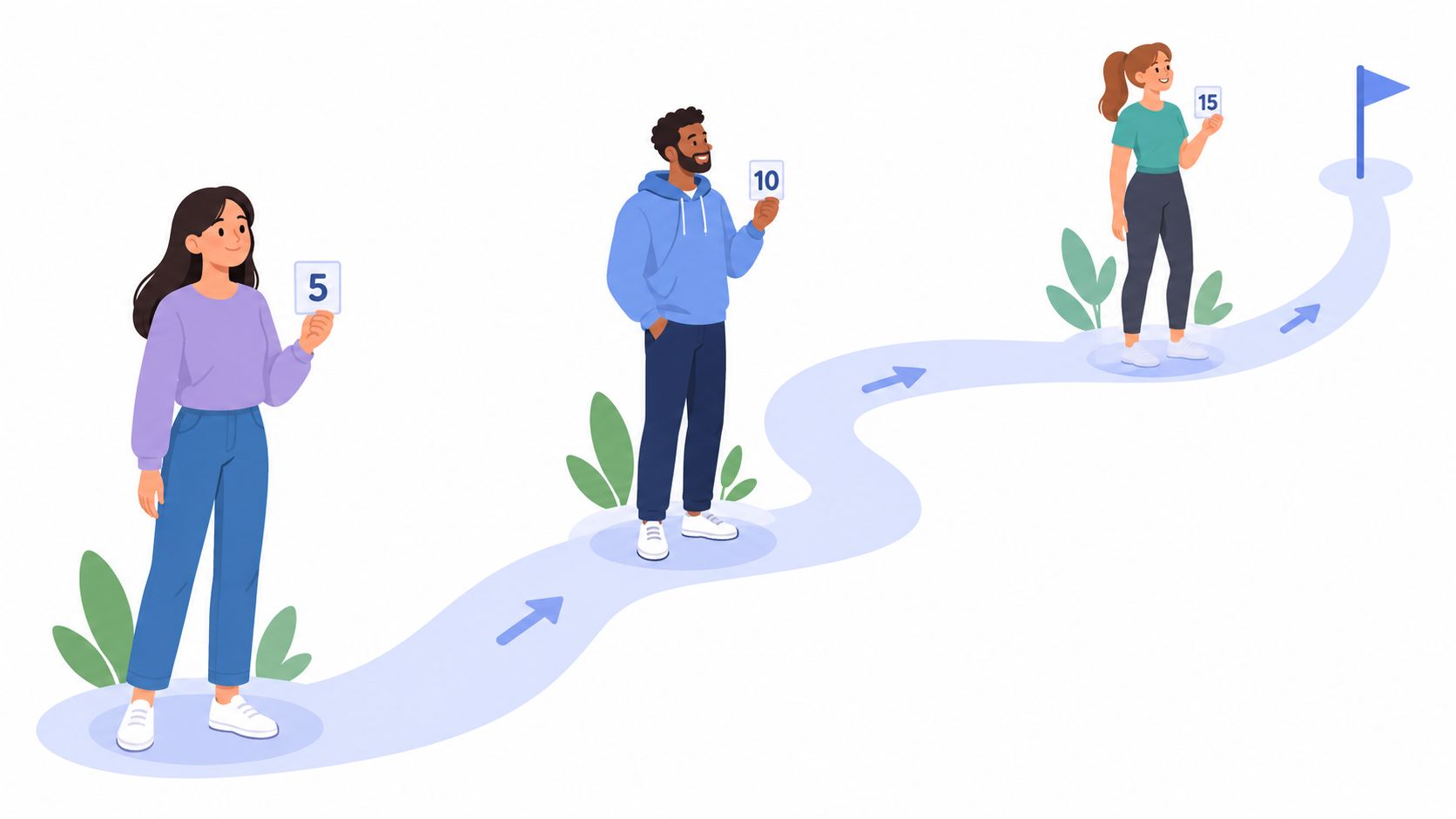
The numbers in the illustration aren't a dosing schedule or a recommendation to increase. There's no achievement attached to consuming more, and finding a comfortable lower amount doesn't mean you should advance.
Write down the exact product, the portion you consumed, when you took it, and how the experience developed. Include surrounding circumstances such as food, alcohol, medications, and whether you felt comfortable with the effects.
Keep the notes descriptive. “More intense than I wanted” is more useful than “strong,” because it helps you make a decision rather than assign a label.
For a discussion of smaller-portion approaches, the guide to microdosing THC gummies offers additional reading. Don't interpret the term microdosing as a promise that you won't be impaired.
Avoid turning body weight into a shortcut or borrowing a dose chart as though it were a prescription. If medications, a health condition, or a previous difficult reaction complicate the decision, speak with a qualified healthcare professional instead of guessing.
The goal is a repeatable, comfortable decision process. If your experience is unpredictable, choosing not to increase is a sensible outcome.
Not feeling an edible yet doesn't establish that the amount was too small. It means you don't yet have enough information to judge the full response.
The review of oral cannabis effects and edible-related risks describes effects that may begin 30 minutes to 2 hours after ingestion, reach full effect as late as 4 hours, and last 6 hours or more, with delayed onset reported up to 4 hours and effects lasting more than 8 hours.
Those are ranges, not appointments. Food, absorption, tolerance, alcohol or medications, and cannabinoid composition can affect the experience, so identical labeled amounts shouldn't be treated as guarantees of identical effects.
The timeline below is a simplified visual, not a countdown for taking another portion.
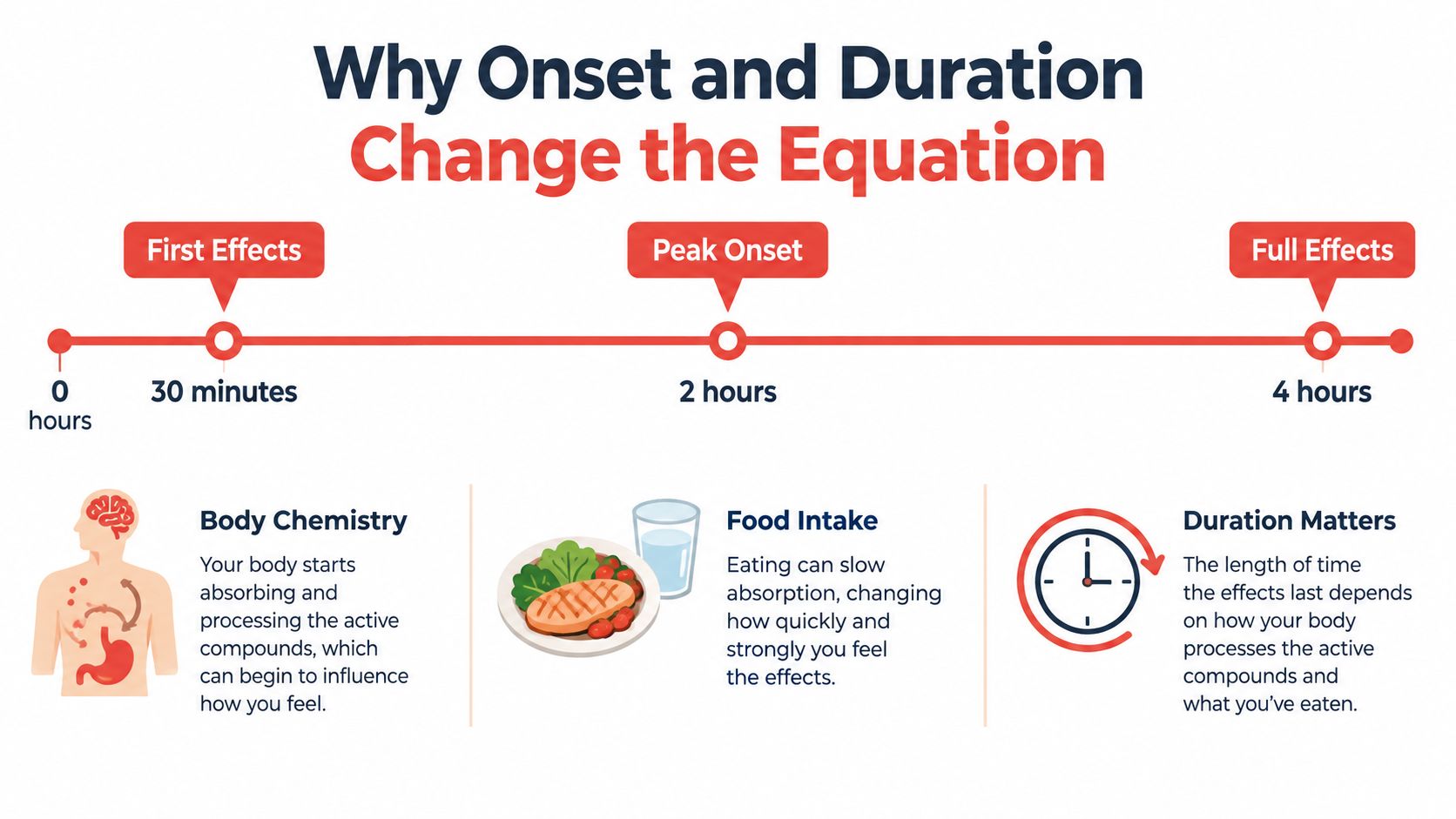
The risky moment is often the gap between swallowing an edible and recognizing its effects. Taking more during that uncertainty means adding to an amount whose full impact you haven't evaluated.
Use a time-based plan rather than checking repeatedly for a reason to redose:
Waiting is part of evaluating an edible, not evidence that you chose the wrong amount.
Keep your schedule open enough that you won't need to rush the effects away or make safety-sensitive decisions. Don't use a timer as proof that you're ready to drive.
If you want more detail on delayed effects, consult the explanation of how long edibles take. The useful question isn't just how much you took, but whether you've allowed enough time to understand what that amount did.
Correct division can't repair an unreliable starting number. Dosing accuracy requires confidence in the label, not just confidence in your calculator.
Don't treat a particularly large potency claim as proof of value. Treat it as a reason to ask more careful questions about the product, the formulation, and the evidence behind the claim.
Ask for a certificate of analysis, or COA, that corresponds to the product you're holding. Compare the package's lot or batch identifier with the report, then check the product description and cannabinoid results.
The guide to reading a certificate of analysis can help you work through the terminology. If the documents don't reconcile with the packaging, don't fill in the gaps yourself.
For regulatory background, consult the FDA's cannabis and cannabis-derived product information. Don't assume a hemp label establishes legality everywhere, confirms label accuracy, or makes a product appropriate for you.
Store edibles securely away from children and pets, retain the original packaging, and avoid driving after consumption. If someone develops severe symptoms or you suspect poisoning, contact emergency services or a poison control service rather than waiting for reassurance online.
Melt offers hemp-derived edibles alongside educational guides on serving calculations and lab reports. Visit Melt to explore the range, then compare the cannabinoid breakdown, serving instructions, and batch documentation before choosing a product.
Your cart is currently empty.