


Free Shipping All Orders Over $95
The cheapest THCA flower on the shelf is rarely the best deal once potency uncertainty and waste enter the calculation, especially when laboratory comparisons have found 15.7% average relative variability in total THC measurements. Build your THCA flower budget around total purchase cost divided by usable sessions, not the lowest advertised price per gram.
That bargain bag deserves the same scrutiny as the expensive jar. A discount is useful only when you can verify the batch, enjoy the flower's condition, and finish what you bought without throwing part of it away.
Buying the cheapest flower assumes every gram delivers comparable value. That's the mistake. You're paying for usable flower, not just material that fills a package and looks impressive in a product photo.
A heavily trimmed, consistent batch and a leafy, uneven batch can share the same advertised weight without offering the same experience. Moisture, terpene preservation, and the amount you discard all belong in the comparison. Treat them as purchasing criteria, not cosmetic extras.
In a 2022 interlaboratory comparison, average relative standard deviation for total THC was 15.7%; a separate study of 53 smokable hemp products found measurements differing by approximately 55% for total THC and 68% for THCA, illustrating how laboratory or method differences can change apparent potency rankings, according to the research on cannabinoid measurement variability.
Those findings aren't a discount you should automatically apply to every label. They're a warning against treating a headline percentage as an exact, universally comparable measurement.
A seller displaying an unusually high potency claim without a matching report hasn't established better value. They've displayed a bigger number.
Watch for these familiar sales tactics:
Buying rule: Don't pay extra for a percentage you can't verify, and don't accept missing documentation because the flower is cheap.
Cheap, consistent, and economical aren't interchangeable. Cheap describes the checkout price. Consistent describes the product you receive. Economical describes what you get from the purchase.
That last category is the one worth optimizing. A higher-priced jar can win, but it has to earn the difference through evidence and your own experience, not branding.
Start with the number that matters to your wallet:
Cost per usable session = total purchase cost ÷ estimated usable sessions
Include the flower price, shipping, taxes, and unavoidable fees in total purchase cost. Estimate sessions from your own experience with comparable flower and the same format. There isn't a universal serving size that makes every buyer's calculation honest.
Don't pad the denominator with sessions you hope to get. If some material is discarded, unusable, or left unfinished, it doesn't count.
This worksheet uses placeholders rather than invented product prices or potency figures. Replace each entry with a current listing, its batch report, and your own conservative estimate.
| Product | Price | Tested THCA | Estimated Sessions | Cost Per Session |
|---|---|---|---|---|
| Lower-priced eighth | Delivered price of budget listing | Batch-specific result, not advertised maximum | Conservative estimate from comparable flower | Delivered price ÷ estimated sessions |
| Higher-priced eighth | Delivered price of comparison listing | Batch-specific result, not advertised maximum | Estimate using the same personal session definition | Delivered price ÷ estimated sessions |
| Previously purchased flower | Actual amount paid | Result from the received batch | Actual usable sessions recorded | Actual amount paid ÷ actual sessions |
The reversal happens when the higher-priced product provides enough additional usable sessions to offset its price difference. Conversely, premium packaging offers no financial advantage when your recorded experience is equivalent.
For an analytical comparison, use:
Potency-adjusted cost = total purchase cost ÷ (flower weight × lower-bound total potential THC fraction)
The parentheses matter. You're dividing the price by the entire estimated cannabinoid quantity, not dividing by weight and then multiplying the price by potency.
Use total potential THC, with the applicable THCA conversion accounted for, rather than substituting raw THCA. Subtract the laboratory's stated measurement uncertainty appropriately: an absolute uncertainty can be subtracted in matching units, while relative uncertainty must first be applied to the reported result. Don't subtract a relative percentage as though it were percentage points.
This yields a conservative analytical comparison, not the amount your body will absorb. Laboratory content doesn't establish a personal dose, predict effects, or measure smoking efficiency.
If uncertainty isn't provided, mark the comparison incomplete. Don't borrow the study average and pretend it describes that particular batch.
For everyday buying, a simple purchase log is more useful than an elaborate spreadsheet. Record the delivered price, product condition, and actual sessions you found usable. Keep your session definition consistent, and don't increase consumption just to improve the math.
Open the certificate of analysis before adding flower to your cart. A COA should help you identify what was measured, how it was measured, and whether the document belongs to your purchase.
Keep this visual beside the report, but treat any illustrated date or potency targets as reminders, not universal acceptance standards.
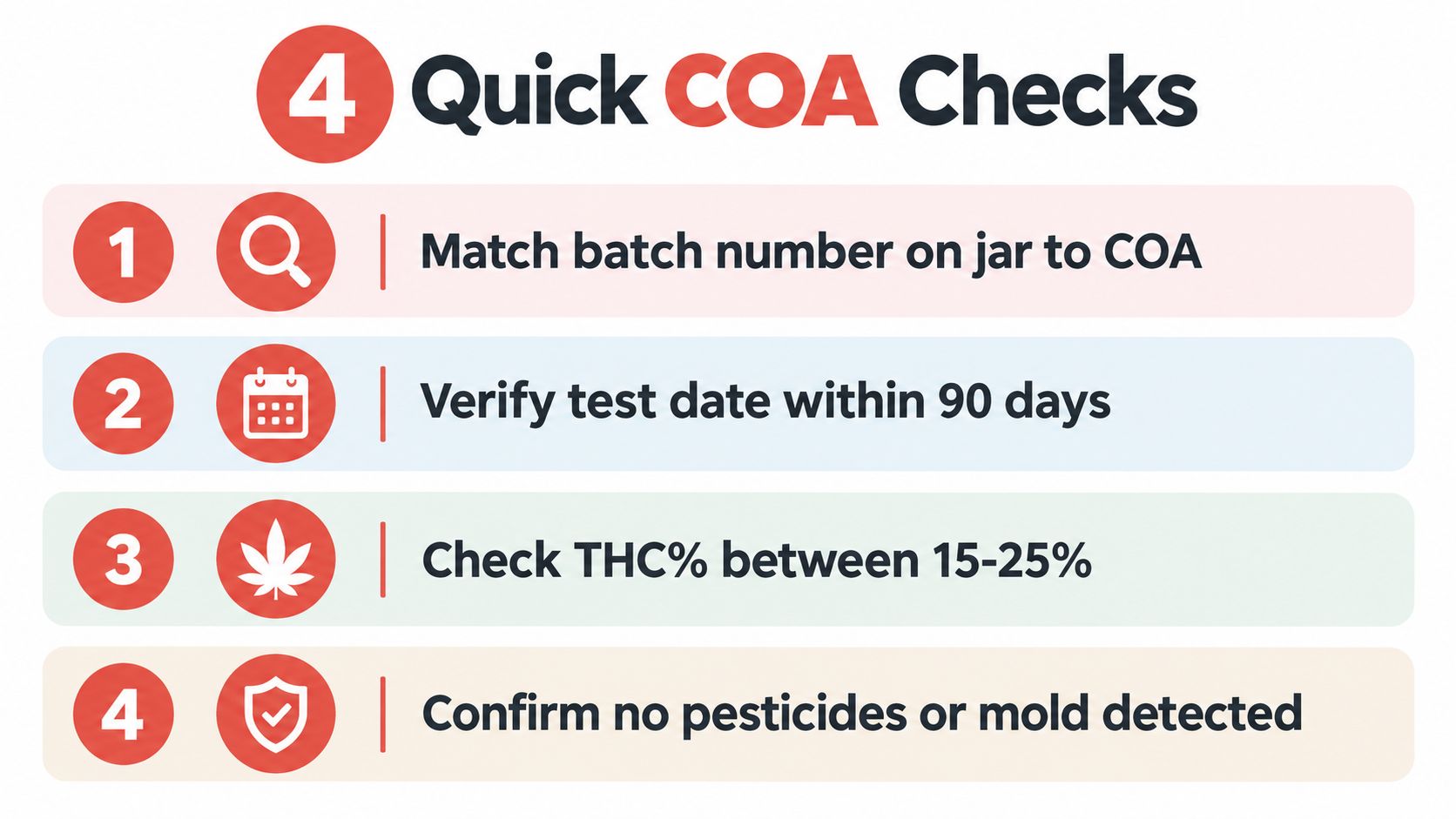
A recent report for another batch isn't useful proof. An older report also doesn't tell you how the flower has been handled since testing. Document identity and product condition are separate questions.
USDA laboratory testing guidance requires accounting for THCA-to-THC conversion and reporting measurement uncertainty; its preparation protocol includes drying, grinding the entire sample, retaining a specimen, determining moisture, and chemical analysis. That makes measurement basis and preparation important when comparing results.
The guidance concerns hemp testing within its regulatory framework. Don't assume its presence automatically proves a finished retail product is legal at your destination.
Complete the remaining checks:
Check whether results use a dry-weight basis before comparing batches. Otherwise, differences in how moisture is handled can undermine an apparently straightforward comparison.
“No contaminants detected” also needs context: which contaminants were tested, and what reporting limits applied? Don't turn a narrow panel into a blanket safety guarantee.
Use the detailed guide to reading a certificate of analysis when unfamiliar fields need explanation. If a seller can't explain the report's connection to your order, choose another listing.
An eighth is my default recommendation for unfamiliar flower. It limits the upfront commitment while letting you inspect the batch before buying more. An ounce makes sense after you know the product suits you, not merely because its unit price looks better.
In a 2025 survey of more than 1,000 adults aged 21 to 74, consumers averaged approximately $99 per purchase, typically buying about an eighth; 20% preferred eighths, 13% preferred ounces, and 56% had changed purchasing habits because of rising living costs, according to the survey of cannabis shopping habits. Those are broader cannabis figures, not a THCA-specific spending target.
| Format | Main budgeting advantage | What to examine before buying |
|---|---|---|
| Eighths | Manageable initial commitment | Whether the delivered price remains reasonable |
| Ounces | Potentially lower unit cost | Your actual usage, batch familiarity, and storage capacity |
| Prerolls | Convenience and less preparation | Declared flower weight, contents, and consistency |
| Multi-packs | Opportunity to compare products | Whether you want every included item |
| Smalls | Alternative to paying for large-bud presentation | Testing, trim, condition, and current price |
Prerolls deserve their own calculation. Don't treat the weight of a finished roll as automatically equivalent to usable flower weight. Paper, filters, and packing differences complicate that comparison, and you can't inspect the contents as easily as loose flower.
Convenience can still justify the purchase. Just recognize what you're paying for instead of calling it a flower bargain.
An ounce of a strain you haven't tried is a larger commitment to an unknown product. A bundle containing unwanted strains isn't good value because the combined retail price looks high.
Smalls belong on the shortlist when large-bud appearance isn't important to you. Read the THCA flower smalls buying guide, then assess the actual batch rather than assuming smaller buds automatically mean either inferior or equivalent quality.
Buy the format that fits your consumption, not the format that makes the discount banner look strongest.
For variety seekers, smaller purchases keep the decision flexible. For repeat buyers, larger formats become reasonable once the flower, documentation, and delivered cost are familiar. Buy a multi-pack only when you would willingly purchase its contents separately.
Consider an illustrative shopping scenario, not a customer case study: a buyer opens a discount-flower listing beside a higher-priced indoor listing. She wants an affordable purchase, but she hasn't decided that either retailer deserves her money.
The useful comparison happens on the product pages, not in the promotional banners.
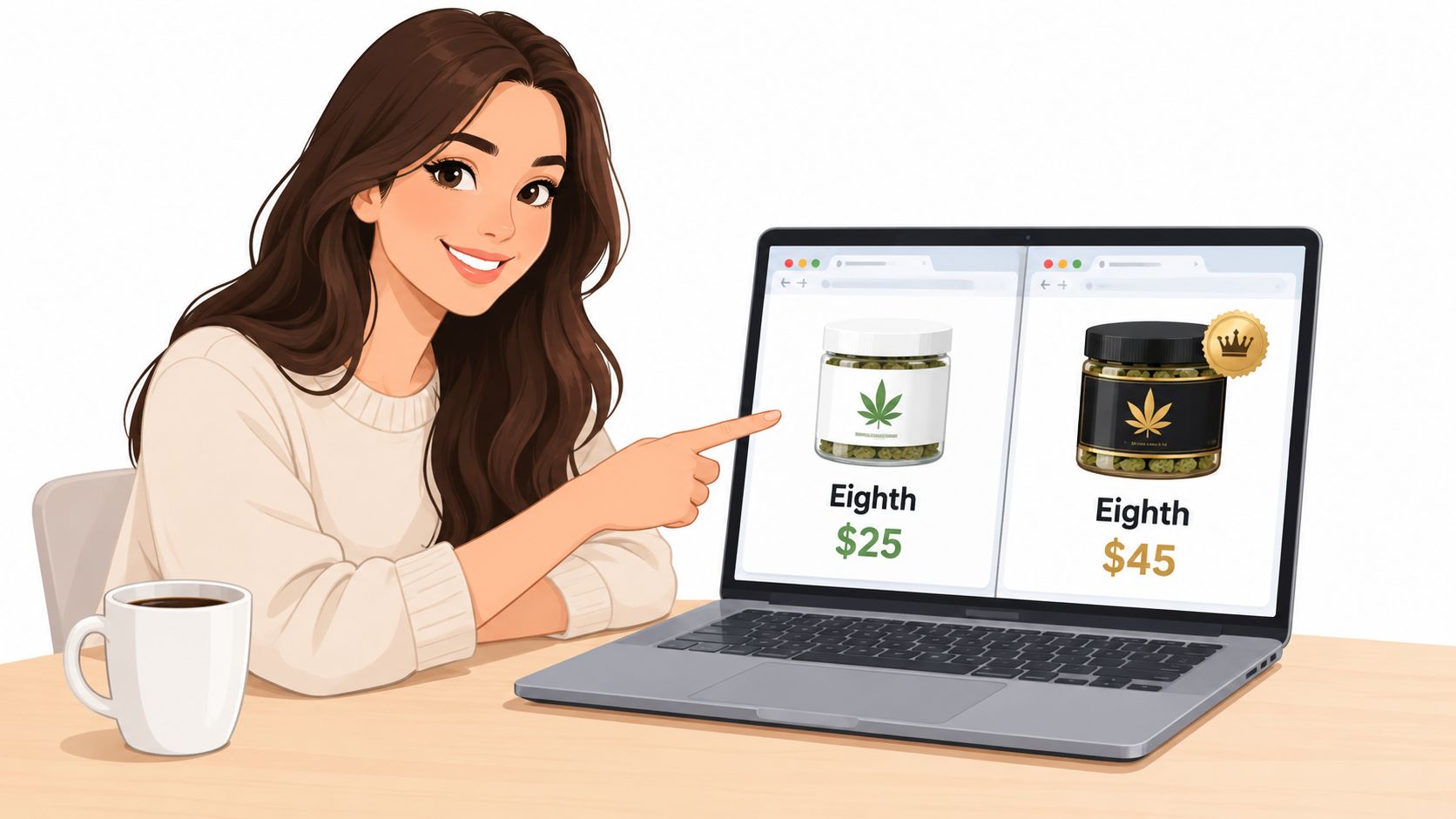
She checks the lower-priced listing first. The seller names a strain and displays a potency claim, but the linked document doesn't identify the inventory being offered. She sends a direct question asking for the matching report and the condition of the current batch.
On the indoor listing, she looks for the same evidence. “Indoor” isn't a waiver from scrutiny, and attractive photos don't establish cure quality. She checks whether the seller provides terpene results, explains cultivation claims, and publishes clear policies for damaged or incorrect orders.
Her decision criteria stay simple:
She's also careful with crossed-out prices. Historical legal-flower benchmarks show why yesterday's reference price isn't a reliable bargain standard: Colorado's median fell from approximately $14 per gram in January 2014 to $5 by September 2020, while Oregon's fell from over $10 in late 2016 to below $4 by the end of 2023, as documented in the review of cannabis market pricing. Those aren't current THCA price quotes.
Keep the listings and their documents open if you choose to watch the accompanying video.
If the discount seller answers clearly, the inexpensive listing stays in contention. If not, she walks away. The higher-priced retailer faces the same standard.
That's disciplined shopping: neither price tier gets an automatic pass.
Don't buy a large quantity and then improvise storage. Decide where it will go before ordering, and keep different batches identifiable so your purchase log remains useful.
My practical routine is straightforward: use clean, airtight glass containers, keep them in a cool, dark place, and avoid unnecessary handling. Choose containers that close securely rather than relying on a loosely folded bag.
This graphic offers a routine to visualize, not a guaranteed shelf life or a universal storage specification.
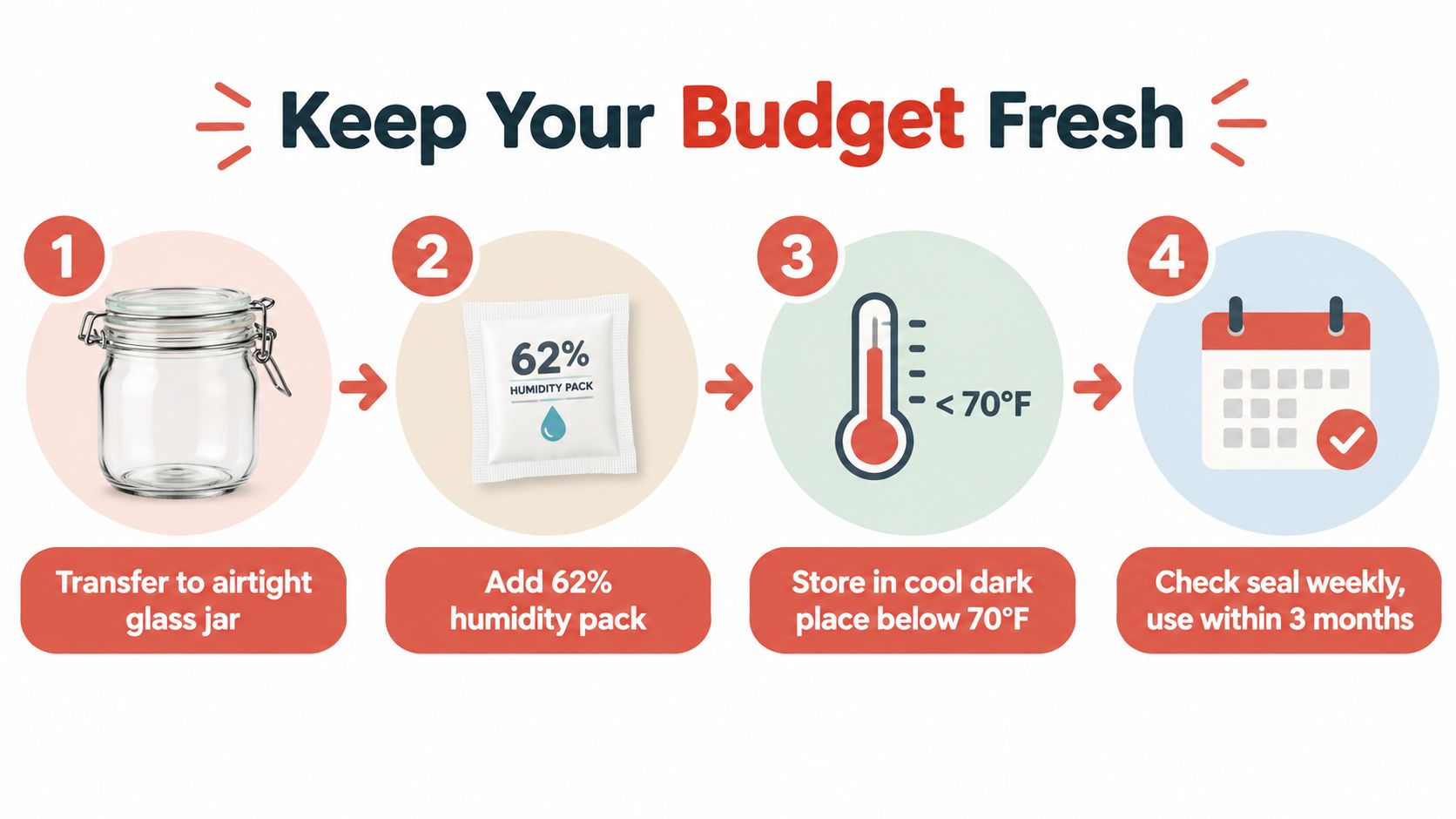
Consult the THCA flower storage guide for container and handling considerations. Keep products secured away from children and pets, and don't treat visual inspection or aroma as a substitute for testing.
Storage caution: A humidity pack isn't proof that questionable flower has become acceptable to use.
Storage planning also needs a legal reality check. Congressional analysis of the federal hemp changes describes legislation counting THCA toward the 0.3% total-THC threshold and establishing a 0.4-milligram total-THC limit for final hemp products once the changes take effect.
That doesn't justify panic-buying. Verify the effective rules, your destination's restrictions, and the retailer's shipping eligibility before each order. A product's availability today doesn't establish its future classification or your right to receive it locally.
Buy an amount you can responsibly manage. A cupboard full of discounted flower isn't a successful budget if you can't verify, legally receive, or comfortably use what you've purchased.
Set your spending ceiling before opening a shop. Otherwise, sellers can turn a modest purchase into a larger order with bundle offers, shipping incentives, and limited-time language.
Use this checklist as a buying aid. The graphic's suggested spending and timing targets aren't universal standards; your written calculation and applicable rules take priority.
Compare the received batch information with the document you reviewed. Record the condition and keep any order paperwork needed to resolve a problem. Don't ignore a mismatch because returning to customer service feels inconvenient.
Then replace your estimate with actual experience. A purchase that looked economical online might not deserve a repeat order, while an unremarkable-looking jar might become your dependable choice.
The right THCA flower budget is personal, documented, and repeatable. You're not trying to win the lowest-price screenshot. You're choosing a product you can verify and enjoy without paying for avoidable waste.
Melt offers THCA flower and Duo prerolls, with an emphasis on third-party testing and transparent lab reports. Visit Melt to compare available formats, review the documentation, and check shipping eligibility before choosing a purchase that fits your session budget.
Your cart is currently empty.