


Free Shipping All Orders Over $95
The most popular advice about THCA flower in California is now the advice most likely to get you into trouble. Older guides still describe THCA flower as a federally legal hemp loophole that can move through the mail because raw Delta-9 THC stays below the federal hemp threshold. That framing ignores what happens when the flower is heated, and it ignores California's post-2026 rules.
California now treats hemp flower with any detectable THC as intoxicating, and the state prohibits the sale of hemp flower and inhalable hemp products such as pre-rolls and vape cartridges. The practical result is blunt: smokable THCA flower has moved out of the hemp-retail lane and into California's regulated cannabis system. The California Department of Cannabis Control explains the current hemp restrictions in its official hemp guidance.
That change affects three things you care about when shopping: where you can buy it, how you should interpret potency, and what quality standards you should expect. A product page that still leans on nationwide hemp shipping may be describing another state, an old rule, or a compliance problem.
The “hemp loophole” explanation for THCA flower in California is outdated. It treats a raw laboratory result as the whole legal story, even though smoking or vaping applies heat and converts THCA into intoxicating THC. A product marketed as federally shippable hemp may not fit California's rules.
Since 2026, California has narrowed the gap between what a test measures and what a buyer inhales. Hemp products with any detectable THC are treated as intoxicating, while hemp flower and inhalable hemp products cannot use the ordinary hemp-retail channel. The state's position appears in its California Department of Cannabis Control's hemp rules.
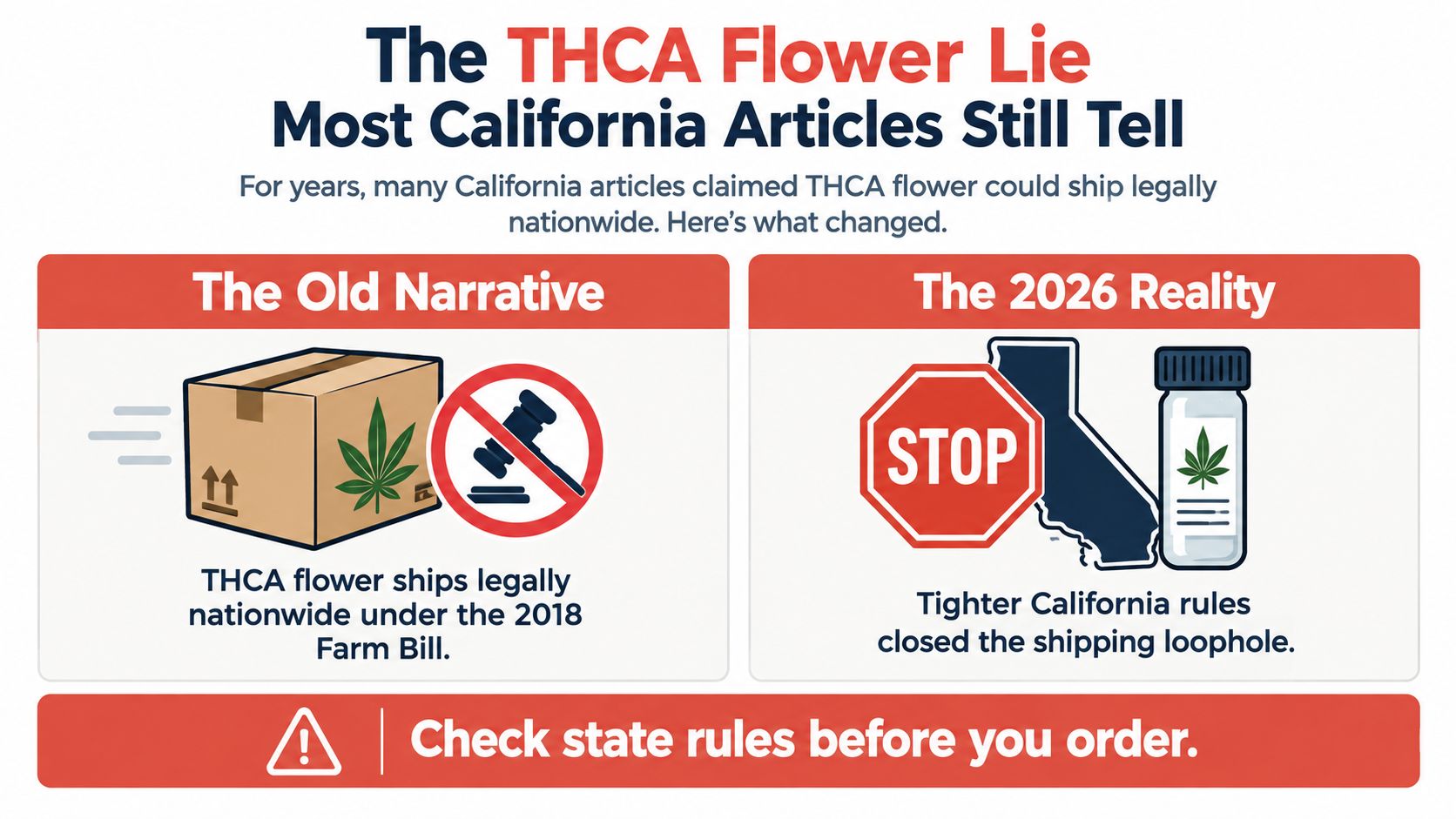
The retail channel changed first. California shoppers should look for licensed cannabis retailers and delivery operators rather than assuming an out-of-state hemp site can legally send smokable THCA flower to a California address.
The label requires context. A high THCA figure describes the acidic precursor in unheated flower. It does not describe the non-intoxicating experience a buyer might expect after combustion or vaporization.
The quality baseline changed too. California requires industrial hemp products to meet cannabis-like contaminant standards. That includes testing for pesticides, heavy metals, and residual solvents through an independent laboratory licensed or accredited to ISO/IEC 17025, as explained in the California Department of Public Health's AB 8 FAQ.
Practical rule: Treat any California seller calling THCA flower a product that bypasses licensed cannabis rules as a warning sign.
Before you buy, ask one direct question: which California license covers this batch? If the seller answers with the Farm Bill instead of a state license, walk away. Then check whether the label, testing information, and sales channel match California's regulated cannabis system.
THCA, or tetrahydrocannabinolic acid, is the acidic precursor to THC. A living cannabis plant produces cannabinoids in acidic forms. Raw THCA flower generally isn't intoxicating because the molecule hasn't yet changed into the neutral THC form that produces the familiar cannabis high.
A simple analogy is a sealed bottle of soda. The contents are already there, but the pressure and sealed state keep the experience different from what happens after you open it. THCA is similarly a precursor form. Heat removes part of its molecular structure through decarboxylation, releasing the neutral cannabinoid.
When you smoke, vape, or bake THCA flower, heat removes the carboxyl group from THCA. The result is Delta-9 THC, the intoxicating cannabinoid associated with cannabis effects. The chemistry is explained in this peer-reviewed overview of cannabinoid acids and decarboxylation.
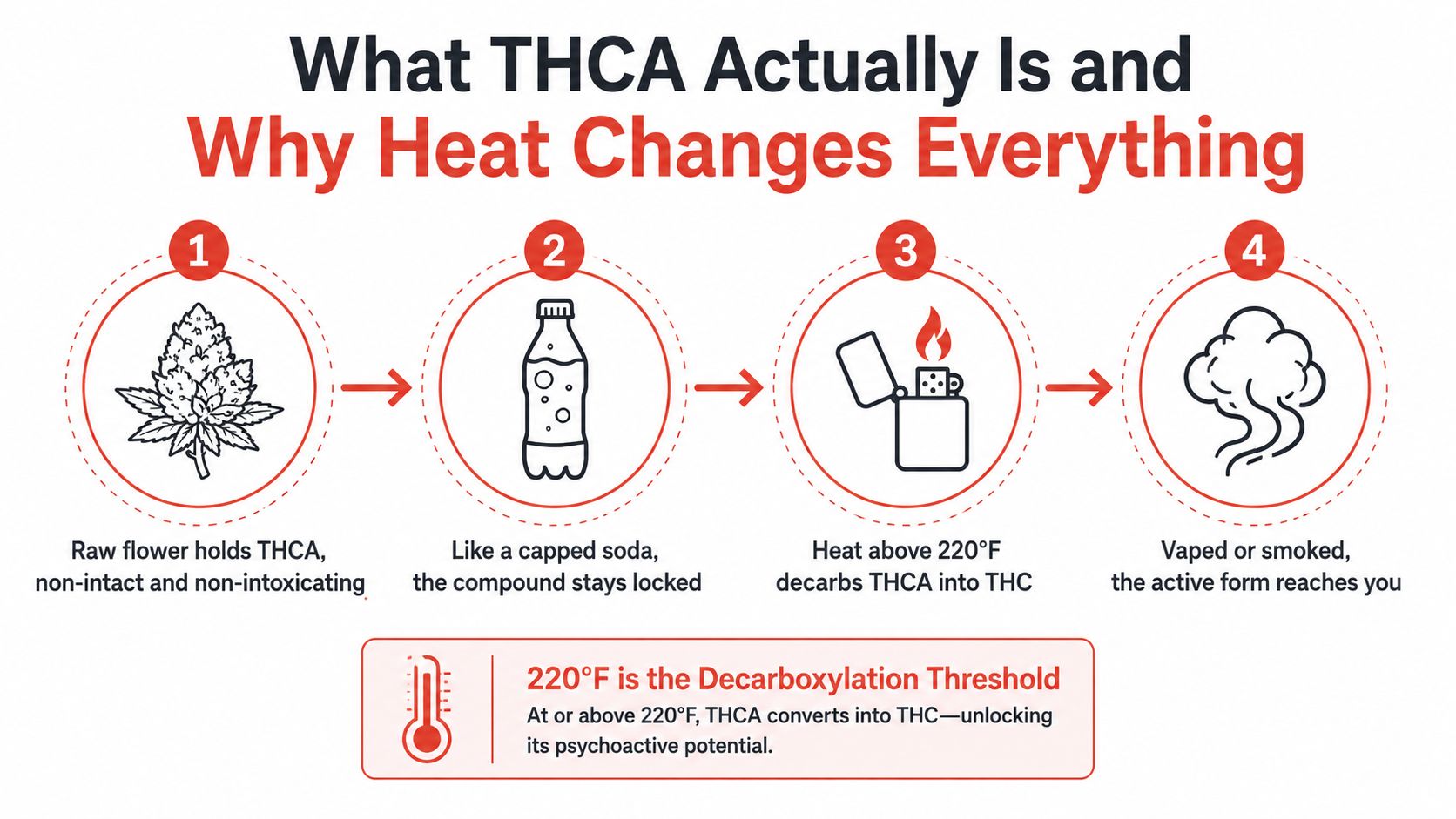
The practical sequence is straightforward:
THCA isn't Delta-8, THCV, or CBN. Those are distinct cannabinoids with different molecular structures and effects. THCA is better understood as a precursor and delivery form of THC, not as a separate intoxicating cannabinoid family.
For shoppers, the takeaway is more important than the terminology. A raw THCA percentage may help you compare flower, but it doesn't turn smoked flower into a non-intoxicating product. California regulators now evaluate the product within a stricter framework because inhalation converts the precursor into the same intoxicating THC that cannabis law already governs.
California's hemp rules changed the shopping equation on January 1, 2026. High-THCA flower can no longer rely on a federal-hemp label to reach California consumers. For buyers, the practical question is no longer whether a listing calls itself hemp. It is whether the product enters the state through the lawful cannabis system.
As of that date, hemp flower, hemp pre-rolls containing hemp flower or hemp-derived cannabinoids, and inhalable cannabis products containing hemp-derived THC cannot be sold, offered, or provided in California. Industrial hemp products also face cannabis-level expectations for contaminants. Treat any smokable THCA product marketed as a simple hemp loophole with skepticism.
Older listings often highlighted Delta-9 THC measured in raw material and treated that figure as the whole compliance story. That approach ignores how consumers use flower. California requires dried flower and non-infused pre-rolls to use its standardized cannabinoid testing method, which explicitly includes THCA.
The approved California standard test methods matter because a product's status depends on more than its marketing copy. The lab method, product type, seller's license, and route to market must line up. A low Delta-9 number alone does not make a smokable THCA product lawful in California.
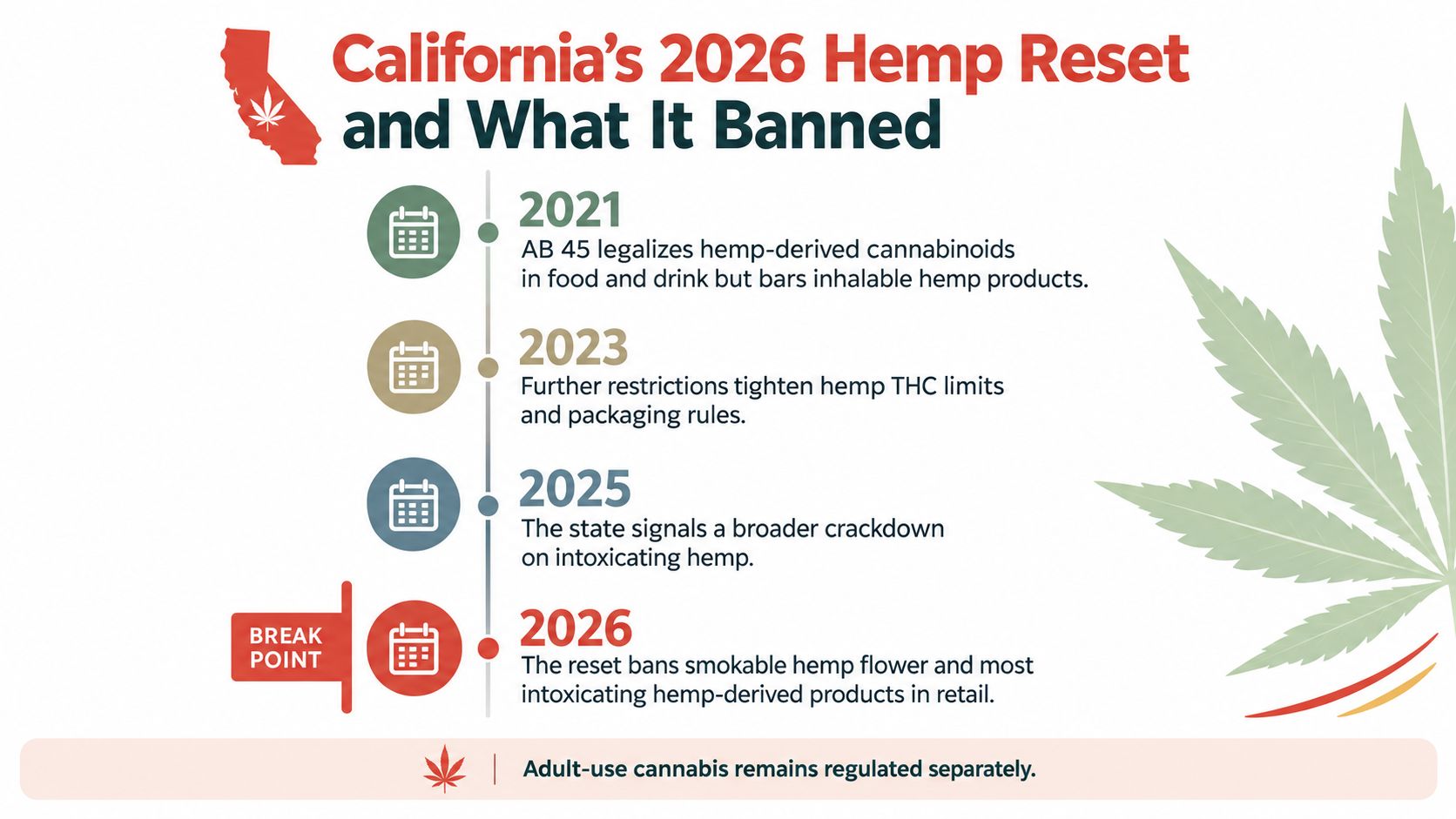
California did not ban cannabis flower. It closed the old hemp route for smokable products that sellers had positioned outside regulated cannabis. Licensed retailers can still sell flower through the state's cannabis system, so shoppers should compare licensed cannabis products rather than search for a hemp workaround.
That change affects availability, pricing, and strain selection. A brand may continue selling THCA flower elsewhere, but a California buyer should demand a clear licensed pathway, compliant testing, and product information that matches the state's rules.
California is a major regulated cannabis market, not a minor exception. Smokable THCA flower now competes inside that market, where licensing and testing matter as much as cannabinoid numbers. That is the reset buyers need to understand before trusting an online hemp listing.
For California adults, the cleanest buying route is a licensed cannabis retailer. That can mean a storefront, a licensed delivery-only retailer, or a licensed delivery service working within the regulated market. These channels can present THCA-rich flower as cannabis, provide batch information, and connect the product to California testing requirements.
The channel you should avoid is the out-of-state hemp retailer that still promises to ship smokable THCA flower into California under a generic federal-hemp argument. California's restrictions make that route legally and practically unreliable. If the seller won't explain its California compliance path, don't make yourself the test case.
| Channel | Price per Gram | State Lab Testing | Ships to CA | Age Verification | Risk Level |
|---|---|---|---|---|---|
| Licensed dispensary | Varies by menu and tax structure | Expected under California cannabis rules | Yes, through licensed delivery where offered | Required | Lower |
| Licensed delivery-only retailer | Varies, often with a narrower menu | Expected under California cannabis rules | Yes, within its licensed footprint | Required | Lower |
| Licensed delivery service | Varies by retailer and service area | Product should come from licensed sources | Yes, within its licensed footprint | Required | Lower |
| Out-of-state hemp retailer | Varies | May not use California's required pathway | Smokable THCA shipping is restricted | Must be verified carefully | Higher |
Dispensary flower is usually the most straightforward choice when you want clear provenance and state-regulated handling. Delivery-only operators can be convenient, but check the license information and the batch-level lab report rather than relying on a polished storefront.
For practical tips on finding nearby compliant options, use this guide to THCA flower near me. Melt offers a California-focused menu that includes THCA flower, but the same shopping rules apply to every brand: verify the seller, inspect the COA, and confirm that the product is permitted where you live.
A Certificate of Analysis should answer four questions before you buy: How strong is it, what else is in it, is it clean, and does the batch match the label? If the document only shows a large THCA number and nothing about contaminants, it isn't enough for a confident California purchase.
Start with the potency panel. THCA is the headline number for raw flower, while Delta-9 THC tells you how much neutral THC the unheated sample contains. A total-cannabinoid field can also show other compounds such as CBGA and CBG, which helps you understand whether the batch is chemically narrow or more varied.
To estimate active THC after heating, use:
Total active THC = THCA × 0.877 + Delta-9 THC
That equation reflects the molecular change during decarboxylation. It doesn't guarantee the exact amount you'll absorb because combustion, vaporization, storage, and personal use all affect delivery, but it gives you a more useful comparison than raw THCA alone.
Look next at the terpene panel. Dominant terpenes help explain aroma and can help you compare two batches sold under the same strain name. A familiar cultivar name is not a guarantee that every harvest will smell or feel identical.
A full compliance report should include results for pesticides, heavy metals, residual solvents, and microbial contamination. Water activity can also help identify whether flower has a moisture problem that could affect storage and quality. Look for a clear pass result, the batch identifier, the testing laboratory, and a report date that matches the package.
A potency-only report is not the same as a full-panel compliance test. California's requirements make that distinction especially important for flower, so learn more about the details in this guide to how to read a Certificate of Analysis.
The useful COA is the one tied to the exact batch in your hand, not a generic laboratory image on a brand homepage.
Strain names are useful shorthand, but they're weak evidence on their own. The same name can describe different cultivation methods, harvests, and terpene balances. Choose the terpene profile first, then use potency to control intensity.
For an evening profile, look for myrcene and linalool. These aromas often lean earthy, floral, or softly sweet, and they suit buyers looking for a slower, more settled session. Start with a moderate amount rather than assuming a familiar indica label tells you everything.
Limonene and pinene fit a brighter, clearer direction. Citrus and pine notes can make a flower feel more alert and expressive, which is a better match for daytime or social use than a heavily earthy profile.
Caryophyllene-led flower tends to bring peppery, spicy character and a more body-oriented experience without automatically implying sedation. It's a sensible category for shoppers who want physical weight but don't want the heaviest evening profile.
Terpinolene-rich flower often brings floral, herbal, and slightly sweet complexity. This is the profile to consider when you want a more creative or spacey head experience, though your response will still depend on dose and tolerance.
For a clearer explanation of how aroma compounds influence shopping decisions, see Melt's guide to what terpenes are in weed.
A flower testing above 28% total THCA belongs in a high-intensity tier. Flower in the 22% to 27% range is a versatile middle ground, while flower below 20% can make sense for lighter sessions or careful dosing. Those ranges are shopping categories, not promises about how every person will feel.
If two batches share a strain name, buy the batch with the terpene profile you want, not the louder marketing copy.
Melt's California menu includes indoor craft and premium sun-grown THCA flower, so a shopper can compare cultivation style alongside the COA. The right choice depends on whether you prioritize intensity, flavor, smoother pacing, or a lower-cost session.
Is expensive THCA flower really craft cannabis, or is the jar just carrying a premium label? In California, the honest answer depends on cultivation method, curing, terpene retention, and batch consistency. A high headline potency number doesn't prove careful production.
Recent market data show that THCA flower isn't moving as one uniform category. Hemp Benchmarks reported that aggregate THCA flower prices fell in January 2026, rose slightly in February as warehouse-grown product gained share, and fell again in March as greenhouse and outdoor prices weakened. Indoor craft flower held up better, while lower-cost greenhouse and outdoor supply faced more pressure.
Indoor craft flower usually gives cultivators tighter control over light, climate, and harvest timing. Look for dense trichome coverage, intact aromas, careful hand trimming, and a cure that feels springy rather than brittle or damp.
Greenhouse flower can offer a strong balance between controlled conditions and lower production cost. It may deliver good flavor and appearance, but batch-to-batch variation deserves closer attention.
Outdoor and bulk biomass can be the value option. It may work well for frequent users, prerolls, or larger sessions, but machine trimming, weaker terpene retention, and inconsistent moisture can reduce the experience even when the label looks impressive.
California's hemp supply base is substantial. The state's 2024 Cannabis Market Outlook, using USDA data, reported about 1.67 million pounds of utilized floral hemp in 2023. The same California Cannabis Market Outlook places THCA flower within a large supply environment where production tiers matter.
| Tier | Avg Price per Gram | Typical THCA % | Top Terpene % | Quality Cues |
|---|---|---|---|---|
| Indoor craft | Varies by batch and retailer | Read the batch COA | Read the batch COA | Dense trichomes, hand trim, strong aroma, stable cure |
| Greenhouse | Varies by batch and retailer | Read the batch COA | Read the batch COA | Balanced appearance, moderate aroma, variable consistency |
| Outdoor or bulk | Varies by batch and retailer | Read the batch COA | Read the batch COA | Lower cost, possible machine trim, lighter terpene expression |
The most useful value comparison is price per gram of active potential, paired with the strength of the dominant terpene profile. Occasional buyers may prefer indoor flower for flavor. Daily buyers may get better economics from greenhouse or outdoor flower. Therapeutic users should prioritize clean testing and consistency over a dramatic strain name.
California buyers need a product-specific checklist, not another generic “shop smart” reminder. Use these checks before paying, and leave when a product fails a major one.
California-sold THCA flower belongs in the tested, tracked adult-use cannabis market. Check the licensed channel first, the batch report second, the terpene profile third, and the potency tier last. That order keeps paperwork and product quality ahead of marketing.
Melt offers California-focused THCA flower, including indoor craft and premium sun-grown options, with batch information and third-party testing presented for shoppers. Visit Melt to compare its current menu by compliance details, terpene profile, and session strength.
Your cart is currently empty.