


Free Shipping All Orders Over $95
There is no single scientifically established best terpene. The right choice depends on the effect profile you want, the cannabinoid combination alongside it, and whether that profile survives reliably in the finished product.
So what is the best terpene for you, specifically? The answer may change depending on whether you want a calm body, a brighter mood, focused clarity, social ease, creative energy, or restful sleep. A terpene name can point you toward a product, but it can't guarantee how that product will feel.
Research supports a more careful view than the usual “top terpene” lists. Specific terpenes can influence cannabinoid activity in context, yet the broader entourage hypothesis remains unverified in humans. The useful question isn't which terpene wins a universal contest. It's which terpene profile best matches your intended session, and whether a current lab report shows that profile in the product you're buying.
Search for “what is the best terpene” and you'll often find a ranked list. Myrcene appears near the top for relaxation, limonene for uplift, pinene for focus, and linalool for calm. Those descriptions can help you learn the vocabulary, but a ranking suggests a level of certainty that the evidence doesn't support.
There isn't a peer-reviewed consensus naming one terpene as universally superior. A 2021 mechanistic study found that selected cannabis terpenes acted at several cannabinoid and non-cannabinoid receptors and could selectively alter the activity of cannabinoid agonists, which supports the idea that terpenes may act as context-dependent modulators, not standalone effect switches (the mechanistic terpene study). A later review concluded that additive or synergistic terpene and cannabinoid efficacy remains unproven in humans.
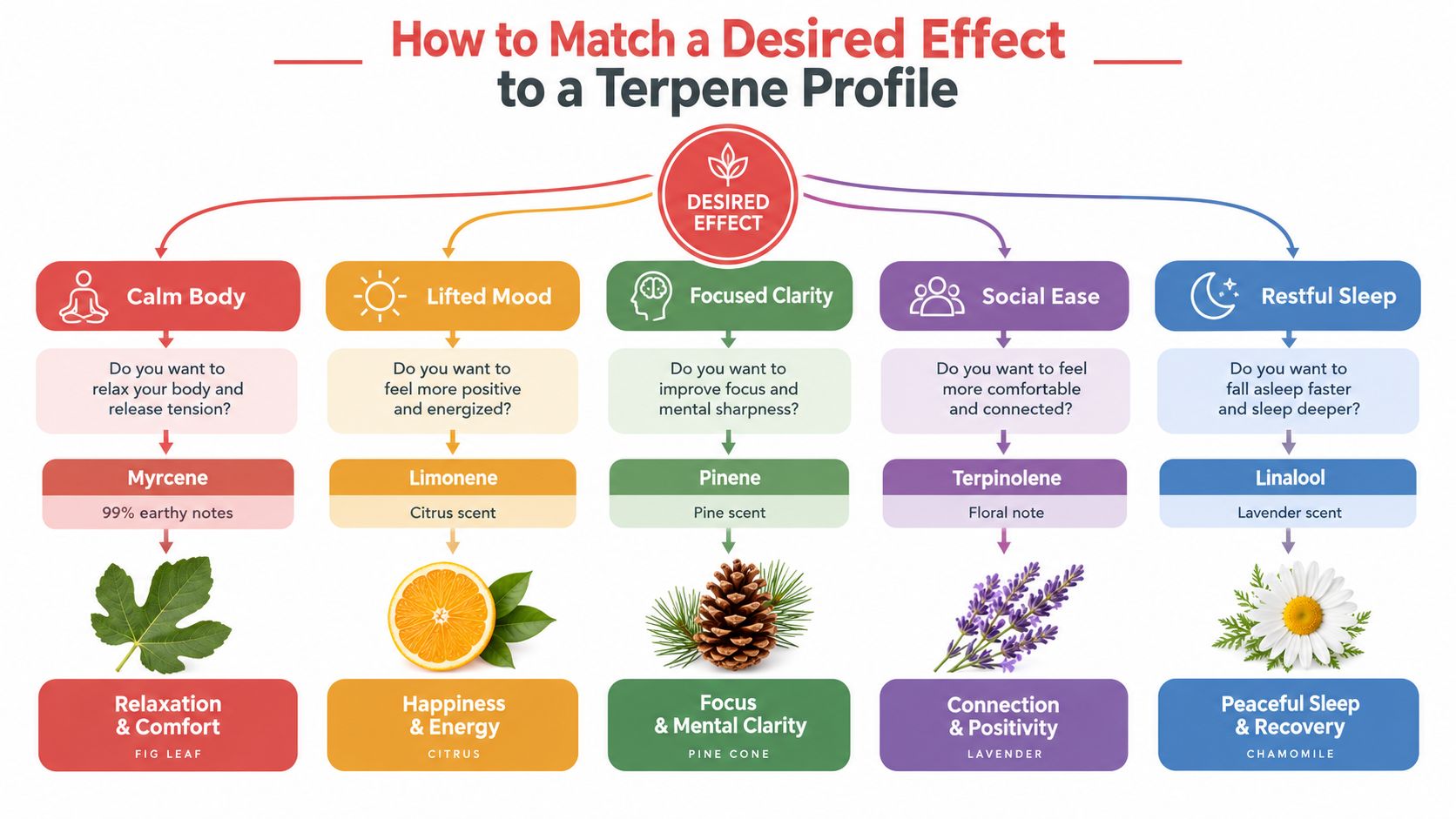
Your target effect gives you a more useful starting point than a popularity list:
The same terpene may feel different in different products because the surrounding cannabinoid ratio, concentration, delivery method, tolerance, and setting all change the experience. A flower with a terpene profile you enjoy may not feel identical in a vape or edible carrying a similar aroma.
Practical rule: Treat a terpene profile as a shopping hypothesis, not a promise.
This use-case approach also protects you from overreading strain folklore. “Indica,” “sativa,” and strain names can offer useful cultural shorthand, but they don't replace the actual profile in the batch. Your best match may be a less famous terpene in a well-tested product rather than the most heavily promoted name.
Terpenes are aromatic compounds that help create the scents of cannabis, citrus, pine, lavender, hops, and many other plants. In nature, plants produce them for purposes that can include defense, communication, and signaling. In cannabis, they contribute to the sensory identity people describe as earthy, fruity, floral, peppery, or pine-like.
A simple analogy helps. Cannabinoids are the main dish, while terpenes are the spice rack. The cannabinoids often shape the broad intensity and character of a session, while the terpene mixture contributes aroma, flavor, and potentially some modulation of how the overall profile is experienced. Spices don't turn one meal into another meal, and a terpene doesn't independently dictate a guaranteed clinical outcome.
A strong citrus smell can be a useful clue that limonene is present. It doesn't tell you how much limonene is in the product, whether the compound survived cultivation and extraction, or how the rest of the cannabinoid and terpene profile will affect you.
Aroma gives you an immediate sensory filter. If you dislike sharp pine notes, a pinene-dominant product may be a poor fit regardless of its advertised effects. If citrus aromas help you choose products you find bright and enjoyable, limonene can become a practical preference marker.
But aroma alone isn't a reliable effects test. Concentration matters, and so do the other compounds in the product. Delivery method matters too. Flower, distillate with added terpenes, rosin, and edibles expose you to different formulations and timing, even when their labels highlight the same terpene.
The entourage hypothesis enters the discussion here. The hypothesis proposes that cannabinoids and terpenes may interact rather than operate as isolated ingredients. Mechanistic evidence supports the possibility of interaction, but the clinical picture isn't settled. A review of the available research describes signals involving cannabinoid-linked pathways and several terpene-specific mechanisms, while also making clear that human confirmation is limited (an overview of terpene mechanisms and effects).
For a plain-language introduction to the compounds, aroma families, and labels involved, this guide to what terpenes are in weed is a useful starting point. The practical lesson is simple: use scent to identify profiles you may enjoy, then use lab data and your own experience to judge whether the product belongs in your routine.
Five names dominate cannabis menus, but familiarity isn't the same as proof. Each one is better understood as a profile lead with a particular aroma, a plausible effect direction, and a different level of research support.
Myrcene usually brings earthy, herbal, muscat-grape, or slightly peppery notes. Cannabis varieties described as heavy, resinous, or physically relaxing often feature it prominently, although the name of the cultivar doesn't establish the actual batch profile.
Consumers commonly associate myrcene with deep physical relaxation and a heavier evening session. The sedative interpretation is widespread, but much of the support remains preclinical rather than a strong human conclusion. If you want a body-focused experience, myrcene is a reasonable profile to investigate, not a guarantee that you'll feel sleepy.
Limonene smells like citrus peel, lemon zest, or orange rind. It appears across many bright, fruity, and tropical cannabis chemovars and often suits people who want an energetic sensory profile.
Research reviews discuss serotonergic and dopaminergic involvement, TRPA1 modulation, and anti-inflammatory or antinociceptive signals. Those signals appear more persuasive in inflammatory and neuropathic models than in acute thermal pain models, so the evidence doesn't justify promising a fixed mood or pain outcome. For shopping purposes, limonene is the most defensible candidate for a brighter, stress-leaning profile, with human confirmation still limited.
Linalool has a floral, soft, lavender-like aroma. It commonly appears in cultivars with sweet floral or creamy profiles and is often chosen for evening use.
The usual association is calmness, quiet sensory character, and pre-sleep suitability. Linalool also appears among the terpenes that produced cannabinoid-tetrad behaviors or selectively increased cannabinoid agonist effects in mouse and cell studies, but those findings don't establish the same result in people. Think of linalool as a useful signal for a gentle, floral evening profile rather than a sleep prescription.
Pinene smells like pine needles, rosemary, or fresh forest air. It appears in many resinous and herbaceous cannabis profiles, including cultivars marketed for a sharper or more alert character.
Pinene has a stronger alertness rationale than myrcene's sedation claims in the available review literature. It may appeal when you want a fresher experience or want to explore a profile that feels less foggy. Still, an alert aroma doesn't override dose, THC sensitivity, or your personal response.
Caryophyllene brings black pepper, clove, dry spice, and sometimes a woody warmth. It appears frequently alongside earthy, fuel-like, and savory cannabis profiles. Researchers often discuss it in relation to cannabinoid-linked pathways, including its interaction with CB2 receptors, but consumers shouldn't turn that mechanism into a guaranteed recovery or tension outcome.
Its best practical fit is a grounded, spicy profile for people who find citrus or floral products too bright. Caryophyllene can also complement myrcene or humulene when the goal is a deeper sensory impression. As with the other entries, the lab report and the complete cannabinoid profile matter more than the terpene's reputation.
| Terpene | Aroma | Reported Effect | Evidence Strength | Best-Fit Session |
|---|---|---|---|---|
| Myrcene | Earthy, herbal, muscat grape | Physical relaxation and heavier body character | Mostly preclinical for sedation claims | Evening or body-focused use |
| Limonene | Citrus peel, lemon, orange | Brighter mood and stress-leaning profile | Mechanistic and model-based support, limited human confirmation | Social, creative, or uplifting sessions |
| Linalool | Floral, lavender, soft spice | Calm, quiet, pre-sleep character | Early mechanistic and preclinical support | Wind-down routines |
| Pinene | Pine, rosemary, fresh herbs | Alertness and mental freshness | More developed alertness signals than myrcene's sedation claims, but limited human confirmation | Focused or daytime sessions |
| Caryophyllene | Black pepper, clove, dry spice | Grounded, warm, tension-oriented profile | Mechanistic and preclinical interest | Recovery-oriented or settled sessions |
For a deeper explanation of how aroma compounds interact with cannabinoids and shape product character, explore how terpenes work. Keep the table beside a current Certificate of Analysis, not in place of one.
The same handful of names can make cannabis shopping feel repetitive. Terpinolene, humulene, ocimene, geraniol, and valencene give you a broader vocabulary for comparing products that don't fit the usual myrcene-limonene-pinene framework.
Terpinolene combines floral, citrus, herbal, and sometimes lightly piney notes. It often appears in bright, aromatic chemovars, including cultivars that consumers describe as energetic or exploratory. A terpinolene-forward profile can suit daytime discovery, creative activity, or anyone who prefers a complex scent rather than a single sharp note.
The effect conversation around terpinolene is less settled than its flavor identity. Treat it as a flavor-first lead and pair it with the cannabinoid profile and your own session notes.
Humulene has an earthy, woody, hop-like character that some people describe as resembling beer or dried herbs. It commonly appears in savory, herbal, and forest-like cannabis profiles.
Humulene can work well alongside caryophyllene when you want a grounded finish rather than a sweet or citrus-forward experience. Its biological potential is still best treated cautiously, with much of the discussion coming from early research rather than solid human outcome data.
Ocimene tends toward sweet herbs, fresh greens, floral lift, and sometimes a tropical edge. It appears in aromatic cultivars with bright, layered profiles and can add a high, fresh note to a blend.
Ocimene may appeal to shoppers looking for an airy daytime aroma. The available evidence doesn't support promising a specific mental effect, so use it first to identify products whose scent matches your preference.
Geraniol smells like roses, soft flowers, and sometimes a light citrus garden note. It can appear in floral or fruit-forward cannabis chemovars and may add polish to a profile that would otherwise feel sharp.
Early cell and animal research has made geraniol interesting to researchers, but that interest shouldn't become a consumer guarantee. Choose it when you enjoy rose-like aromatics and want to compare how a floral profile performs in a complete product.
Valencene carries orange rind, sweet citrus, and gentle woody notes. It appears in some citrus-forward cannabis profiles and can make a blend feel rounder and less lemon-sharp.
Its best-fit use is sensory. Valencene is a good candidate for people who like orange and tangerine aromas but want something softer than a strongly acidic citrus profile. Human evidence for a distinct effect remains limited.
| Terpene | Aroma | Reported Effect | Evidence Note | Best-Fit Session |
|---|---|---|---|---|
| Terpinolene | Floral, citrus, herbal, lightly piney | Bright, exploratory character | Flavor identity is clearer than effect evidence | Daytime exploration or creative activity |
| Humulene | Earthy, woody, hop-like | Grounded, savory impression | Early research and limited human confirmation | Settled evening or recovery-oriented use |
| Ocimene | Sweet herb, fresh green, floral | Light, fresh sensory lift | Primarily an exploratory profile lead | Daytime and social settings |
| Geraniol | Rose, soft floral, gentle citrus | Gentle floral character | Early preclinical interest | Quiet, aromatic sessions |
| Valencene | Orange rind, sweet citrus, light wood | Rounded citrus impression | Limited evidence for a distinct effect | Uplifting flavor exploration |
These compounds are especially useful when you stop asking which terpene is strongest and start asking which combination feels coherent. Terpinolene with citrus notes may suit a curious daytime session, while humulene with caryophyllene may provide a more earthy and complete sensory arc. Neither pairing guarantees an outcome, but both give you more precise language for comparing products.
What are you buying when a package leads with one terpene name? You are getting a clue about aroma and possible effect profile, not a complete forecast of the finished product. The label may identify a dominant compound while leaving freshness, processing stability, and lot accuracy unclear.
A lot-specific Certificate of Analysis (COA) turns that clue into something you can evaluate. Check these points:
Use the document as a record for the product in your hand, not as a generic certificate for a brand. Match the package lot number to the COA, confirm that the test date falls within the past 6 to 12 months, and compare total terpenes across two recent lots when those reports are available. Similar results suggest better repeatability. A large shift does not automatically make a product poor, but it limits how confidently you can learn from one purchase.
Format changes the result you experience. Extraction, heating, storage, and blending can alter how the original profile appears. Flower may offer layered, vivid aroma, while distillate with reintroduced terpenes may pursue a narrower flavor direction. Rosin can express another balance because its process preserves a different part of the plant's character.
A dominant terpene without cannabinoid context remains an incomplete shopping hypothesis. For an explanation of how cannabinoids and terpenes may interact, read this overview of the entourage effect, then verify any product claim against the lot-specific COA. The finished experience also depends on formulation, freshness, and dose.
Reliable sourcing and repeatable testing give you a better basis for comparison than strain folklore. Record the product, lot, dose, and experience. If similar profiles produce similar sessions, those notes become useful. If the profile changes between purchases, the terpene name alone cannot predict what comes next.
Choose the effect profile you want, then ask whether the finished product documents it clearly and consistently. That is a more practical definition of the “best terpene” for your next session.
Begin with the outcome, not the cultivar name. Write down one phrase that describes the session you want, then use the terpene profile as a filter.
Flower usually gives you the broadest full-spectrum sensory experience. Distillate with reintroduced terpenes can offer a more targeted flavor direction, while solventless products and rosin appeal to shoppers who prioritize a concentrated expression of aroma and texture. These formats aren't interchangeable, so compare like with like when keeping notes.
Check the current COA rather than relying only on the menu description. Then record the product format, approximate dose, dominant terpene, aroma, and felt result in a simple log. Your own responses may not match a general terpene profile, and that personal record is more useful than a generic ranking.
Shopping filter: Start with the effect you want, match the scent you enjoy, verify the profile on the COA, and let repeatability decide whether the product stays in your rotation.
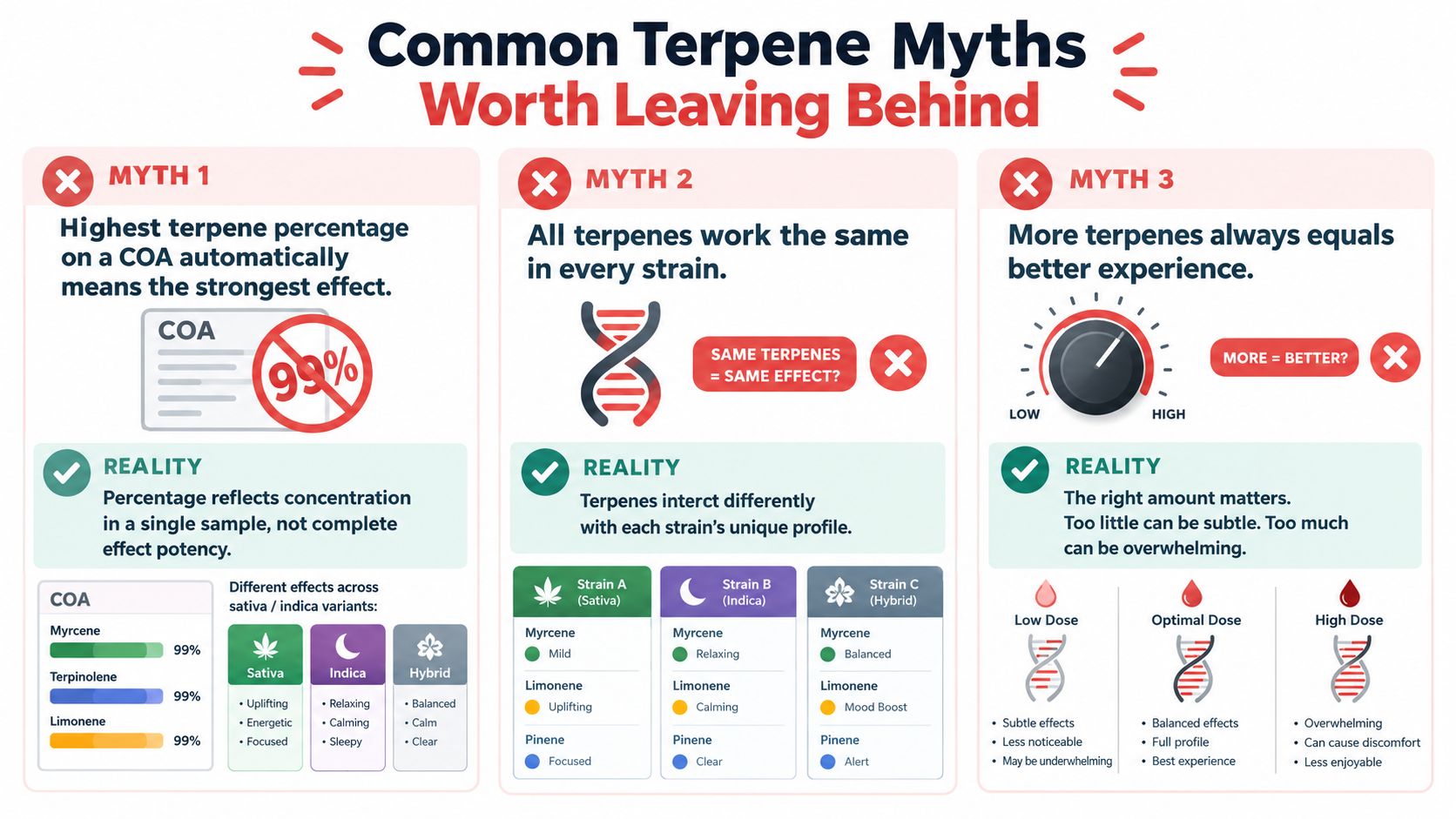
Myth one, the highest terpene percentage automatically creates the strongest effect. A percentage describes concentration in a particular sample. It doesn't measure your individual receptor response, and a high test result doesn't erase the influence of cannabinoids, dose, tolerance, delivery method, or degraded material. Ask whether the reported level suits the complete formula and whether the product is fresh.
Myth two, indica means relaxing because of myrcene, while sativa means uplifting because of limonene. Those category labels compress complex chemotypes into broad marketing language. Two products in the same category can have different terpene ratios, cannabinoid profiles, growing conditions, and extraction histories. Ask for the actual profile instead of inferring it from the category.
Myth three, an isolated terpene recreates the effect of whole-plant flower. A pure limonene cartridge isn't automatically equivalent to limonene-forward flower. The flower includes a wider chemical context, while the cartridge includes its own carrier, concentration, processing history, and cannabinoid formulation. The possibility of terpene and cannabinoid interaction makes the comparison more complicated, not less.
Research on α-humulene, geraniol, linalool, and β-pinene has shown cannabinoid-linked activity in mouse and cell studies, while limonene research includes several mechanistic and model-based signals. Those findings can guide questions, but they don't turn a label into a clinical prediction.
The better habit is to treat the label as a hypothesis to test. Does the aroma appeal to you? Does the COA support the stated profile? Does the complete product produce a repeatable session at a comfortable dose? Those questions are more useful than chasing the largest number or most fashionable strain name.
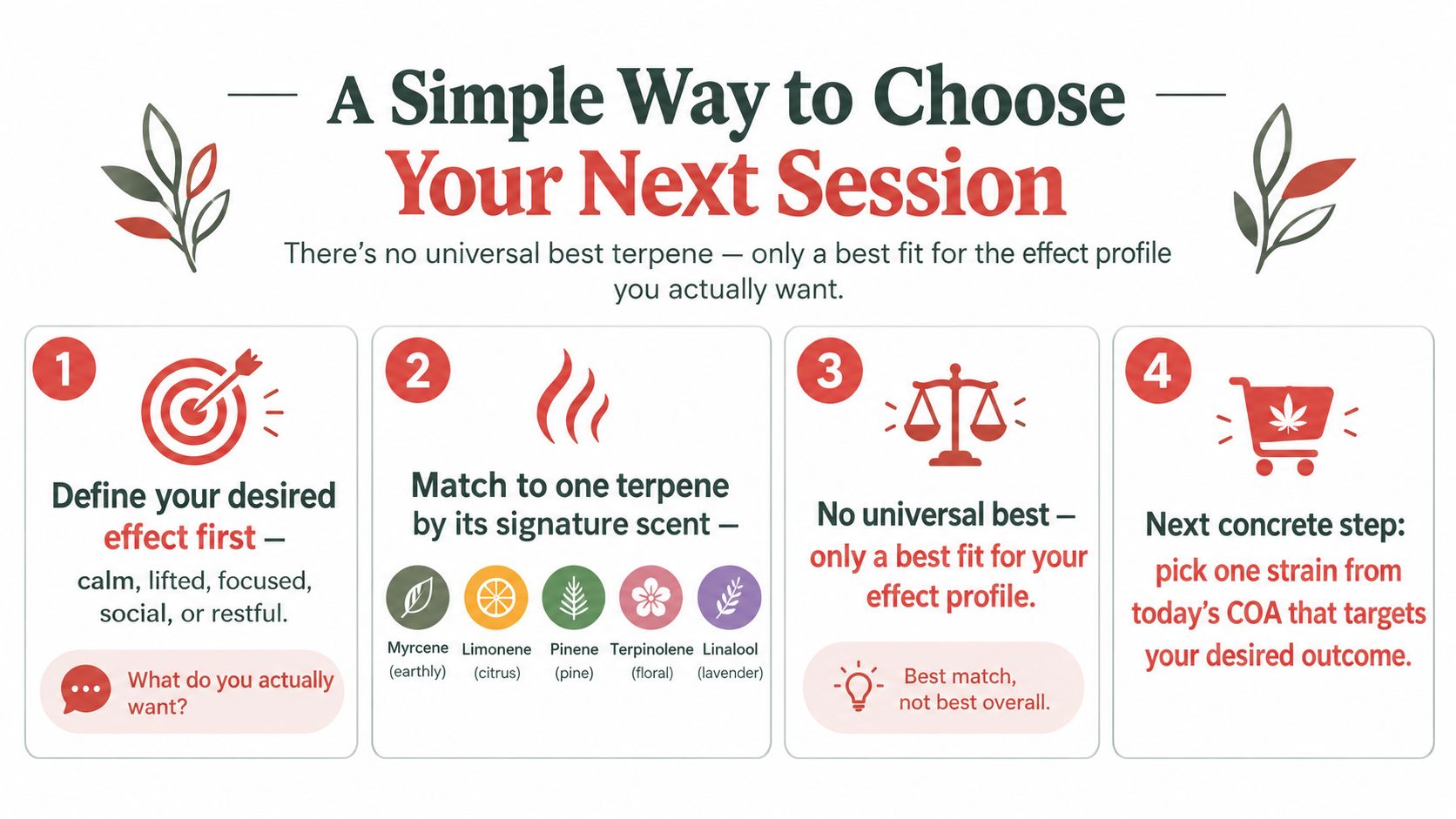
There isn't a universal best terpene. There is a best fit for the effect profile you want, the aroma you enjoy, and the product you can verify.
Choose one desired outcome first. Then select a product whose current lab report shows a dominant terpene aligned with that outcome, rather than trusting a jar description alone. Keep a short session log with the product format, dose, dominant terpene, aroma, and how the session felt. Over time, that record will show which of the citrus, pine, floral, earthy, or spicy profiles work for you.
Terpene literacy turns shopping from guesswork into a repeatable method. You don't need to crown one compound the winner. You need to find a transparent, consistent profile that matches the kind of session you're trying to create.
Melt offers strain-specific terpene profiles across products such as THCA flower, all-in-one devices, and edibles, with third-party lab reporting to help you compare aroma and formulation before buying. Visit Melt to review the available profiles and choose your next session with the COA, not the buzzword, in hand.
Your cart is currently empty.