


Free Shipping All Orders Over $95
Apollo lunar samples are U.S. government property and generally cannot be bought, while naturally fallen lunar meteorites can be legally purchased when their ownership and scientific identity are properly documented. The Apollo missions returned approximately 842 pounds, or 382 kilograms, of lunar rocks, core samples, pebbles, sand, and dust to Earth, but that material isn't part of a normal consumer market.
Can you buy a moon rock if an online seller offers one with a certificate? The answer depends entirely on which kind of lunar material the seller claims to have. “Moon rock” can mean a sample collected by astronauts, or a lunar meteorite that reached Earth naturally. Those objects may look similar to an untrained buyer, but their ownership histories and legal treatment are clearly different.
People asking can you buy a moon rock are combining two separate categories under one name.
An Apollo lunar sample was collected during a U.S. government mission and returned to Earth by astronauts. NASA treats those samples as government property. They remain in NASA's lunar curation system, where qualified scientific institutions can receive approved loans, but private buyers generally can't purchase them.
A lunar meteorite is different. It was blasted from the Moon by a natural impact, traveled through space, and fell to Earth independently of a government mission. A properly classified lunar meteorite may be legally sold, although local ownership, export, and cultural-heritage rules still apply.
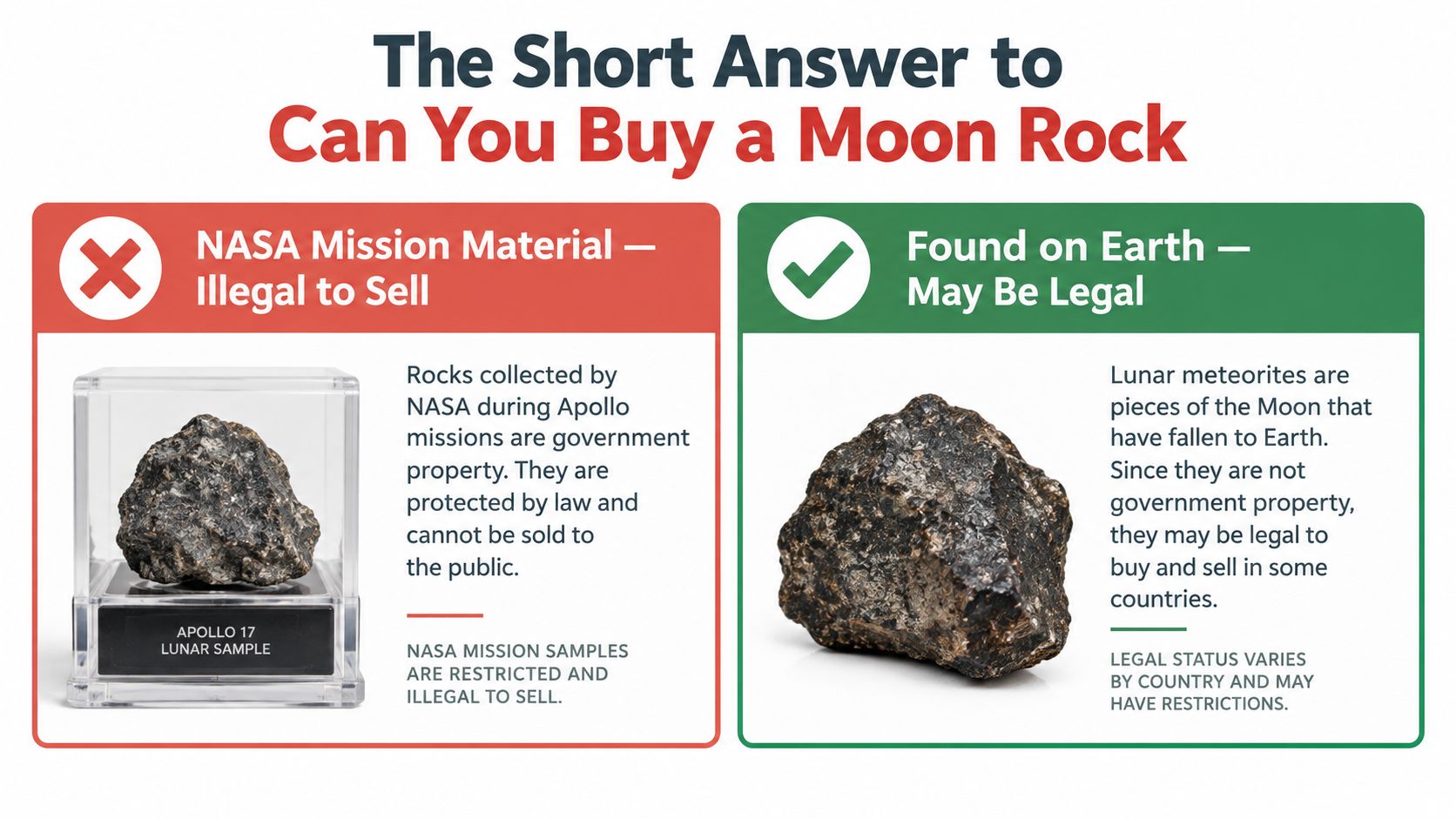
The distinction is easier to remember this way:
| Sample Type | Source | Legal Private Sale |
|---|---|---|
| Apollo lunar sample | Collected on the Moon by astronauts during a U.S. government mission | Generally not legal to buy or sell |
| Lunar meteorite | Natural lunar material that fell to Earth | May be legal, subject to applicable laws |
The scale of the Apollo collection explains why these samples attract attention. Between 1969 and 1972, the Apollo missions returned approximately 842 pounds, or 382 kilograms, of lunar material, according to Smithsonian coverage of lunar sample ownership. NASA stores most of it under controlled custody and lends it to approved researchers instead of treating it as merchandise.
Practical rule: If a listing says “Apollo moon rock for sale,” pause before thinking about price. The first question is whether the seller could legally own the specimen at all.
A legitimate lunar meteorite listing should use precise language. It should identify the material as a lunar meteorite, not casually call it an Apollo fragment, and it should provide a classification, find location, laboratory documentation, and ownership history. A photograph or attractive display case can't establish title or authenticity by itself.
NASA's position begins with ownership, not appearance. Material collected during the six Apollo landing missions belongs to the U.S. government, so a private seller generally can't transfer valid title to a buyer. That makes an alleged Apollo sale entirely different from an ordinary mineral transaction.
A dealer might describe a piece as rare, historic, or "from an estate," but those descriptions don't solve the title problem. If the material is from an Apollo mission, the seller must be able to show a lawful chain of custody connected to NASA's controlled sample system. A commercial certificate that lacks authorized records doesn't create ownership where the seller never had it.
NASA's lunar samples are stored and managed through a formal curation system. Qualified scientific institutions may study them through loans, but a loan isn't a sale and doesn't give the recipient unrestricted ownership. The same principle affects commemorative specimens distributed for public display. They were intended for institutional custody, not as ordinary private gifts.
A small incident illustrates the risk. In a 2017 case, NASA asserted ownership and sought the return of a bag of lunar dust after the material entered private hands, as reported in Space.com's explanation of Apollo lunar-rock ownership. The issue was not just whether the dust looked lunar. NASA challenged the underlying ownership.
That distinction protects buyers from a costly misunderstanding:
Treat any online listing for an alleged Apollo rock as a high-risk provenance claim. Don't send payment based only on a photograph, a framed plaque, a handwritten history, or a generic mineral certificate. Ask for the specimen's complete custody records and verify the claim with an appropriate authority before taking possession.
The safe conclusion is narrow but clear. Authentic Apollo samples can be viewed in museums or accessed through approved scientific loans, but they aren't legitimate consumer collectibles. A buyer seeking lawful private ownership should look for a naturally fallen lunar meteorite instead.
Can you legally buy a moon rock without buying government property? In many cases, the answer is yes, if the specimen is a lunar meteorite and the transaction follows the laws that apply to its recovery, ownership, sale, and transport.
A lunar meteorite begins with a natural impact on the Moon. Ejected material travels through space, and some fragments eventually fall to Earth. Unlike Apollo samples, these rocks were not collected and returned by astronauts on a U.S. government mission. They may therefore enter private trade when the relevant jurisdiction recognizes the seller's title and permits the transaction.
Legality and authenticity remain separate questions. A dealer must have the right to sell the specimen where it was found. The buyer also needs to consider the laws of the source country and the destination. Export controls and cultural-heritage rules can restrict movement even when laboratory testing confirms that the rock came from the Moon.
The basic distinction is:
A lunar meteorite can be a lawful collectible because its ownership does not depend on an unauthorized transfer from NASA. Its credibility rests on scientific classification, physical evidence, recovery history, and an unbroken chain of custody. Terms such as “rare moon piece” or “space treasure” provide no substitute for those records.
Public reports of private auction results show that authenticated lunar meteorites can command high prices. That makes provenance and testing important before payment, not after a dispute.
A lawful lunar meteorite purchase is possible, but it still requires verification. Establish what the rock is, who owns it, and whether it may legally cross every relevant border.
A lunar meteorite can't be authenticated reliably by appearance alone. Some terrestrial rocks can resemble extraterrestrial material, and an unusual surface or dark color doesn't prove lunar origin. Scientific identification depends on several forms of evidence that point to the same conclusion.
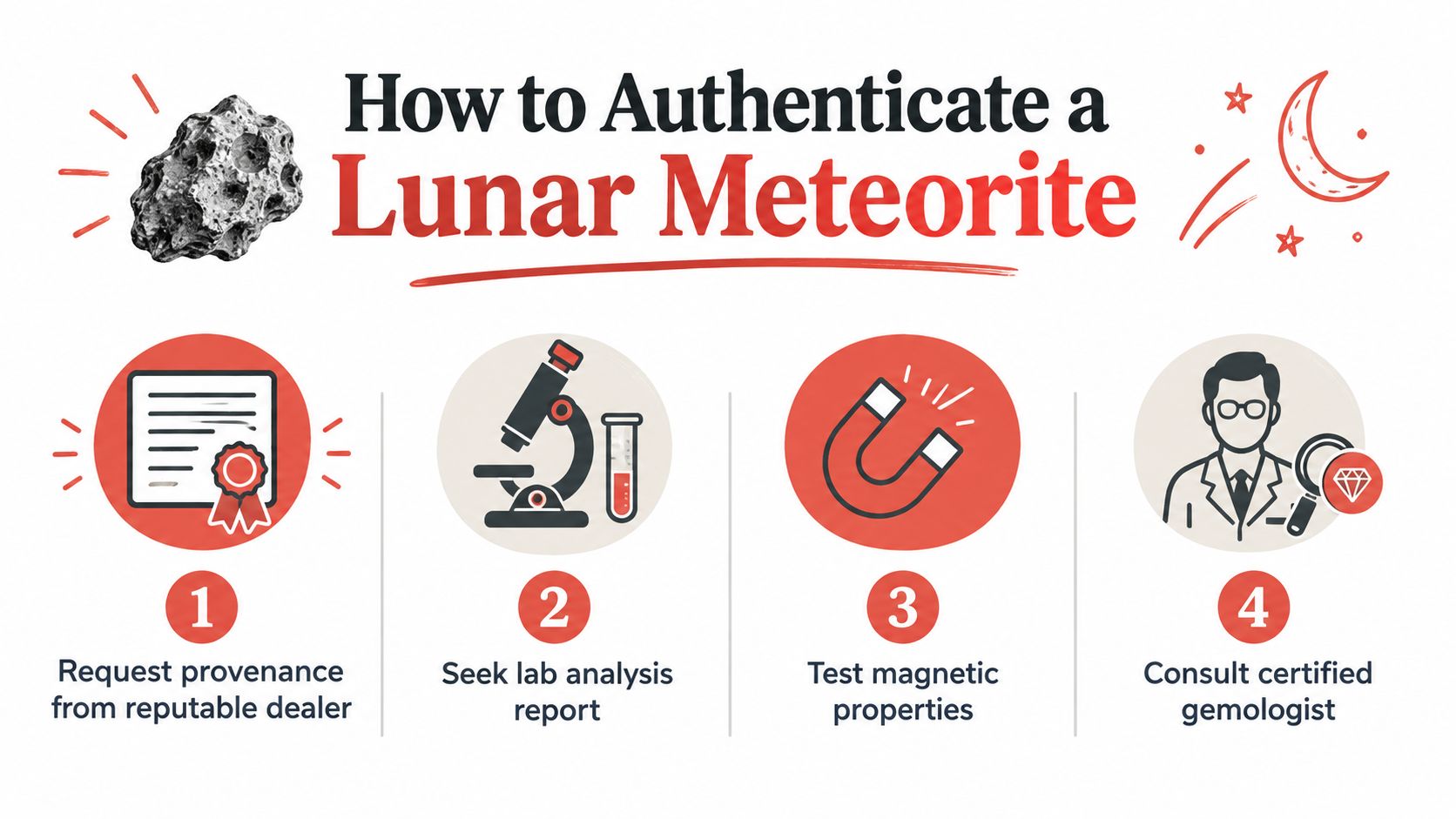
Ask the dealer where the specimen was found and how it moved from recovery to sale. A documented find location gives researchers and buyers a starting point for checking the material's history. The ownership record should remain continuous, with no unexplained gap between the finder, intermediary, laboratory, and current seller.
Request a recognized meteorite classification and a laboratory report that identifies the specimen or its parent material. The paperwork should connect clearly to the piece being offered, including specimen photographs, mass, labels, or other identifying details. A certificate that describes only a generic “moon rock” without a traceable specimen reference deserves caution.
Laboratories compare mineralogy, bulk chemistry, and oxygen-isotope composition with Apollo and other verified lunar samples, as described in the overview of lunar meteorite identification. These methods work together. One visual feature or one informal test can't replace laboratory analysis.
Use this checklist before agreeing to buy:
| Requirement | Description | Importance |
|---|---|---|
| Recognized classification | Documentation identifying the meteorite and its accepted classification | Establishes a scientific basis for the lunar claim |
| Laboratory report | Analysis connecting the material to lunar mineralogy and chemistry | Helps distinguish lunar material from terrestrial lookalikes |
| Find location | A documented place of recovery | Supports the specimen's history and legal review |
| Specimen photographs | Images showing the actual piece, not a stock image | Links the paperwork to the offered object |
| Ownership history | A continuous record from recovery to present seller | Helps establish lawful title |
| Export and delivery review | Confirmation that the material can leave its source country and enter the destination | Reduces cross-border legal risk |
Don't confuse a magnetic test, a density estimate, or a jeweler's opinion with full authentication. Those checks may provide clues, but they don't prove lunar origin. If you're assessing a seller's documentation generally, this guide to spotting fake products can help you think critically about mismatched labels, stock photography, and unsupported claims, although lunar material still requires specialist scientific review.
A cautious buyer should also ask who performed the analysis and whether the report concerns the exact specimen. If a dealer refuses to disclose the laboratory, find location, classification, or chain of custody, walk away rather than trying to solve the uncertainty through price negotiation.
Can a lunar meteorite's price prove that it is genuine? No. Market value reflects several factors, including classification, mass, condition, scientific interest, recovery history, and documentation. A small, well-documented fragment may be more valuable to a serious collector than a larger rock with an uncertain identity.
The reported $855,000 private auction sale shows that authenticated lunar meteorites can attract serious attention. It does not establish a standard price for every specimen. The documented auction example records one reported result, not a valuation formula.
A chain of custody answers two different questions. Does the offered object match the material examined by a laboratory? Did everyone who handled it have the right to possess and transfer it? Scientific testing addresses the first question. Ownership, title, and export records help address the second.
Review these records before treating a listing as a collectible:
Documents work like pieces of a puzzle. A certificate may confirm composition without proving ownership. An invoice may show a sale without proving lunar origin. This guide to reading a certificate of analysis offers a useful method: check what was tested, who tested it, which sample the document covers, and what the document does not claim.
A high price can reflect rarity, but it can't repair a broken chain of custody.
Cross-border purchases require extra restraint. A seller may possess a genuine meteorite yet lack permission to export it. Cultural-heritage protections may also apply even when a listing ignores them. If the legal position remains unclear, consult a qualified lawyer or the relevant government authority before payment or shipment.
A responsible buyer can reduce most avoidable problems by separating the decision into three questions.
First, identify the category. If the seller claims the object came from an Apollo mission, don't treat it as a normal collectible. Apollo samples remain government property, so the claim requires exceptional, authorized provenance. If the listing describes a lunar meteorite, continue by checking its scientific and legal records.
Second, verify the specimen. Request a recognized classification, laboratory analysis, find location, photographs of the exact piece, and an unbroken ownership history. Scientific evidence should compare mineralogy, chemistry, and oxygen-isotope composition with verified lunar material. Appearance is only a starting point, never a conclusion.
Third, confirm the transaction is lawful. Check whether the source jurisdiction permits private ownership and export. Then confirm that the destination permits import and possession. When the seller won't provide the information needed for that review, the safest choice is not to buy.
Keep the following decision rule nearby:
The answer to can you buy a moon rock is therefore precise rather than a straightforward yes or no. You generally can't buy NASA-collected Apollo material, but you may be able to buy an authenticated lunar meteorite that reached Earth naturally. Responsible collecting means paying for documented science and lawful title, not for an exciting label.
Melt offers carefully selected hemp-derived cannabinoid products with third-party testing, transparent lab reports, and discreet shipping for eligible U.S. customers. If you value documented products and informed buying decisions, visit Melt to explore the collection and review product information before ordering.
Your cart is currently empty.