


Free Shipping All Orders Over $95
The most popular advice about disposable vapes vs cigarettes is also the most misleading: “Vaping doesn't burn tobacco, so it's safe.” No. Removing combustion changes the exposure profile, but it doesn't erase nicotine dependence, aerosol contaminants, device failures, or long-term uncertainty. The opposite slogan, “vaping is just smoking with better branding,” fails too. The products create different emissions, different waste, and different patterns of use.
For an adult who already smokes, the useful question isn't whether a disposable vape is harmless. It's whether a specific, tested product used as a complete substitute for cigarettes reduces exposure to combustion-related toxicants, and whether the practical trade-offs make that switch sustainable. For someone who doesn't currently use nicotine, the recommendation is simpler: start with neither.
The common assumption that disposable vapes are easier to judge than cigarettes breaks down the moment you look past the label. “Less toxicant exposure” is a useful starting point, but it is not a buying guide, and it is not a safety certificate. If you want a comparison that helps you make a real decision, read it like a product assessment, not like a slogan.
The chemistry is only part of the story. Cigarettes create smoke through combustion. Disposable vapes create an aerosol by heating a liquid. That difference matters, but it does not settle the argument, because aerosol output can shift with liquid ingredients, coil condition, temperature, battery behavior, manufacturing quality, and how hard and how often the user puffs. Two products sold in the same category can produce very different exposures.
That is why category-level claims often mislead. A government evidence review in England found substantially lower biomarkers of exposure to cigarette-associated toxicants among people who vape under typical short- to medium-term conditions, especially when they switch completely rather than combine both products. The point for an adult smoker is straightforward: reduced exposure can support harm reduction. It does not make every disposable a smart choice, and it does not make any inhaled product harmless.
“Disposable vape” describes a format, not a stable chemical profile.
A sealed nicotine device from a regulated channel, a hemp-derived all-in-one, and an unverified product from an informal seller can all look similar on the outside while differing in formulation, heating design, active ingredients, and quality control. If you skip those differences, you miss the part that affects risk.
Sales growth is not proof of safety, but it is a good reason to examine the category closely. The CDC Foundation's sales brief reported that disposable e-cigarette unit sales rose 201.3%, from 4.1 million to 12.3 million units, between February 2, 2020, and June 16, 2024. Their share of all e-cigarette unit sales also climbed from 26.0% to 58.1% over the same period.
Practical rule: Ask what a specific product emits, whether the batch is traceable, and whether it replaces cigarettes completely.
A useful comparison has three layers:
Ignore any one of those layers and you are trusting packaging instead of evidence.
A cigarette is a paper-wrapped tobacco product designed to be lit and burned. The burning tobacco produces smoke, while the paper, tobacco, additives, filter, and ash become part of the physical waste stream. The user gets a rapid nicotine experience alongside combustion products, including tar and carbon monoxide.
A disposable vape is a sealed electronic device containing a battery, heating coil, liquid reservoir, and mouthpiece. The coil heats the liquid into an aerosol without burning tobacco. That aerosol can contain nicotine or cannabinoids, flavoring constituents, solvents, particles, and metals. "Vapor" is common consumer language, but aerosol is the more accurate term because the output isn't harmless water.
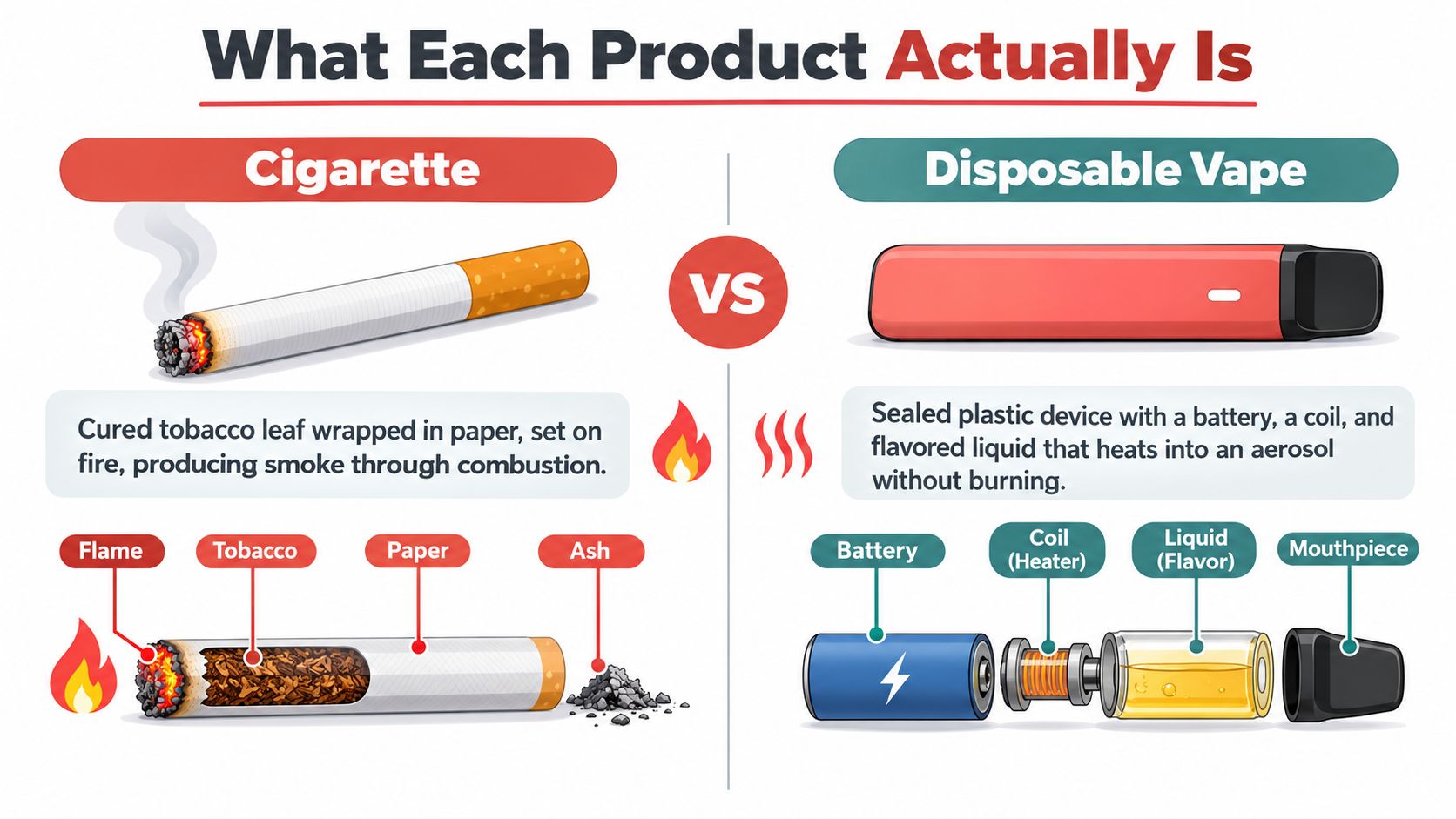
| Feature | Cigarette | Disposable vape |
|---|---|---|
| Core material | Cured tobacco wrapped in paper | Formulated liquid in a sealed electronic device |
| Energy source | Flame and combustion | Battery-powered heating coil |
| Inhaled output | Smoke | Aerosol |
| Nicotine or cannabinoid control | Product-specific tobacco and nicotine delivery | Formulation, device design, and user behavior |
| End-of-life waste | Filter, paper, ash, residual chemicals | Battery, coil, plastics, electronics, and residual liquid |
The product history also differs. In Great Britain, approximately 4.7 million adults, or 9.1% of the adult population, were current vapers in 2023, compared with roughly 700,000 in 2012. Disposables were the main device for 31% of vapers in 2023, while 43% of current vapers reported disposables as their primary device, according to ASH's adult vaping report.
That history matters because not every disposable is a nicotine product. Nicotine devices are usually discussed in relation to smoking substitution and dependence. Hemp-derived devices, such as Melt's AMF Blend all-in-one products, introduce a cannabinoid profile, terpene formulation, age restrictions, and jurisdiction-specific compliance questions. The basic hardware may look similar, but the active ingredients and buyer risks aren't interchangeable.
For a plain-language breakdown of the hardware and operation, see this guide to what a disposable vape is. The important point is simple: a cigarette is a combustible tobacco product, while a disposable vape is an electronic delivery system whose safety depends partly on what it contains and how it heats.
Start with the part many comparisons rush past. A complete switch from cigarettes to a regulated vape can reduce exposure to many combustion-related toxicants, but vaping still delivers nicotine at similar levels for many users and can add device-specific contaminants of its own. If you keep smoking alongside vaping, the comparison gets muddy fast.
That is why “less harmful” is too blunt to be useful. The question is exposure to what, from which device, under which conditions, and with what pattern of use.
Cigarettes burn tobacco. That combustion creates smoke containing tar, carbon monoxide, and a long list of byproducts. Disposable vapes heat a liquid or extract instead, so the exposure profile changes. As the 2022 government review noted, the case for lower toxicant exposure is strongest when vaping fully replaces smoking. Dual use weakens the benefit and makes self-assessment harder because many people count the cigarettes they smoke but lose track of the puffs they take.
Nicotine is where a lot of buyers fool themselves. A 2025 review of biomarker evidence found lower exposure to most measured toxicants among people who vaped than among people who smoked, while nicotine exposure was often similar. So yes, you may cut down some of the toxic burden that comes from burning tobacco and still stay just as dependent. For an adult trying to leave cigarettes, that can be an acceptable trade. For anyone assuming lower toxicant exposure automatically means lower addiction risk, it is the wrong conclusion.
Disposables also encourage a different pattern of use. A cigarette has a built-in stopping point. A vape can sit in your pocket all day and invite small, repeated hits between tasks, in the car, or at your desk. That convenience helps some smokers switch. It also makes nicotine intake less visible and easier to underestimate.
The harder truth is that aerosol quality varies by device. Coil materials, liquid formulation, heating temperature, battery behavior, storage conditions, device age, and puffing style all affect what comes out of the mouthpiece. Aerosols may contain nicotine, ultrafine particles, volatile organic compounds, carbonyls, and metals such as nickel, tin, and lead.
That gray zone matters. A device-specific laboratory finding summarized in the 2025 biomarker and toxicant review reported very high lead emissions from one disposable under test conditions. You should read that as a warning about product variability, not as proof that every disposable performs the same way. Brand, batch, and hardware quality matter.
If a disposable starts tasting burnt, running unusually hot, leaking, or pulling differently, stop using it. Those are buyer-level warning signs, and pushing through them is a bad bet.
The honest verdict: For an adult smoker who switches completely, vaping can reduce exposure to many cigarette-related toxicants. It can also maintain nicotine dependence, introduce its own contaminants, and leave long-term health questions that still deserve caution.
Skip the marketing label and read the paperwork. “Third-party tested” only matters if the report shows what was tested, when it was tested, which batch it represents, and whether it covers the contaminants that matter for that product.
This is the part many comparisons miss. Lower exposure to some toxicants does not make every disposable trustworthy. Product quality still swings by brand, batch, and hardware, so the buyer's job is to check the report before assuming the device in front of them is clean enough to use.
For a nicotine disposable, look for measured nicotine concentration, constituent testing, heavy metals, and batch identity. For a hemp-derived disposable, check cannabinoid potency, residual solvents, pesticides, microbial screening, heavy metals, and the product's lot or batch number. A polished product page falls short of what a batch-matched laboratory report provides.
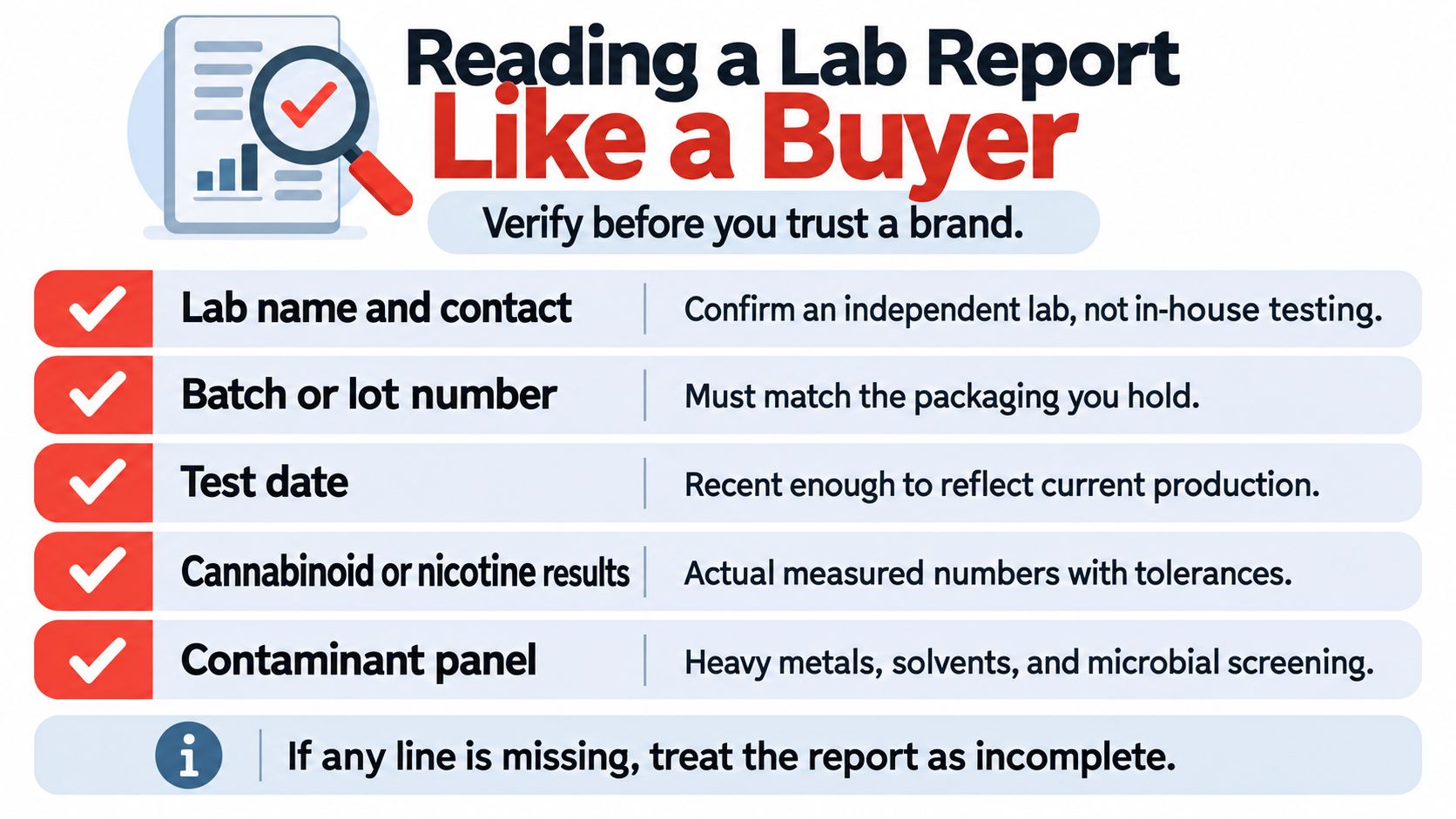
If you want help decoding the layout, this guide to reading a certificate of analysis gives a practical walkthrough. Also check whether the testing covers the finished device or only the incoming oil. A clean raw ingredient report does not confirm what the completed device emits during use.
A certificate of analysis is evidence about a sample and the attributes measured in that sample. It does not prove inhalation is harmless, that every device in a production run performs the same way, or that the product is legal everywhere. It also may not tell you how emissions shift as puff count rises or as the coil ages.
Use a report as a screening tool. If it leaves out the lab identity, batch number, date, measured results, or contaminant coverage, pass on the product or ask for the missing information.
Cost comparisons become unreliable when writers invent a universal monthly price. Cigarette taxes vary by location, disposable prices vary by product, and consumption varies even more. A person who smokes a fixed number of cigarettes may use a disposable continuously because it's always available. Another person may use one only in situations where smoking is inconvenient.
Use your own receipts and count complete devices, not advertised puff claims. A disposable can run out faster than expected if you take long draws, share it, use it frequently, or keep using it after the flavor and performance change.
| User profile | Cigarettes / month | Disposables / month | Key convenience trade-off |
|---|---|---|---|
| Pack-a-day adult smoker | Count your usual monthly packs | Count devices actually finished | Cigarettes provide a defined unit, while a disposable may remain available for repeated use |
| Moderate disposable user | Zero if they've fully switched | Track actual replacements | No lighter, ash, or cigarette pack, but the device can become an always-on habit |
| Heavy disposable user | Depends on whether cigarettes remain in the routine | Track every replacement and early failure | Fewer visible sessions can conceal frequent use and unexpected replacement costs |
Disposable vapes remove several practical annoyances. There's no lighter, no ash, and usually less lingering smell on clothes or inside a car. The device is compact, prefilled, and ready to use.
That convenience has a cost beyond the receipt. A cigarette tells you when the session is over. A disposable doesn't provide the same natural stopping point, and a depleted battery or empty reservoir can leave you replacing the whole device. The format also creates electronic waste every time the product reaches the end of its usable life.
For a fair comparison, record three things for a month: money spent, devices or packs consumed, and how often you use the product outside your original plan. The third measure often reveals the true trade-off.
Cigarettes and disposables can both reinforce nicotine dependence because both deliver nicotine rapidly enough to connect use with relief, stimulation, or routine. Switching formats doesn't automatically make the habit easier to stop. It may remove smoke while leaving the reinforcement loop intact.
The physical experience differs. Cigarettes produce smoke, heat, ash, and a recognizable smell that clings to fabrics and interiors. Disposable aerosols usually disperse differently and don't leave the same cigarette-smoke odor, but “less smell” doesn't mean “no exposure.” People nearby can still encounter exhaled aerosol, and indoor rules should be treated seriously.
A cigarette gives a short, bounded ritual. You light it, smoke it, and discard the butt. A disposable offers more discretion and less setup, which can suit a smoke-free apartment, a long commute, or a workplace where smoking isn't permitted. That same discretion can encourage more frequent, unnoticed puffs.
For an adult smoker trying to move away from cigarettes, a vape may fit the hand-to-mouth routine and provide nicotine without combustion. The switch only delivers its clearest harm-reduction logic if cigarettes stop. Keeping both products in rotation preserves cigarette smoke exposure while making total nicotine use harder to judge.
If your goal is harm reduction, measure success by cigarettes eliminated, not by how discreetly you can add vaping.
Flavor also changes the experience, especially with hemp-derived products. A strain-specific terpene profile can make a device feel distinct from a tobacco routine, but flavor is not evidence of cleaner emissions, lower potency, or better device construction. Read the lab report before trusting the sensory experience.
The environmental tradeoff is ugly either way. Cigarettes leave behind endless small litter. Disposable vapes leave behind fewer pieces, but each piece is more complicated, with a lithium battery, heating hardware, mixed plastics, electronics, and leftover liquid all packed into one throwaway product.
Cigarette butts are still a serious waste stream. They collect in gutters, sidewalks, soil, and waterways, and the filter does not make them harmless. Disposables create a different problem class. Once you toss one, you are dealing with battery-fire risk, e-waste, and materials that ordinary curbside systems are not built to separate safely.
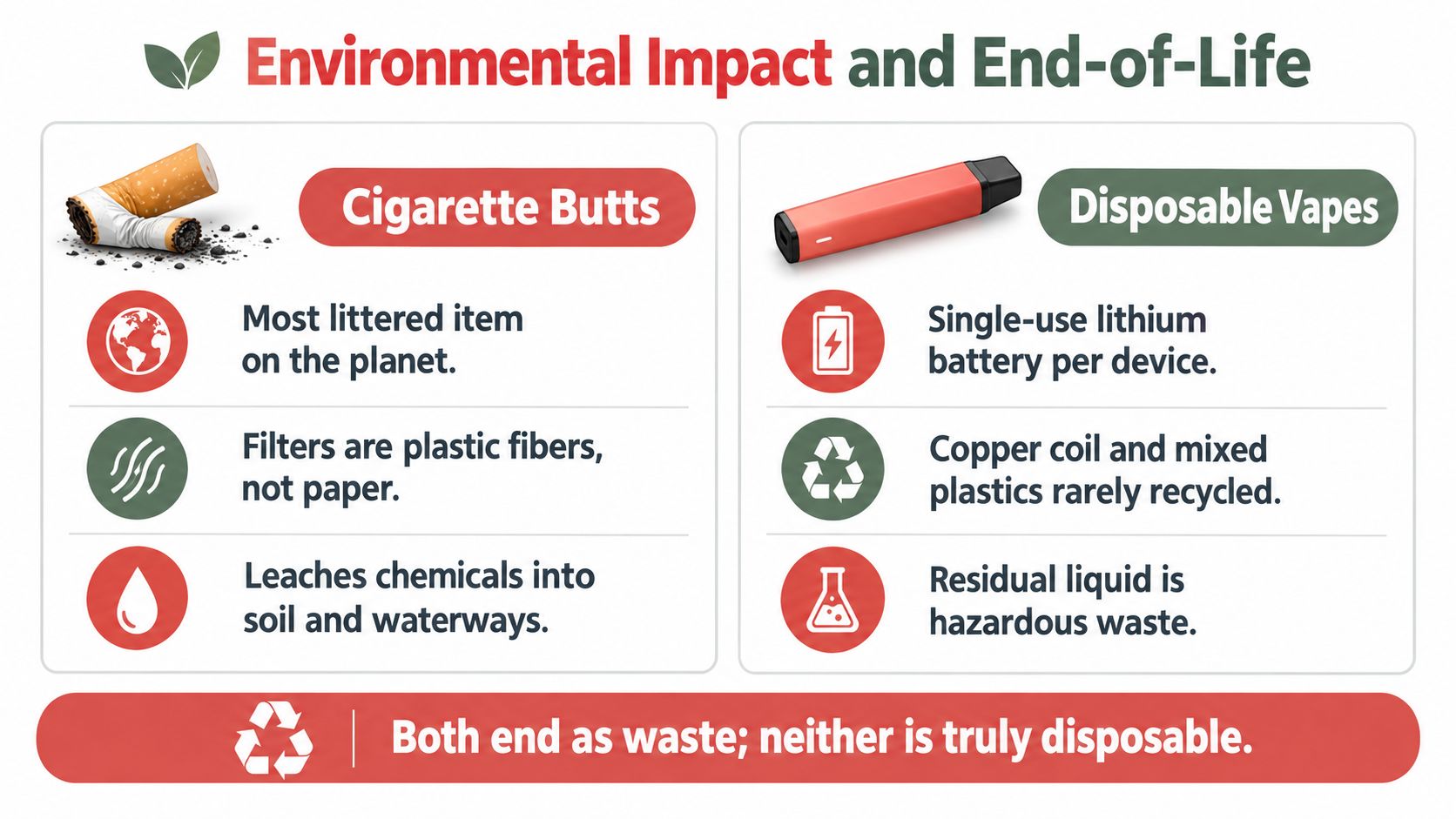
The disposal pattern is part of the product. A U.S. survey of 1,313 disposable-vape users aged 15–24 found that 52.9% put empty devices in regular trash, 21.4% kept or collected them, and users discarded an average of 3.1 devices per month. A 2025 research protocol also estimated that roughly 150 million disposable vapes enter American landfills annually (per the 2024 CDC-linked survey and 2025 research protocol).
Good product education should cover disposal, not just ingredients and flavor. Packaging matters too, and buyers who care about waste can look at eco-friendly packaging without pretending packaging alone fixes a throwaway battery device.
The adult who smokes every day and wants to reduce combustion exposure: A regulated vape is the more defensible option only if you commit to complete substitution. Use a documented product, monitor nicotine use, and build a plan to reduce or stop vaping rather than maintaining both habits.
The occasional adult user who values discretion: A disposable may be more convenient than cigarettes, but convenience can blur the stopping point. Set boundaries before you start, don't use it around other people indoors, and don't mistake smooth flavor or low odor for low risk.
The adult cannabis consumer in a jurisdiction where the product is legal: Choose a hemp-derived device with a clear cannabinoid profile, batch-matched third-party testing, and transparent contaminant results. Melt offers hemp-derived all-in-one devices and other cannabis products with published product information, but legality and shipping restrictions still depend on location.
Neither product makes sense for a person who doesn't already use nicotine or cannabis, anyone under 21, or anyone in a jurisdiction that restricts the relevant hemp-derived product. For the adult smoker deciding between disposable vapes vs cigarettes, the clearest recommendation is also the least glamorous: eliminate combustion completely, verify the device instead of trusting the label, and keep working toward no inhaled nicotine.
If you're comparing a disposable device on exposure, batch traceability, and real-world use, visit Melt to review its hemp-derived all-in-one products and lab-report information. Use the same buyer standard everywhere: confirm what's in the device, match the report to the batch, and check that the product is legal where you live.
Your cart is currently empty.