


Free Shipping All Orders Over $95
A CDT vape is a vaporizer cartridge or disposable flavored with terpenes extracted directly from cannabis rather than artificial compounds or non-cannabis botanical sources. Scientific reviews have identified at least 120 cannabis terpenes, although other reviews report more than 200 terpene structures across cannabis genotypes.
You're standing at a dispensary counter or browsing an online product page, comparing two nearly identical vape devices. One says “botanical terpenes,” the other says “CDT.” The second sounds more natural, perhaps even safer or stronger, but the label alone doesn't answer those questions.
CDT tells you where the terpene fraction came from. It doesn't prove potency, purity, safety, effects, or legal status. The useful question isn't only whether a vape says CDT. It's whether the brand can document that claim and show what else is in the finished oil.
Suppose a retailer offers two cannabis vape cartridges with similar cannabinoid descriptions. One uses a flavor blend derived from citrus, pine, or other non-cannabis plants. The other uses aromatic compounds recovered from cannabis and added to cannabinoid oil. The second product is a CDT vape, meaning a vape formulated with cannabis-derived terpenes.
Terpenes are volatile aromatic compounds made in the plant's glandular trichomes alongside cannabinoids such as THC and CBD. They help shape the smell and taste associated with cannabis cultivars. In a vape, the cannabinoid oil generally supplies most of the intoxicating effect, while the terpene fraction contributes aroma, flavor, viscosity, and potentially the way the oil vaporizes.
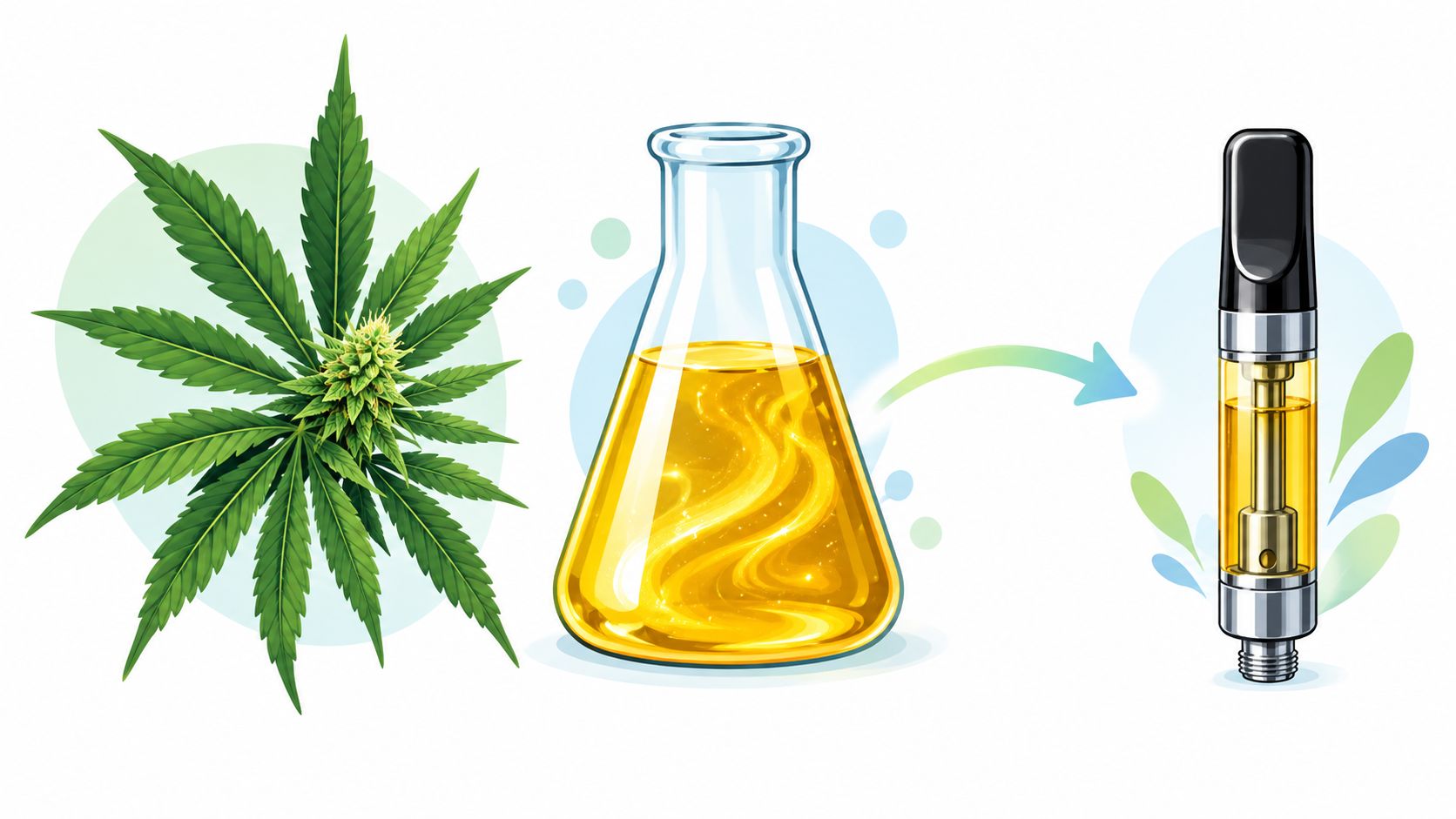
CDT is a sourcing description. It indicates that the manufacturer intends the aromatic fraction to come from cannabis rather than exclusively from botanical sources or artificial flavor compounds. That can create a more cannabis-forward profile, with notes such as citrus, pine, floral, herbal, earthy, or fuel-like aromas.
The term doesn't tell you whether the oil is distillate, live resin, or another extract. It also doesn't establish how much terpene is present, whether the product contains contaminants, or whether the listed source has been independently verified.
Practical rule: Treat “CDT” as the beginning of your quality check, not the conclusion.
A product page can make a sourcing claim, but a batch-specific certificate of analysis can show cannabinoid concentrations, terpene identities, residual solvents, pesticides, heavy metals, and microbial results. That distinction matters because a natural ingredient can still be poorly processed, inaccurately labeled, or unsuitable for inhalation.
The easiest way to understand CDT is to think of terpenes as a recipe for aroma. A cannabis plant produces its own mixture, while a manufacturer using botanical or synthetic ingredients may construct a profile from selected molecules.
Cannabis-derived terpenes are recovered from cannabis or hemp and reintroduced into cannabinoid oil. Botanical terpenes come from non-cannabis plants. Synthetic terpenes are manufactured compounds. Individual molecules can overlap between these categories, but the source, blend, concentration, and surrounding minor compounds can differ.
Scientific reviews identify at least 120 cannabis terpenes, divided into 61 monoterpenes, 51 sesquiterpenes, 2 diterpenes, 2 triterpenes, and 4 miscellaneous compounds. Other academic reviews report more than 200 terpene structures across cannabis genotypes, with variation linked to cultivar, growing environment, harvest timing, and processing methods. These figures come from a scientific review of cannabis terpenes and their chemistry.
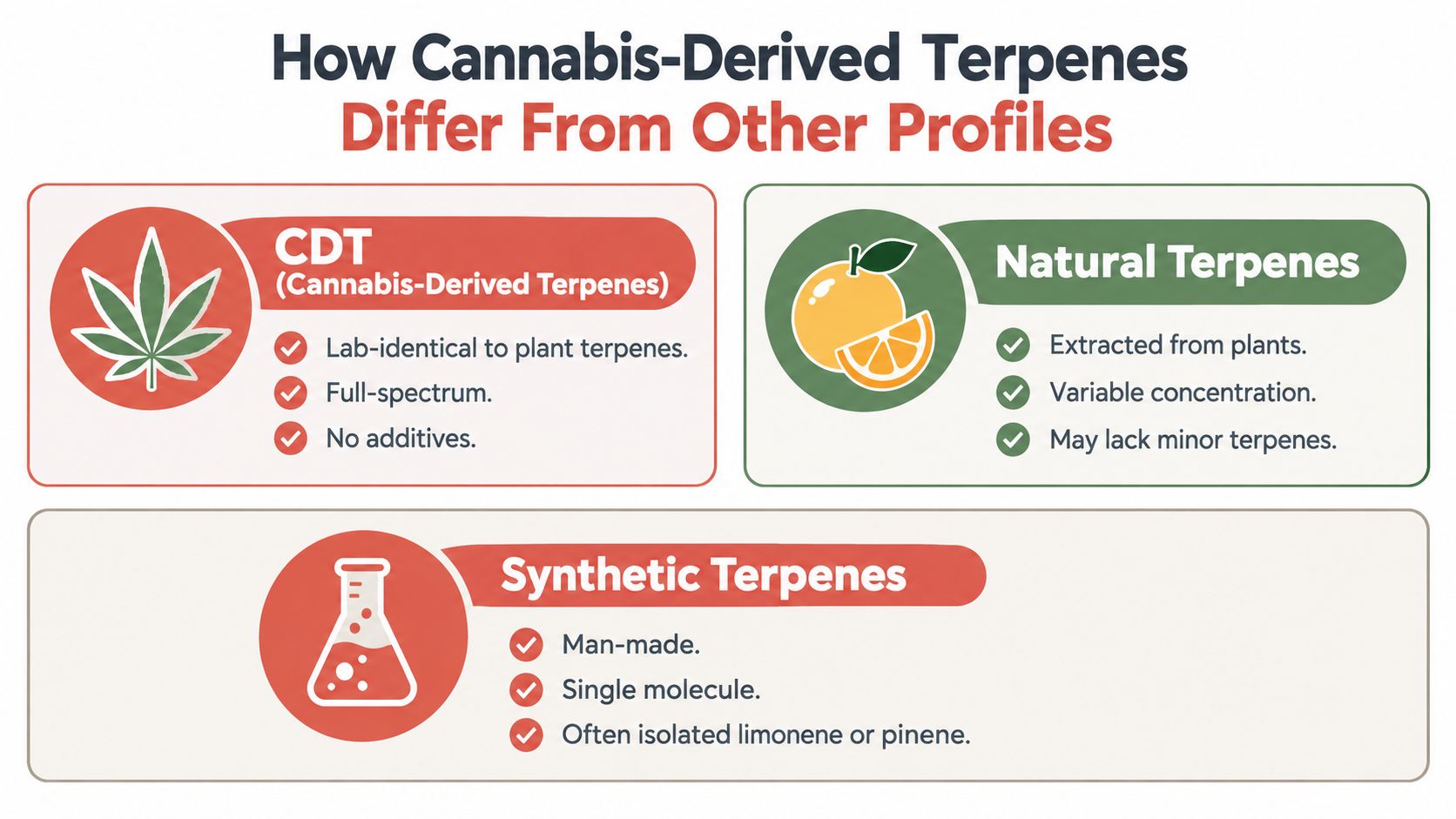
Common cannabis terpenes include myrcene, limonene, alpha-pinene, linalool, humulene, and beta-caryophyllene. A CDT blend may aim to preserve a recognizable cultivar-linked profile, but the final mixture depends on extraction, storage, concentration, and blending.
That's why a strain name isn't a complete chemical specification. Two products carrying the same cultivar name can have different terpene proportions, especially if one uses a reconstructed flavor blend and the other uses a cannabis-derived fraction.
You can read a plain-language guide to what terpenes are in weed for more background on aroma compounds and their role in cannabis products.
A more cannabis-like flavor also doesn't guarantee a particular experience. Terpenes aren't generally intoxicating on their own, and researchers continue to study how they may interact with cannabinoids. Academic reviews describe biological activity and possible cannabinoid interactions, but the significance for human clinical outcomes remains incompletely established.
This separates three ideas that shoppers often combine:
CDT primarily addresses the first two, and only partially. It doesn't predict a guaranteed medical or intoxicating result.
A regulated CDT vape and an informal-market cartridge may both use the word “natural,” but the purchasing risks can be very different. The main safety benchmark is contaminant and additive control, not flavor intensity or terpene origin.
During the U.S. EVALI investigation, CDC-linked testing found vitamin E acetate in 24 of 46 assessed THC-containing products from affected patients. An FDA investigation summarized by the CDC found that 79 percent of tested products from 73 EVALI patients contained THC, and 78 percent of those THC-positive products also tested positive for vitamin E acetate. The CDC investigation summary describes the association between THC products containing vitamin E acetate and most cases in the outbreak.
These findings point to a risk from adulterated or poorly controlled formulations. They don't prove that cannabis-derived terpenes are harmless or harmful at every concentration. They show why buyers need to evaluate the whole formulation rather than assume a label tells the full story.
A compliant retailer should be able to identify the product's cannabinoid contents, ingredients, testing status, and applicable restrictions. An informal seller may offer a strong flavor claim without showing a current report for the finished oil.
Reject products with:
Stop using a vape and seek medical attention if you develop chest pain, shortness of breath, persistent cough, nausea, or fever. The CDC also advises avoiding THC vaping products from informal sources.
A certificate of analysis, or COA, is useful only when it matches the product you're buying. Start with the batch number on the cartridge, package, or label. Compare it with the batch number on the laboratory report. If they don't match, the document doesn't verify that unit.
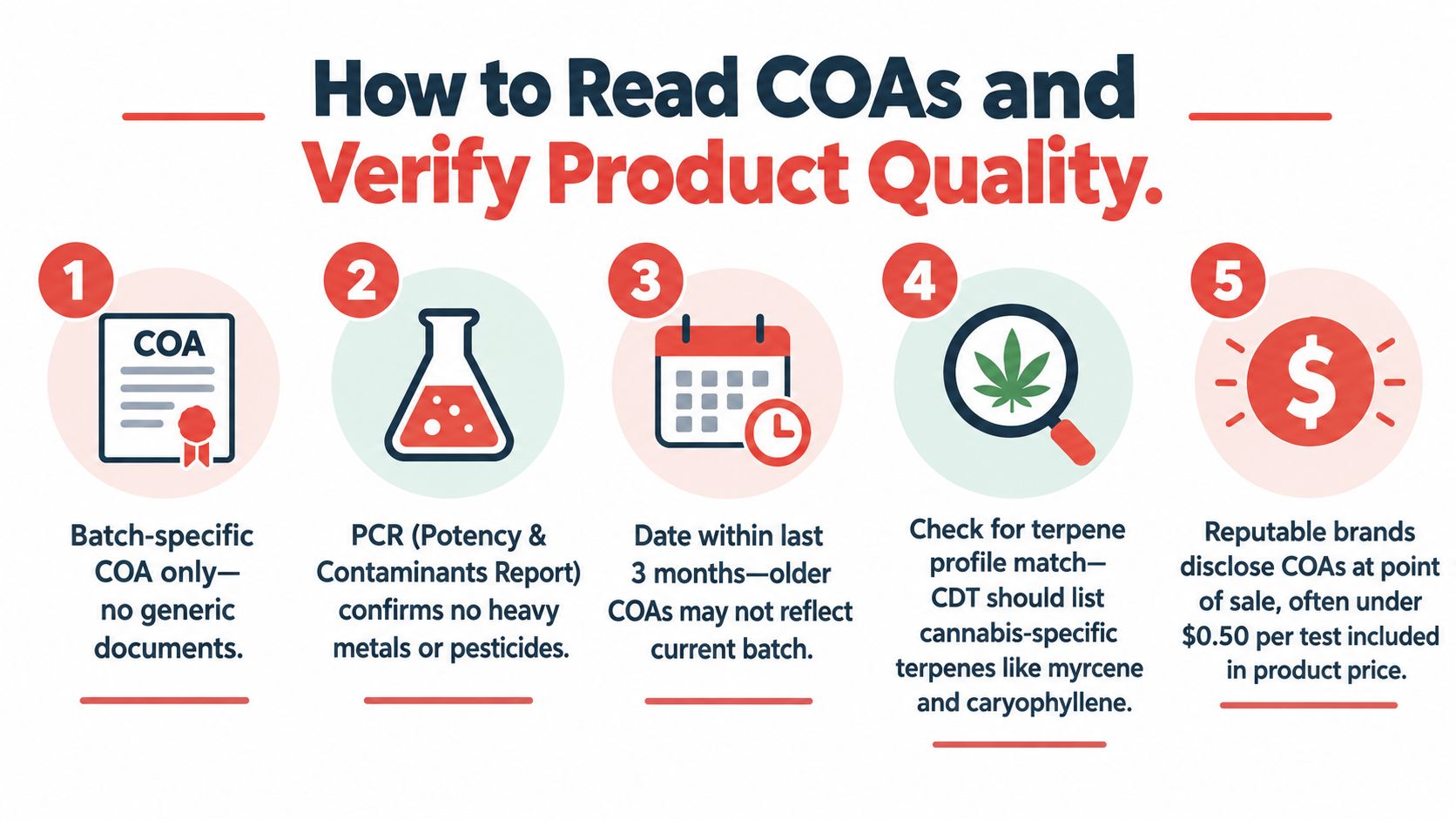
Use this sequence before purchase:
The guide to reading a certificate of analysis can help you recognize the difference between a complete report and a document that covers only one input material.
The oil doesn't operate in isolation. Coil temperature, wick or ceramic design, airflow, and voltage affect aerosol yield and thermal degradation. The terpene fraction also affects aroma, flavor, viscosity, and potentially the vaporization profile.
That means a terpene report for an ingredient isn't the same as testing the finished cartridge. Hardware can change how the oil is delivered, so a more complete quality program considers both composition and device parameters.
Flavor strength isn't proof of terpene authenticity. Documentation is stronger evidence than your palate.
A reputable report should identify the testing laboratory and provide enough detail to connect the result to the product. If a seller won't provide a current, batch-specific COA, don't use the product's polished packaging as a substitute.
A CDT label doesn't create a legal category. Terpene origin alone doesn't determine whether a vape is lawful. The answer depends on the cannabinoid, THC measurement, formulation, jurisdiction, and state or local restrictions.
That distinction matters for hemp-derived products. A hemp-derived vape containing CDTs may be treated differently from a marijuana vape, delta-8 product, or THCA product, depending on where you live and how local rules define and regulate those products. Federal hemp definitions also don't prevent states from applying stricter requirements.
A package can use compliant language while the contents fail to match the label. Evidence from illicit-market testing found 93 percent of tested vape cartridges had multiple pesticide detections, sometimes at levels thousands of times above allowable limits. Separate research on commercial cannabis products detected undeclared residual solvents in 42 of 70 samples, or 58.3 percent. These findings are summarized in research on CDT and BDT vape cartridges.
The figures don't mean every CDT product carries those risks. They show why origin claims and legal wording can't replace independent testing.
Use a jurisdiction-first process:
For businesses, cannabis industry compliance guidance provides broader context. For individual buyers, the practical lesson is simpler: CDT describes formulation, while compliance depends on the entire product and the jurisdiction.
Use this checklist each time you consider a hemp-derived or cannabis-derived vape. It turns a vague premium-sounding label into a series of questions a seller should answer.
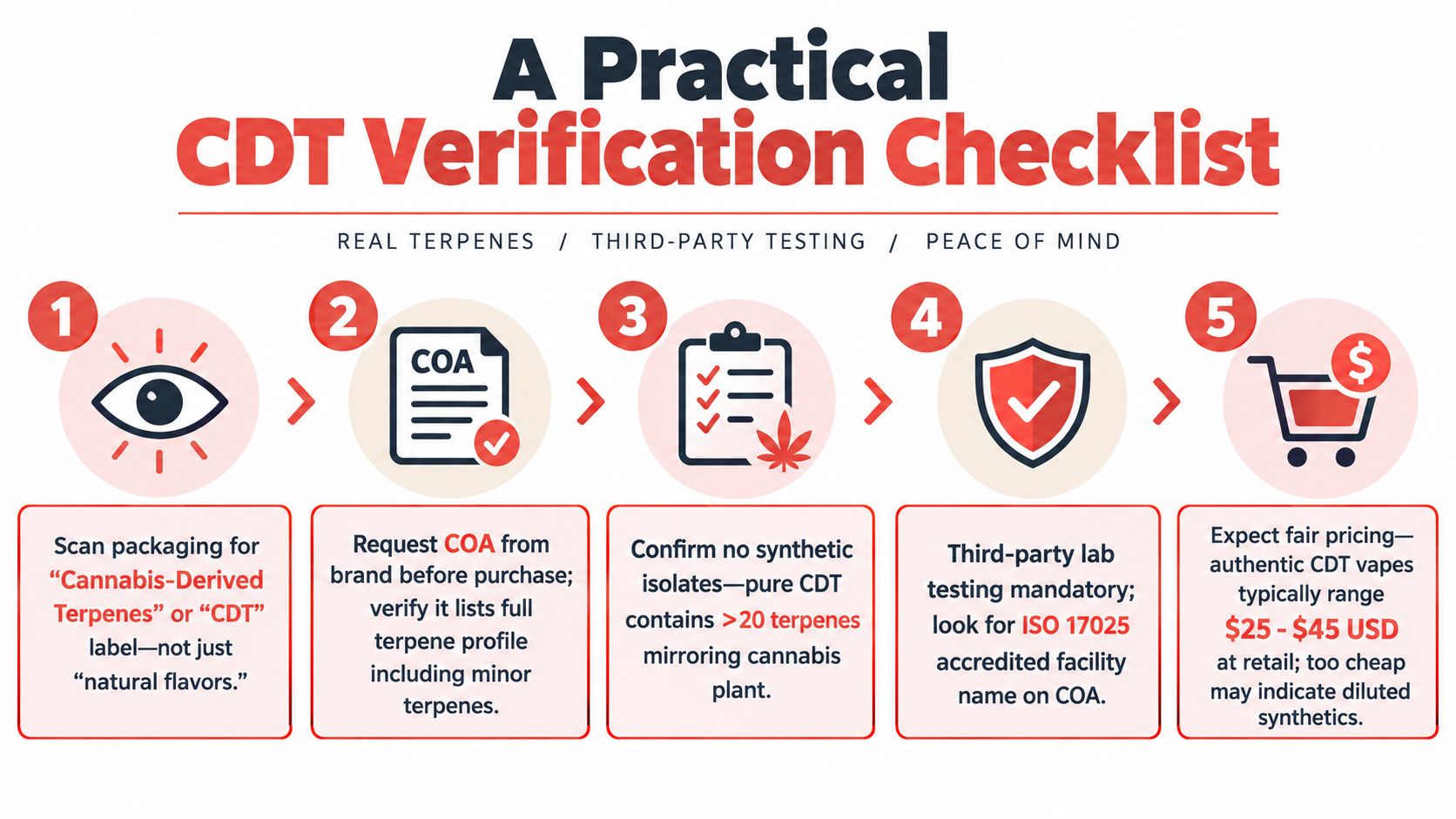
Ask, “Is the terpene fraction cannabis-derived or botanical?” Then ask, “Can I see the COA for this exact batch?” A seller who answers clearly gives you useful information. A seller who redirects you to flavor descriptions hasn't verified the product.
Natural flavor doesn't settle inhalation safety. A CDT claim doesn't settle legality. The reliable buying pattern is source documentation, complete ingredients, batch testing, contaminant results, and intact hardware.
The answer to “what is CDT vape” is straightforward: it's a vape using terpenes sourced from cannabis. Those compounds help shape aroma and flavor, and they may help a manufacturer create a profile that feels more connected to a cannabis cultivar than a simple botanical or synthetic flavor blend.
The label still has limits. CDT doesn't tell you the cannabinoid concentration, terpene percentage, extraction method, contaminant status, device performance, or legal classification. It also can't promise a particular effect. Buyers should treat it as a transparency starting point.
Keep these distinctions in mind:
A careful buyer doesn't need to become a chemist. You need to ask for the right documents, read the ingredient panel, compare the batch number, and walk away when the seller can't explain what's inside. Brands such as Melt offer all-in-one vape products described with cannabis-derived terpenes and third-party lab testing, so shoppers can use the same verification checklist rather than relying on the product name alone.
For a cleaner decision, prioritize a regulated retailer, a current batch-specific report, transparent ingredients, and an undamaged device. That process won't guarantee a particular experience, but it gives you a much stronger basis for judging authenticity, quality, and compliance.
Melt offers all-in-one vape devices with strain-specific terpene profiles and third-party testing information for adult shoppers evaluating cannabis-derived formulations. Visit Melt to review its vape, THCA flower, and edible products alongside the available lab documentation.
Your cart is currently empty.