


Free Shipping All Orders Over $95
Most buyers still hear “legal hemp” and assume the answer is simple. It's not. A product can clear the federal THC threshold and still get blocked by a state rule, refused by a carrier, or fall apart once you look at the cannabinoid chemistry and the lab work behind it.
That's the part most guides skip, and it's why people end up with packages delayed, returns denied, or products that are legal on paper but not realistic to order. The smart way to buy legal hemp products is to treat legality like a four-way filter, not a single checkbox. Federal status matters, state rules matter, carrier policy matters, and product chemistry matters too.
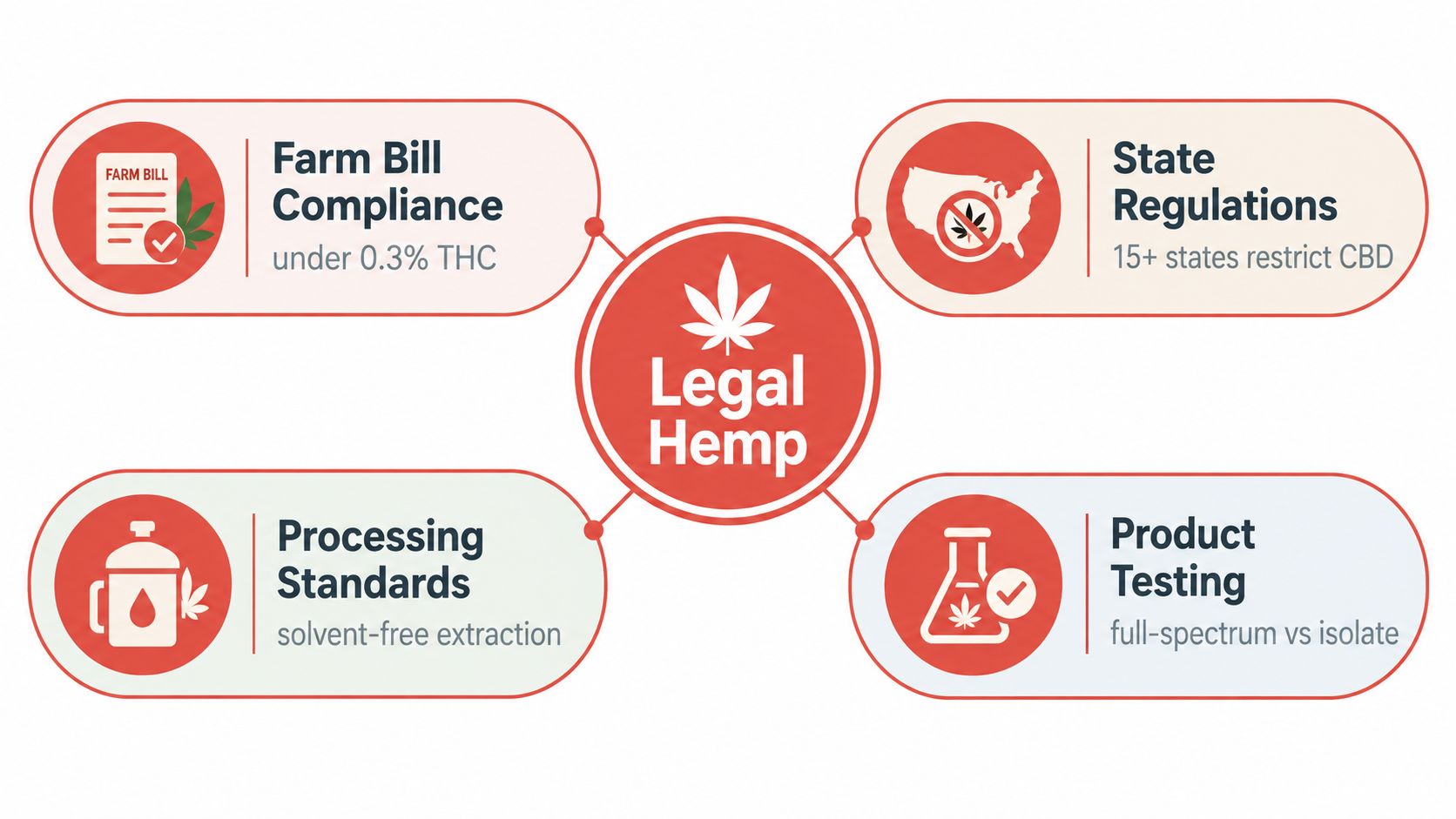
If you want the plain-language version of how hemp labeling works, Melt's explainer on what hemp-derived means is a useful starting point, but the bigger lesson is this, legality changes depending on where the package is going and what's inside it.
The biggest mistake is treating “legal hemp” like a permanent yes. It's a moving target, and the answer changes with the rule you're using. A product can be federally compliant under the hemp definition and still hit a wall later because a state bans the format, a carrier won't move it, or the chemistry inside the product pushes it into a different category.
Start with the federal threshold, because that's the baseline. Then check the destination state, because state law can be stricter than federal law. After that, look at carrier policy, because a shipping company can refuse a package even when the product itself is lawful. Finally, look at chemistry, especially with products that can change after heating or processing.
Practical rule: if you can't answer all four checks before checkout, you don't really know what you're buying.
That's why a product can be legal in one ZIP code and a headache in another. Flower, vapes, and edibles don't trigger the same downstream issues, and products built around converted cannabinoids deserve extra scrutiny. If the brand won't make the rules easy to find, that's usually your sign to move on.
The right mindset is simple. Don't ask, “Is hemp legal?” Ask, “Is this exact item legal to buy, ship, receive, and use where I live?” That one question saves money, time, and a lot of customer service email.
The federal hemp rule starts with the Agricultural Improvement Act of 2018, which removed hemp from the Controlled Substances Act definition of marijuana if the plant and its derivatives contain no more than 0.3% delta-9 THC by dry weight Congressional Research Service summary. That definition covers Cannabis sativa L. and its parts, including seeds, extracts, cannabinoids, isomers, acids, salts, and salts of isomers, so the law reaches farther than many shoppers expect.
USDA handles the hemp cultivation framework, including how hemp is grown, processed, marketed, and sold. FDA still has authority over hemp-derived consumer products under the Federal Food, Drug, and Cosmetic Act, which is why hemp is not a free-for-all. FDA says hulled hemp seed, hemp seed protein powder, and hemp seed oil may be used legally in the U.S. food supply, while CBD is treated differently and cannot be dropped into supplements or added to foods at will.
A hemp label does not override food and drug rules. Federal hemp status is only one gate, not the whole decision.
USDA's first national hemp production data for the 2021 crop year shows the industry is real and measurable, not a niche theory. Growers planted roughly 54,200 acres and harvested about 33,500 acres, with Montana at 4,500 harvested acres and Colorado at 3,100 USDA hemp production summary. That scale tells you legal hemp is an actual agricultural category with supply, compliance, and processing issues like any other crop.
Provisions enacted in November 2025 take effect on November 12, 2026, and will revise the federal hemp definition toward total THC and limits on some intoxicating cannabinoid products Congressional Research Service product note. That matters most for THCA, because THCA can convert into THC when heated. Buyers who still use a delta-9-only mental model will make bad calls.
Shop hemp in 2026 with the next rule set in mind. Ask whether the product still works under the upcoming federal standard, because the answer is changing.
The label matters less than the experience. Flower, disposables, prerolls, and edibles all sit under legal hemp, but they do not behave the same once you buy them. Pick the format for the use case, not for the packaging copy.
Flower, especially THCA flower, is for buyers who want the closest thing to a traditional cannabis session. Heat changes the chemistry, so the world-changing result depends on how it is consumed. If you care about ritual, flavor, and a familiar smoking experience, this is the lane.
Disposables are built for convenience. They are easy to carry and easy to use, but that same ease makes it easy to overbuy. Hardware quality matters here, because a weak battery or poor airflow can make decent oil feel bad.
Prerolls sit in the middle. They are simple, social, and low-effort, which makes them useful when you do not want to pack a bowl or manage a device. The tradeoff is control, because you are trusting the fill, the grind, and the paper to do the job.
Edibles move in the opposite direction from flower. They come on slower, last longer, and are harder to fine-tune in the moment. That makes them a better fit for people who want a set-it-and-forget-it format, as long as they keep dose discipline in check.
| Format | Onset | Duration | Dose Control | Best For |
|---|---|---|---|---|
| Flower | Fast | Shorter than edibles | More hands-on | Ritual, flavor, immediate use |
| Disposables | Fast | Moderate | Moderate | Convenience, portability |
| Prerolls | Fast | Moderate | Lower | Easy sessions, social use |
| Edibles | Slow | Longer | Harder | Discreet, extended sessions |
The point is simple. Legal hemp is a product family, not a single product class. A strong buy in one format does not redeem a sloppy buy in another, because chemistry, hardware, and timing all change the result.
If you only want one rule here, use this one, buy the format that matches your patience and your tolerance for uncertainty.
A certificate of analysis is only useful if you know what it proves. A lot of buyers stop at “lab-tested,” which is lazy and usually not enough. A COA should let you check the exact batch, the lab, the test scope, and whether the numbers match the package in your hand.
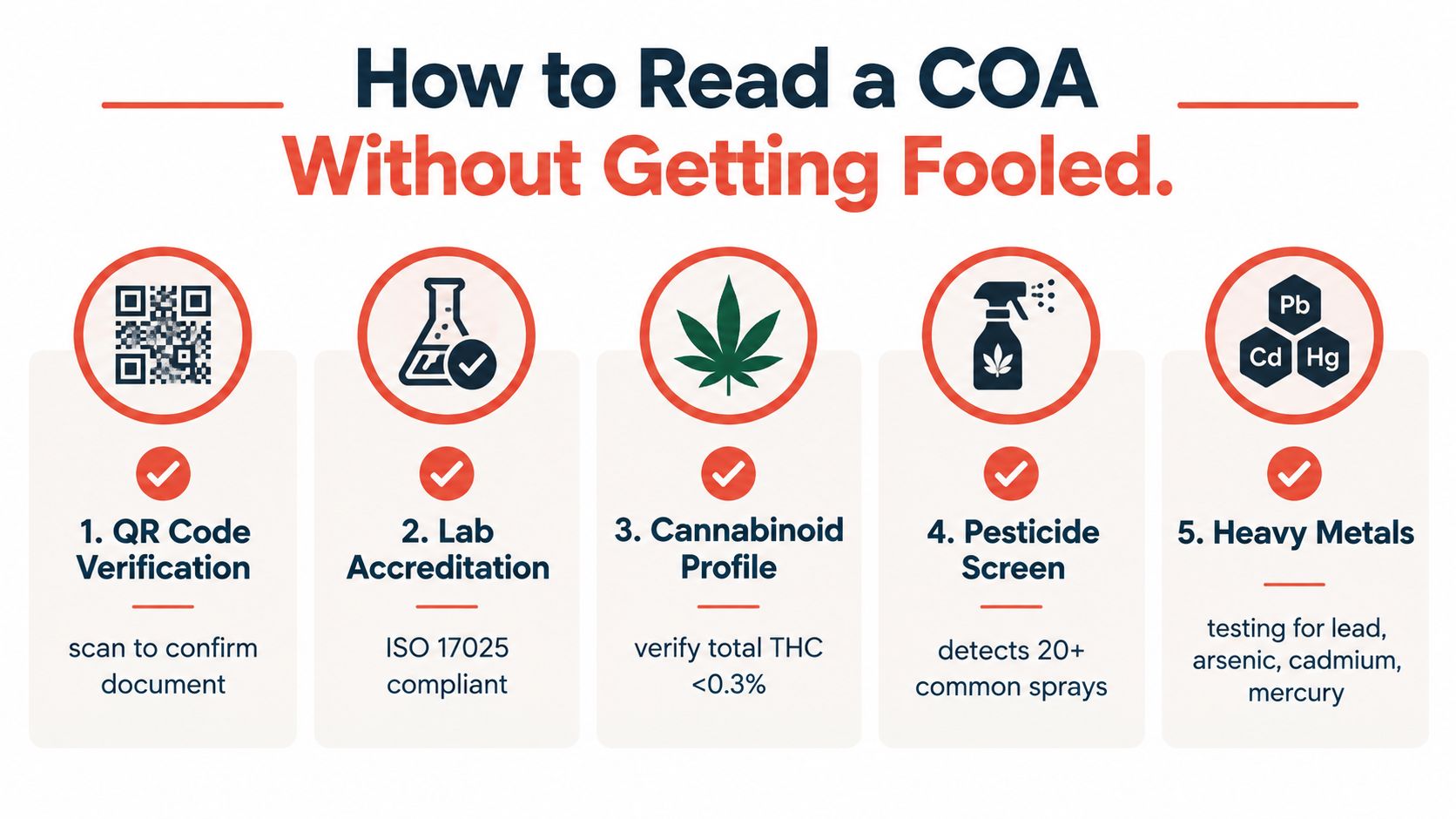
The first thing I look for is the batch number and collection date. If those don't line up with the package, stop there. Then check the lab name and accreditation status, because a report from an unknown lab carries less weight than one from a properly credentialed testing facility. After that, look at what was screened, not just what the marketing page says was screened.
A 2025 analysis of 104 online hemp-derived intoxicating products from 68 brands found 95% contained synthetically produced cannabinoids, including 97% of sampled vape products, and detected novel cannabinoids such as THCP and HHC in a substantial share of samples analysis of hemp-derived intoxicating products. That doesn't mean every converted cannabinoid is bad. It does mean a potency panel alone doesn't tell you whether a product was naturally extracted, chemically converted, or fully transparent about what you're inhaling.
For a tighter breakdown of what to check, Melt's guide on how to read a certificate of analysis is a solid companion. Use the report to verify honesty, not to outsource judgment.
Federal rules set the floor. State rules decide what lands at your door. A product can clear hemp thresholds and still get blocked by the destination state, the carrier, or the seller's own checkout filters. Read the shipping policy before you read the flavor copy.
A few checks separate a real order from a wasted cart.
Practical rule: if the retailer cannot explain why your state qualifies, do not place the order.
State rules also change by product type. Some states are fine with hemp CBD but tighter on intoxicating formats, including THCA flower or vapes that behave more like cannabis than conventional hemp. That is why a destination check matters more than a broad “hemp is legal” claim.
For state-by-state background, Melt's page on state cannabis laws is a practical reference point. Use it to confirm your own address, not to assume every state treats hemp the same way.
The takeaway is simple. Legal hemp is a moving target, and you only have a real purchase when the law, the shipment, and the product chemistry all line up at the same time.
Good hemp looks cared for before you ever light it or open it. If a brand talks about quality but hides the plant, the cure, the hardware, or the test docs, it's mostly selling language. Strong products usually show their work.
Indoor or greenhouse flower should look deliberate, not rushed. You want even structure, a proper cure, and trim work that doesn't leave the flower looking butchered. Terpene expression matters too, because it's one of the clearest signs that the plant was grown for flavor and not just for biomass.
Disposables should feel engineered, not generic. If the oil is decent but the hardware leaks, clogs, or burns hot, the whole item suffers. Packaging should also protect the product and make the compliance details easy to find.
A clean brand page makes life easier. It should tell you what the product is, what it isn't, and how it was tested. If the only thing a seller wants to talk about is intensity, that's not a quality signal, that's a distraction.
One example in the market is Melt, which sells hemp-derived disposables, THCA flower, prerolls, and edibles with an emphasis on transparent lab reports and California-crafted terpene profiles. I'm not saying that makes it the answer for everyone, only that it shows what a more honest product presentation looks like when a brand is willing to put the documentation next to the item.
Buyer's shortcut: if the flower looks flat, the hardware feels cheap, or the COA is hard to find, skip it.
Quality and safety are linked, but they're not the same thing. A product can look premium and still deserve hard questions about what was tested and what wasn't. If the brand makes it easy to verify the batch and the package, that's a better sign than any glossy photo.
If you're stocking legal hemp for resale, the questions get more operational. You need proof, paperwork, and a clean line between hemp-derived SKUs and licensed cannabis SKUs at the register. That's not busywork, it's what keeps the shelf from becoming a liability.
Ask for COAs by batch, not just a generic folder. You also want licensing or business documentation, chain-of-custody details where relevant, and a clear answer on who is responsible if a shipment doesn't match the paperwork. If the brand can't produce those materials quickly, that's a problem.
Retailers should also run age-gating and ID verification consistently. If your checkout or in-store process is sloppy, the product compliance on paper won't save you. The same goes for inventory systems, because hemp-derived items shouldn't be mixed up with licensed cannabis SKUs.
For wholesale buyers, the serious questions are simple. How are products labeled? How often are batches tested? What happens if the rules shift before your inventory sells through? That last one matters more heading into the back half of 2026, because the federal hemp definition itself is changing.
If a partner can't talk clearly about documentation and compliance, don't give them shelf space. Good wholesale relationships reduce friction. Bad ones move it into your inbox.
Start with the part that controls whether the product reaches you: federal status, state status, carrier status, COA status, and age-gate status. If one piece fails, skip the order.
Will THCA flower stay legal through 2026? The safer move is to treat it as time-sensitive stock, not a forever category. Buy only what you can move before the rule change covered earlier, and check the COA for the total-THC figure, not just delta-9. If your state tightens first, your inventory can turn into dead weight fast.
How do I spot a real COA? Match the batch, match the date, and match the product. The lab file should show the relevant analytes and line up with the package in front of you. A polished PDF means nothing if the details do not match.
Are disposables safer than flower? No. They just raise different questions, mostly around device quality and the testing behind the oil.
What if a package gets held? Ask the seller for the carrier policy, then check whether your state and product type were eligible at checkout.
Melt focuses on legal hemp-derived products with a compliance-first checkout, batch-level testing, and a lineup that includes THCA flower, disposables, prerolls, and edibles. If you want a cleaner way to shop this category, visit Melt and compare the product page, lab report, and shipping rules before you buy.
Your cart is currently empty.